

AI researcher • developer • engineer • DMs always open
Bali, Indonesia
- Tweets 6,107
- Following 402
- Followers 10,610
- Likes 14,053


Jev Engineering changes the unit of optimization from “agent” to “decision.”
that sounds small, but it changes the architecture.
and up to 193x faster and 444x cheaper in tests.
normal multi-agent stack:
agent
→ prompt
→ tool
→ output
Jev-style stack:
shared state
→ decision boundary
→ selected branch
→ execution
→ measurement
→ state update
now you can optimize the actual control points:
latency per decision
cost per fork
confidence threshold
retry policy
branch survival
termination condition
the agents underneath can change.
the models can change.
the tools can change.
the decision layer stays measurable.
that’s why Jev Engineering feels more like systems engineering than prompt engineering.


16
9
73
6,313
i gave Space Bunny three words of direction and it turned them into a full agent product.
“agent swarm terminal” was basically the whole prompt.
what came back was MESH - a complete product for running one objective across 64 AI agents, with its own brand, landing page and interaction model.
it built the whole idea around:
one goal
→ 64 agents
→ parallel routes
→ human gate
→ verified result
and it didn’t stop at the hero section.
the model came up with the product positioning, agent workflow, terminal UI, pricing tiers from $0 to $249, launch flow, verification layer and even the visual language around the product.
the model is Space Bunny, and it’s available on OpenCode this week.


Space Bunny (stealth model) is free for the next week
- 1M Context
- Multi-modal
- Zero Data Retention
12
3
41
1,733
Jev Engineering turns a static agent workflow into a graph that can rewrite itself while running.
the video is basically the problem at scale:
hundreds of routes
→ thousands of crossings
→ different agents
→ different tools
→ different confidence levels
Jev Engineering doesn’t control every step.
it controls the crossings.
when two paths compete:
→ score both
→ kill the weak route
→ reroute the task
so instead of one fixed chain, you get a live braid:
state
→ decision → parallel paths → crossings → Jev → next state
that’s the point of Jev Engineering:
more parallel execution without letting the system lose the objective.
the agents create the paths.
Jev decides which paths survive.
full breakdown below ↓

21
17
153
10,748
Jev Engineering is what lets 43 decisions control 5,400 agent runs without a human in the loop.
5,400 agent runs
→ 18 turns → 43 Jev decisions → 0 humans → $0.020 decision cost → goal met at 0.93
Jev doesn’t need to reason through every individual action.
it only needs to control the important forks:
which agents continue
→ which route changes
→ when to retry
→ when the result is good enough
→ when the entire run should stop
that’s the idea behind Jev Engineering:
thousands of actions underneath.
a tiny decision layer steering the whole system above them.
the agents do the work. Jev decides when the work should change.
full breakdown below ↓

23
19
113
9,199
Jev Engineering turns one agent chain into a decision graph that can reroute itself and moves the expensive model out of every decision loop.
the important part in this setup isn’t the number of agents.
it’s that execution doesn’t follow one fixed path.
and up to 193x faster and 444x cheaper in tests.
every result can change what happens next:
state
→ Jev decision → branch → specialist agent → result → score → reroute
and Jev Engineering sits above that graph deciding:
which route stays alive
→ which specialist gets control
→ when two branches should merge
→ when a result needs another pass
→ when the goal is good enough to stop
by the end of the run:
5,400 executions → 0.93 goal score → $0.020 decision cost
that’s why Jev Engineering is more than model routing.
it’s the control layer that keeps a changing agent graph pointed at one objective.
full breakdown below ↓

20
17
191
13,676
Jev Engineering is what turns a messy agent graph into a controlled decision loop.
and up to 193x faster and 444x cheaper in tests.
the video looks complex, but the idea is simple:
Jev Engineering makes that decision explicit.
state enters
→ routes get scored
→ confidence updates
→ weak branches die
→ strong branches keep moving
→ execution unlocks
so instead of every agent improvising independently, the system keeps narrowing the graph.
0.00 → 0.41 → 0.68 → 0.80 → 0.93
and that score can decide:
which model runs
→ which tool gets called
→ which branch retries
→ which result gets rejected
that’s the point of Jev Engineering:
don’t just give agents more intelligence. engineer how they make decisions.
full breakdown guide below

13
23
206
19,296
Jev Engineering is what lets one decision layer control hundreds of agent paths without turning the system into chaos.
and up to 193x faster and 444x cheaper in tests.
it’s deciding:
→ which model gets called
→ which tool gets access
→ which result survives
that’s what the video is showing.
one state enters.
Jev turns it into structured decisions.
those decisions fan out across dozens of routes, agents and tools.
then everything collapses back into one verified state.
so instead of:
LLM
→ agent → tool → another LLM → another guess
you get:
state
→ Jev decision layer → parallel routes → execution → verification → next state
that’s the point of Jev Engineering:
more parallelism without giving every branch permission to improvise.
full breakdown in the article below ↓


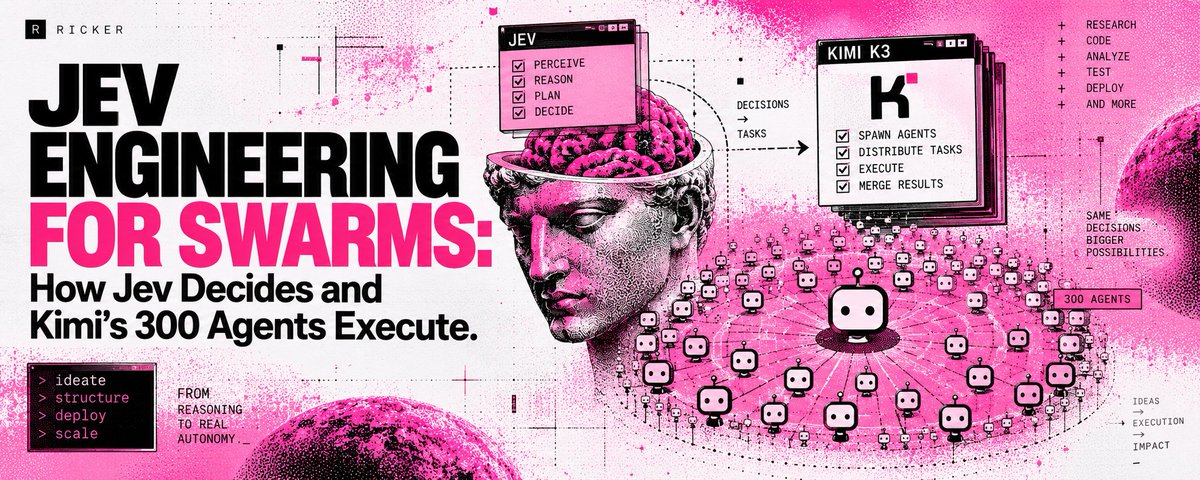
Jev could become the decision layer behind the next generation of AI agents.
Instead of burning 5–20 sec and expensive LLM calls figuring out every next step, it can route decisions in milliseconds at near-zero cost.
In this article, I break down how ↓
37
61
455
44,458
Jev Engineering is what turns an agent stack into an actual control system and moves the expensive model out of every decision loop.
and up to 193x faster and 444x cheaper in tests.
the model shouldn’t decide everything.
in this setup:
request
→ structured state
→ Jev router
→ cheapest capable model
→ worker
→ relevance / approval checks
→ execution gate
→ tool
the important part is that the decision layers don’t generate prose.
they route → score → block → approve.
so expensive models only get called when the task actually needs them.
that’s the point of Jev Engineering:
separate reasoning from decision-making, then make the decision layer measurable, cheap and fast.
full breakdown in the article below ↓

Jev could become the control layer AI agents have been missing.
Instead of spending 5–20 seconds and expensive LLM calls deciding every next step, it can route actions in milliseconds at near-zero cost.
In this article, I break down how

66
238
1,618
178,364
Jev Engineering is the layer most agent stacks are still missing.
state → decision → action → verification → next state
up to 193x faster and 444x cheaper in our tests.
everyone is optimizing the model.
Jev Engineering optimizes what happens between model calls.
every agent eventually hits the same fork:
state
→ multiple possible actions
→ one route has to win
instead of sending every decision back to an expensive LLM call, Jev turns that into a dedicated layer:
so the loop becomes:
LLM → reason
Jev → decide
tools / agents → execute
state → update
Jev → decide again
once decisions become their own engineering layer, you can benchmark, batch and verify them separately.
full blueprint in article ↓

Jev could become the control layer AI agents have been missing.
Instead of spending 5–20 seconds and expensive LLM calls deciding every next step, it can route actions in milliseconds at near-zero cost.
In this article, I break down how
42
79
872
117,553