

Decoding the Math Behind the Market Cycles at @zuriquecapital. Now building the Wall Street Insider Report (1,900+ Readers in 70+ Countries)
Decode the Market Cycles →
- Tweets 3,504
- Following 109
- Followers 261
- Likes 854




TIME: How dangerous is AI?
The Economist: Can it be stopped?
My portfolio: Please don't.😬


1
2
33


Giving an AI access to your files, calendar, notes, and messages is the adult version of letting your mom clean your room.
Everything will be organized.
You will also have to explain some things.

Muse for Mac is out today! It works across apps, files, calendar, notes, and messages on your computer. You control what it can access. The team is shipping fast. Download at ai.meta.com/muse/download
2
47
Lumber just closed at its lowest price of the year.
Lumber was also very cheap in 2008.
Great time to build a house. Terrible time to the market.

1
48

First experience in an autonomous car @basso_tom . The driver was too quiet 😬

2
5
406
Your barber owns the Nasdaq.
Your dentist owns the Nasdaq.
More money went into it last month than in any month in history, and everyone can explain why.
Investors pumped $12.8 Billion into the Nasdaq 100 $QQQ last month, its largest inflow in history 🚨 🚨

1
226


ζ 10 Assets. 2 Questions. 20 Numbers
Free 10 Curated Assets Cycle Analysis
$AEMD $DKNG $OKLO $SDGR $DAIC $TEM $HELP $RARE $XENE $BB
ζ 10 Assets. 2 Questions. 20 Numbers
Free 10 Curated Assets Cycle Analysis
$AEMD $DKNG $OKLO $SDGR $DAIC $TEM $HELP $RARE $XENE $BB
Markets Changed. Most Portfolios Did Not.
Every trading day the Wall Street Insider Report runs 10 curated assets through 2 questions.
Question 1: which phase of the cycle each asset is in right now.
Question 2: how much of it a portfolio is allowed to hold, read off the Calculated Exposure Ceiling.
10 assets, 2 answers each, 20 numbers a day, refreshed every session.
1 subscription, 1 price, cancel anytime.
The cycle moved. The allocation stayed where it was.
A portfolio sized for a phase that already ended, and what 20 fresh numbers a day are worth to a holder who measures every cycle before deciding how much of it to own.
Know more: x.com/zuriquecapital/status/…

1
350
ζ $MEDS Priced at $1.00, Closed at $6.07
Know More: How We Decode the Math Behind the Market Cycle

1
1
317
Dan Castro retweeted
The chips inside a Toyota Camry and a dishwasher outperforming the chips inside data centers 😬

1
1
54
“the industry's advice to "keep it passive" really amounts to: you aren't smart enough to take even the obvious stuff into account, and not only that, we aren't either."

ADAPTIVENESS MATTERS
The conventional wisdom in investing is that you can't time the market, shouldn't try, and will only hurt yourself if you do. Parts of the industry have elevated this into a cult of passive: whatever happens, just keep buying.
There is some logic here. Market action is mostly noise. People tend to overweight irrelevant datapoints, inappropriately extrapolate recent events, and pay high transaction cost drag when tunrover is too high. Trading too much destroys capital.
But “people often respond badly to useless information” is NOT a justification for “you should never respond to useful information.”
Ignoring all incoming information when deciding what to own is clearly crazy. For example, if you really took the industry's advice to keep it passive to heart, you would have been buying bonds with negative nominal yields for years in Europe. This wasn't difficult to understand at the time. There are clearly certain datapoints that should matter enough to inflect investment behaviour. And the world is changing faster than ever before - you've got to be able to react.
I view adaptiveness as a design choice with trade-offs to navigate, just like any other design choice. How much and how frequently you change your positions should depend on:
1) How materially the information changes your assessment of future returns and risk.
2) What it costs to change the portfolio relative to the expected benefit.
Reacting appropriately to new info does not require having an opinion on every headline.
Of course, the hard part is establishing that the information you are paying attention to actually helps. Making adjustments is a lot easier with LIQUID, capital-efficient instruments (like futures) in your toolkit. And clearly "less is more," in the sense that under-reacting will tend to draw your results closer to a still-acceptable passive-like outcome, while too-much overreacting will nearly guarantee permanent capital destruction.
Still, I think you can do far better than passive alone, by paying attention to the basics, like: risk conditions, capital efficiency, awareness of macro factors, momentum, carry returns, and the like.
Finally: the industry's advice to "keep it passive" really amounts to "you aren't smart enough to take even the obvious stuff into account, and not only that, we aren't either."
That's wrong and it really shouldn't take alot to do better. The key is a disciplined methodology for judiciously turning evidence into positions, with enough humility and restraint to mostly leave the noise alone.

1
54
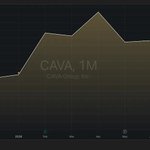
Cava Grew Sales 31% and Lost 25% of Its Value in 1 Month $CAVA
You read the same number everyone did. Now read the cycle under it:
▪️Cava $CAVA Cycle Decoded
▪️<Phase: 5 /Calculated Exposure Ceiling: 4.6%>
The CDC declared the largest cyclospora outbreak in US history over on September 11: 12,883 illnesses across 21 states, traced to 1 lettuce supplier.
Cava $CAVA reported Q2 revenue up 31.3% to $368.4 million, same-restaurant sales up 9% and traffic up 5.3%.
Sales growth slowed to flat in July, then recovered to mid-single digits by the earnings call.
The shares closed at $54.89 Monday, down 25% in 1 month, while the California State Teachers Retirement System raised its stake 7,511% in Q2 to 7.2% of the company.
A 31% growth rate priced 25% lower in 30 days, and what a recall costs a chain whose own traffic grew 5.3%.
Read More: x.com/zuriquecapital/status/…


1
189
Veea Rose 85% on a Term Sheet Priced at $750 Million $VEEA
The news is public. The read below is not:
▪️Veea $VEEA Cycle Decoded
▪️<Phase: 6 /Calculated Exposure Ceiling: 0%>
Veea $VEEA traded 85% higher at $4.23 in Tuesday premarket, after a 47% close at $2.29 Monday, 2 weeks after a 1-for-20 reverse split.
The catalyst is a signed term sheet with NovaGen Group, not a definitive agreement, plus a $10 million commitment from GeoNova Capital.
Management values the combined company at about $750 million, on its own internal projections.
The stock closed Monday 88% below its 52-week high. The cash committed is $10 million. The stated value is $750 million, 75 times the commitment.
A $750 million number resting on a term sheet and $10 million, and what a premarket bid discovers before the definitive document exists.
Read More: x.com/zuriquecapital/status/…

1
93