

Financial freedom is an alignment problem. 10,000+ hours studying money. Bitcoin is infinitely better than you can imagine.
∞/21m
- Tweets 5,971
- Following 841
- Followers 16,417
- Likes 7,522


Pinned Tweet

This morning, you made the most important financial decision of your life.
You woke up. You went to work. And you exchanged another piece of your life for a very particular thing.
That “thing” has a name:
Money.
But you didn’t trade your lifeforce for “money,” you traded it for a *certain form* of money.
After studying money for over 10,000 hours, I realized that the number one thing that most people misunderstand about money is the actual money they’re using on a day-to-day basis.
Hours, years, decades of your life spent working for a certain form of money, and yet most people don’t understand what that certain form of money is. And I don’t mean the name of it. I mean the nature of it. The properties of it. The functions of it.
Think about that… Most people spend decades of their lives working for something they can’t explain. It’s like spending decades of your life playing basketball without ever understanding what basketball is. It’s an insane thing to imagine. But I promise you it pales in comparison to the insanity of the current money system.
Then there’s the next piece of understanding, or the lack of it, which is:
What is money supposed to do for me?
Most people can answer that. They’ll say something like, “I work a job so I can earn money. That way I can pay for things. I can buy groceries. I can pay rent. I can save and invest and hopefully grow my wealth to buy a home someday and provide for my family.”
More or less, that’s the answer you’ll hear. But deeper, at the core essence of money itself, what is money supposed to do for you? What is money supposed to do for everybody?
The purpose of money is simple: transfer value across space, scales, and time.
That’s what we use money for.
We use money to take value from place to place, across oceans, from home to the grocery store. With money, we transfer value across space.
Money also transfers value up and down the economic scale. If you want to exchange your value for a house, if you want to buy a pack of gum, money is the tool you use to do that.
Lastly, money is supposed to transfer value across time. You earn money today. You want to be able to use it tomorrow, a year from now, 10 years from now, 40 years from now, and have its actual value held such that you can exchange its value for another piece of value. Groceries, vacations, raising a kid, and so on.
That’s what money is supposed to do: transfer value across space, scales, and time.
The slightly more esoteric layer is that money is supposed to represent your time and energy most effectively, because that’s what you’re exchanging in order to earn money. You give your time and energy to the market in order to receive money.
If you start a food truck, you’re expending your time and energy. Both the time and energy that you’ve spent in the past learning about food, what recipes you want to use, cooking skills, how to cut an onion, and then the time and energy that you’re spending to buy the ingredients, build relationships with vendors, actually get the food truck, advertise it, build out your menu. Then you bring the ingredients together. You make food. And you sell it.
Someone buys your food and gives you money in exchange. That money represents the time and energy you spent to earn it.
That’s the deeper layer of what money is supposed to be doing: it is representing the time and energy you have given to the market.
So now, imagine if the money you’re using is going down in value.
What does that mean?
The money you’re using is going down in time, and it’s going down in energy.
That means you have less time, and that means you have less energy.
The result?
You have to work more. Life is less affordable. You need to invest your money to make up for the loss.
Then you realize… that’s the *exact* experience of people who use the U.S. Dollar and all fiat currencies, which are guaranteed to lose value over time because of inflation.
Some people would stop there. Not here. It goes deeper.
Why is inflation required? Why do we have inflation?
Inflation is required because the Dollar, and the wider fiat system, is a debt-based system.
In this system, there’s an endless number of debt claims made, but money isn’t necessarily created when that debt claim is made.
For example, when you use a credit card, you’re not actually paying with money. You’re paying with a debt claim. The hope is that you’ll receive actual money at some point and pay off the debt claim.
When you extrapolate this out to the whole system, it results in there being more debt than there is money. Debt claims are constantly being created, but that does not mean that the money to pay off the debt has been created. The gap between debt claims and money is evidenced here (attached image one):
Okay, but what does this mean?
If there is less money than there is debt, there has to be more money created to pay off the debt. If not, then when the debt comes due, there wouldn’t be money to pay for it, causing the debt to collapse down to the actual amount of money that there is.
When you have an entire system that functions this way, it creates constant systemic risk, because there is constantly a gap between debt claims and money. If no new money is created to pay off the endless number of debt claims, the system would collapse. People would go bankrupt. Companies would default. Governments wouldn’t work.
In the debt-based system, there HAS to be new money creation. It is a built-in requirement to keep the system alive. That “new money creation” is what inflation is — and it is what causes price inflation. They create new money, and then prices rise (COVID is a prime example of this).
What is another side effect of the system’s mandatory inflation?
The Dollar loses value. And what do you do? You spend decades of your life working for the Dollar. Which is losing value. Which is losing time and energy (attached image two).
You’re exchanging your life for something that is constantly losing time and energy.
The debt-based system that you are in is a backward force. The money you’re using and working for is losing value. You want financial freedom, but the fundamental tool that represents financial freedom is working against you. It’s like rowing a boat against the current. The Dollar is making your financial freedom more difficult every year because it is losing value every year. It is that simple.
Imagine if you held a stock that lost 7% of its value every year while trying to build financial freedom.
With the Dollar, and all fiat currencies, you’re spending decades of your life working to earn a stock that loses value every year.
And if you don’t understand that, if you don’t realize the nature of the Dollar, you feel this invisible antagonistic force working against you every day of your life, all while you participate in this reality and system of money.
This is why it’s so important to understand money. If you don’t understand the Dollar, you feel this huge, vague, constant, stressful money problem, and you have no idea where it’s coming from or how to actually fix it.
Then you realize… this is exactly why most people have this huge, vague, constant ball of money stress surrounding them at all times. They don’t understand the form of money they’re using, which means they don’t understand that it’s the money that’s working against them.
The single most important financial decision you will ever make is what money you will use. Why? Because the money you adopt is the thing that you’re exchanging your time and energy for.
You are saying, “I will trade decades of my life to earn this particular form of money,” and most people don’t even think twice about what that form of money is.
The vast majority of the world woke up this morning and went to work for money that made their financial lives harder.
Next year comes around and they say, “Why is my financial life harder? God, this system sucks.”
“It’s got to be the politicians.”
“We should tax the rich.”
“It’s the corporations. They’re raising prices. They’re causing inflation.”
No.
It’s the money.
The money is the system.
The political nonsense, the growing wealth gap, the corporations raising prices… they all sit on top of the same foundation: the money system.
The system is what enables monetary corruption. It lets central banks, in partnership with their politicians and closest confidants, print an endless amount of money to pay for whatever they want.
That is why there’s no debt limit. That is why we have $40 trillion of debt, because we’re in a money system that has an endless stream of money available to the government. What do you think they’re going to do?
Of course they’re going to take advantage of it. They’ll promise X, Y, and Z to voters and say, “Hey, we’ll take care of you. We’re going to spend more on education, tax the rich, and spend on these welfare programs to give you support and help.”
The system promises you things, and can “deliver” on them, because there’s no actual discipline to their spending. There’s no limit. They can spend and promise as much as they want, which is what they’re incentivized to do so you can vote them into office.
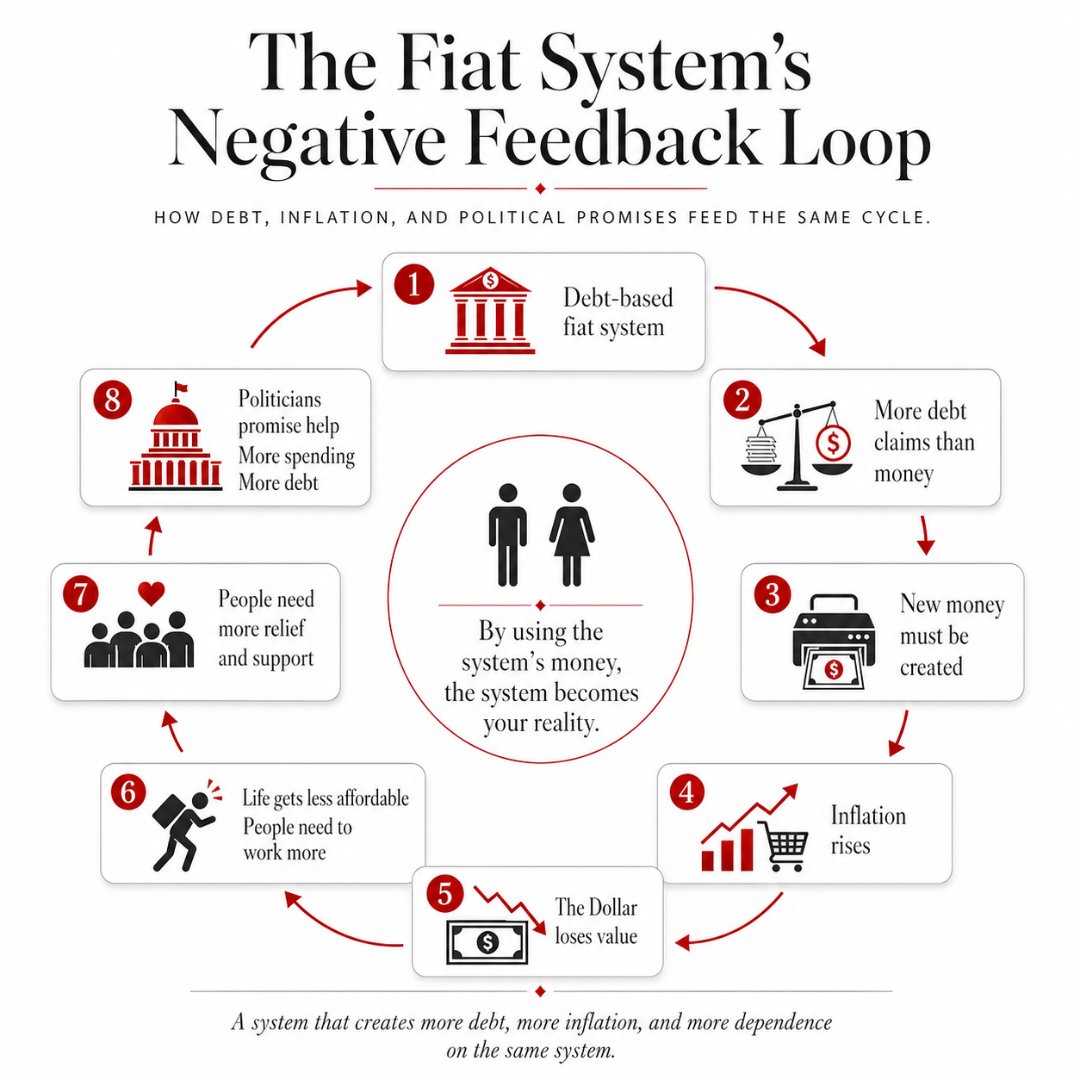
But that spending causes more debt. Which necessitates more inflation. Which makes your life even harder, putting you in greater need of support, raising the incentive for politicians to promise you more things.
The politicians are promising things in an attempt to solve problems from the same system that caused the problems. Which is why their promises never work. And that promise, and the delivery of that promise — which can happen because the money supply is infinite — is making the system worse, which makes your reality worse, creating more promises, more spending, and more debt.
It’s a negative feedback loop, and you’re in the middle of it (attached image three).
As long as you’re using the U.S. Dollar, or any fiat currency, this is your experience.
---
This is part one of a six-part series titled, “I Studied Money for 10,000 Hours. Here’s What Actually Matters” which originally appeared on my newsletter (in bio).
Part two will be released later this week.
Feel free to share this post with anyone who may find it valuable.


11
8
33
4,551
After studying money for 10,000 hours, what is the single most important thing I've learned?
That there’s actually a root-level solution to this *massively* corrupt system we live in.
The level of corruption present in the world right now is off the charts, and it’s getting worse, constantly.
I see it every single day. Wherever I am, wherever I’m traveling to, grocery stores, airports, restaurants. Online. I see it everywhere. I see, physically, people wearing the energy of fiat.
To see this level of corruption and disease everywhere… it’s sickening.
But to actually see, one, what the root-cause of it is, which is the money, which is the *only good* woven into all other goods, which is causing these perverse incentives, which is causing war and inflation and financial groups to buy up shelter as an investment and make literally a fundamental need of humanity more difficult to afford...
To see that, but to also see and understand the root-level solution to it…
That’s why Bitcoiners are some of the most avid, passionate, and strongly-convicted groups of people in the world.
They’ve seen the vastness of the problem and the vastness of the solution.
And it’s like, “Holy shit. I’m down with that over here, and I’m not down with that over there.” That’s certainly been the case for me.
I've said that the single most important financial decision you’ll ever make is the money you use.
Likewise, the single most important financial decision humanity will ever make is the money we use.
Right now, we’re deciding mostly from a place of a lack of awareness.
We’re deciding to use the U.S. dollar, and as a result, we’re experiencing the consequences, which is what nature does. You do something and nature teaches you what happens through the lesson of consequence. We are reaping the consequences of choosing the U.S. Dollar.
But when you really get down into it, you realize that humanity never really chose to use the U.S. dollar or fiat currencies.
There was never a vote held for President Nixon to remove the dollar from the gold standard in 1971. The people never had a say. The people never had a choice as to whether or not the Federal Reserve was created in 1913.
It was never up to the people. It was never a decision that was left to us.
It was imposed upon the people. And that’s exactly what fiat translates to: by decree.
We’re living in a system of decree imposed upon the people.
What’s happening now is we actually have the opportunity to decide what money we’re using.
That is the most important financial decision you will ever make.
It is the most important financial decision *we* will ever make.
Because that’s the singular thing that shapes our experience with money the most. The actual form of money that we’re using.
Now that we’re gaining awareness of the fiat system — and we not only have awareness of the solution, we have the solution itself — we have the ability to shift into the solution.
We now have the opportunity to make the decision that’s right in front of us, right now.
We have the opportunity to shape our experience with money and align with financial freedom by moving away from a system that’s not aligned with financial freedom and move to a system that is aligned with financial freedom. Why would humanity not want that?
Spoiler alert: humanity does want that.
You’re living through the realization.
2
4
17
808
Look at Bitcoin block rewards priced in hashrate instead of fake fiat money:
2012: 24.5 TH/s
2016: 1.53 EH/s (62,000× increase)
2020: 115.25 EH/s
2024: 618.13 EH/s
Both Bitcoin's market value per block and Bitcoin's hashrate per block have increased.
The incentive per block is stronger and the security per block is stronger.
But BlackRock thinks there could be an incentive and security problem.
The proof-of-work (and the lack thereof) speaks for itself.

This is one of the greatest misunderstandings in Bitcoin.
Block subsidies getting cut in half every four years does NOT mean that there are "lower block rewards."
Nominally, yes, the rewards are halved every four years. But value-wise, which is the critical factor, the rewards increase over time.
For example:
50 BTC was mined every Bitcoin block until November 28, 2012.
When that last 50-BTC block was mined, the market value of 50 BTC was $619.
On November 28th, the Bitcoin subsidy halved from 50 BTC to 25 BTC.
That's less, right? The incentive is lower, right? That's a security problem, right?
Watch.
25 BTC was mined every block from November 28, 2012 to July 9, 2016.
When that last 25-BTC block was mined, the market value of 25 BTC was $16,274.
50 BTC in 2012: $619
25 BTC in 2016: $16,274
The value of the "lower" block reward in 2016 was greater than the "higher" block reward in 2012.
The same pattern has repeated every Bitcoin halving cycle:
50 BTC in 2012: $619
25 BTC in 2016: $16,274
12.5 BTC in 2020: $107,522
6.25 BTC in 2024: $406,215
Stop looking at nominal value. Focus on market value.
There is no incentive problem. There is no security problem.
Do not let fiat institutions tell you otherwise.
5
562
Cole Walmsley retweeted
This is one of the greatest misunderstandings in Bitcoin.
Block subsidies getting cut in half every four years does NOT mean that there are "lower block rewards."
Nominally, yes, the rewards are halved every four years. But value-wise, which is the critical factor, the rewards increase over time.
For example:
50 BTC was mined every Bitcoin block until November 28, 2012.
When that last 50-BTC block was mined, the market value of 50 BTC was $619.
On November 28th, the Bitcoin subsidy halved from 50 BTC to 25 BTC.
That's less, right? The incentive is lower, right? That's a security problem, right?
Watch.
25 BTC was mined every block from November 28, 2012 to July 9, 2016.
When that last 25-BTC block was mined, the market value of 25 BTC was $16,274.
50 BTC in 2012: $619
25 BTC in 2016: $16,274
The value of the "lower" block reward in 2016 was greater than the "higher" block reward in 2012.
The same pattern has repeated every Bitcoin halving cycle:
50 BTC in 2012: $619
25 BTC in 2016: $16,274
12.5 BTC in 2020: $107,522
6.25 BTC in 2024: $406,215
Stop looking at nominal value. Focus on market value.
There is no incentive problem. There is no security problem.
Do not let fiat institutions tell you otherwise.

BlackRock flagged Bitcoin miners as a risk factor in IBIT's 10-K.
The filing says lower block rewards "could result in less of an incentive for miners," which puts network security in question.
Every halving cuts the subsidy that pays for Bitcoin's security. The operators still running afterward are the ones whose power costs work at the smaller reward, so hashrate ends up wherever energy is cheap and reliable.
An IBIT share tracks the price of Bitcoin and adds nothing to the hashrate protecting it. A hosted miner adds hashrate and sends the Bitcoin it produces to a wallet its owner controls.
We run 4+ EH/s across 9 owned Iowa sites at 95%+ uptime, on power rates we locked in before the last halving.
BlackRock's lawyers are asking who keeps hashing when the reward shrinks again.
We've planned the business around that question since 2021.

38
35
217
16,389
Cole Walmsley retweeted
Your entire future bloodline, every last one of them, is SCREAMING at you to buy Bitcoin right now.
3
6
54
1,745
If you want the short thesis of Bitcoin, here you go:
1. Bitcoin is a decentralized monetary system. It is controlled by nobody. It was designed this way. This is significant because the main problem with money over the course of human history is centralized corruption.
2. Bitcoin has a predetermined set of rules that governs the functioning of Bitcoin as a monetary protocol. This hardcodes the rules in advance, rather than leaving them up to the ongoing discretion of a central authority, like a government or central bank, that can change the rules wherever they feel like it, while citizens are left playing a vague guessing game as to how their money is going to be manipulated.
Bitcoin’s rules are also fully open-source. Everyone can see the rules of the system. Anyone can inspect how the system functions. Whereas fiat money is vague, unpredictable, and manipulated, Bitcoin is transparent, predictable, and unmanipulated.
3. Bitcoin has a fixed supply cap of 21 million BTC. It was designed to never be inflated past that point. The decentralized network running Bitcoin’s predetermined rules protects and secures this supply cap. Bitcoin makes inflation, and all of its evils, go extinct.
4. Bitcoin removes the middleman from money because a middleman-model introduces the need for trust. Trust gives an authority power over the system. Power opens the door to corruption. This is the money-power paradox: If someone has the power to determine the truth of the money, they also have the power to corrupt the money.
For example, in the fiat banking system, when you send someone money, you have to trust that your bank will update the money ledger properly, and the other person has to trust that their bank will update their ledger properly. Both banks have to trust that the central bank will update the ledger held between banks properly. This trust enables banks and centralized powers to add and remove money from the ledger, censor transactions, remove people from the ledger, deny access to the ledger, seize or confiscate funds, conduct financial surveillance, and more.
As Satoshi Nakamoto says, “The history of fiat currencies is full of breaches of that trust.”
5. Satoshi solved the trust-based model by introducing a peer-to-peer cryptographic-proof model. Think of it like a cash transaction. When you give someone a cash bill, there is no middleman standing in between you and the receiver. It is a peer-to-peer transaction. Two parties come to a monetary agreement, you hand them the bill, they receive it, and the transaction is done. Satoshi created this dynamic in electronic form, which is why he titled the Bitcoin whitepaper “Bitcoin: A Peer-to-Peer Electronic Cash System."
Satoshi was able to create this by designing a system that used cryptographic proof to demonstrate and ensure participants were behaving honestly and that the predetermined Bitcoin rules were being followed. Tens of thousands of Bitcoin nodes (it’s more than that) all around the world independently and constantly verify that the system is running properly. Because they are all running the same rules, and because those rules define exactly how the global network reaches consensus, and because those rules are transparent, predictable, and unmanipulated in an open-source and decentralized network, the Bitcoin system is able to operate with verifiable consensus.
As the saying goes, “any sufficiently advanced technology is indistinguishable from magic.” What seems impossible or magical today becomes normal once people learn how it works. “Mastering Bitcoin” by Andreas Antonopoulos is a great resource if you’re interested in digging into the bones of Bitcoin’s underlying technology. The text of the book is available for free under an open license in the respective GitHub repository.
6. Proof-of-work is the heart of Bitcoin. It is what connects and aligns Bitcoin with natural law. As Satoshi Nakamoto designed Bitcoin, the only way for the Bitcoin ledger to be updated, and the only way new bitcoins can be created, is if a miner demonstrates “proof-of-work.”
In Bitcoin’s case, “work” means harnessing real-world energy — be it solar, wind, hydropower, nuclear, natural gas, or otherwise — that is then used to generate electricity to run Bitcoin mining computers that perform proof-of-work. A gasoline car must use real-world gasoline to power itself. The Bitcoin network must use real-world energy to power itself.
Miners gather unconfirmed transactions within the network into a block, and then try to find a specific number in order to “solve” that block. They run their mining computers using real-world energy in an attempt to guess that number. Once they guess the number, they announce to the network that they’ve found it. From there, the nodes verify that the number meets the predetermined Bitcoin target and that all transactions within the miner’s block adhere to Bitcoin’s rules. Once the nodes verify that the work is valid, the block of transactions is added to the official history of Bitcoin, and the ledger is updated. This is how the “work” of the miners is “proven.”
The Bitcoin protocol awards the winning miner with transaction fees attached to transactions within the block and a predetermined amount of new bitcoins. This is how Bitcoin's supply comes into existence. The more computational power a miner has, the more guesses they have, the more likely they are to win and be rewarded. This incentivizes miners to harness cost-effective energy from the real-world to perform proof-of-work. This is what connects the digital Bitcoin network to the physical natural world, but it is also what protects the Bitcoin network from attack.
In order to overrun the Bitcoin network, you must harness at least 51% of all the energy in the Bitcoin network, but that energy is massive: as of this writing, the computing power of the Bitcoin network does 988 quintillion calculations per second. In 2013, global Bitcoin computing power was already 256 times faster than the world’s top 500 supercomputers combined. Computing power is over 211,000 times more powerful today than in 2013.
In terms of computing power, there is no computer network remotely close to Bitcoin. All this to say... You would have to harness a ridiculously absurd amount of energy to 51% attack the network, but, as Satoshi says in the whitepaper, the incentives don’t play out in favor of the attacker anyways, “The incentive may help encourage miners to stay honest. If a greedy attacker is able to assemble more CPU power than all the honest miners, he would have to choose between using it to defraud people by stealing back his payments, or using it to generate new coins. He ought to find it more profitable to play by the rules, such rules that favor him with more new coins than everyone else combined, than to undermine the system and the validity of his own wealth.” Incentives are why Bitcoin works.
7. The significance of proof-of-work is that it ensures that the Bitcoin network is constantly in harmony with nature. If natural energy is not used in a verifiably honest way, the Bitcoin network cannot function. Every bitcoin ever created has come from the harnessing of real-world energy. Every Bitcoin transaction ever confirmed has been processed through real-world energy. All activity within the Bitcoin network comes from the processes of nature. Whereas fiat breaks the laws of nature, Bitcoin harmonizes with them. Bitcoin *is* nature in digital, monetary form.
8. Bitcoin is superior money. It transfers value most effectively across space, scales, and time, because it fulfills the requisite properties of money better than anything else. Most especially, it finally introduces an impenetrable network to protect the money from corruption, which is something humanity has never seen before. All other attempts at cryptographic money, an industry referred to as “crypto,” are inferior to Bitcoin because, at best, they can match the properties of Bitcoin (which is all we need for money), but they will never have the computational power of Bitcoin. This means that all of “crypto” is, at best, a less-secure version of Bitcoin. Forms of intelligence do not choose that which decreases their chances of survival, which is why humanity will choose the most-secure version of superior money, which is Bitcoin. This is why many say, “Bitcoin, not crypto.”
9. Bitcoin separates money from State. The monopoly between money and State is the root corruption plaguing today’s society, thus, the separation of money from State is the most important technology that can exist.
10. Bitcoin is money that progresses forward — its value goes up over time. Fiat is money that progresses backward — its value goes down over time.
Backward money → backward society. It is antithetical to individual and collective progress to denominate our energy with something that loses value. Money that moves in a negative direction is not a positive thing. Money that moves in a positive direction is a positive thing.
11. Fix the money, fix the world.
12. There are other aspects of Bitcoin’s thesis not covered here, but those are best saved for a long-form publication, which is why I am writing a book titled, “The Bitcoin Thesis.” Regardless, one thing remains: if you want the truth, follow the money.
25
82
381
20,390
Let me say this very clearly.
You are under-allocated to Bitcoin.
The scale, the significance, and the speed of the transformation that is coming will be unlike anything humanity has ever seen.
After it is finished, you will wish you had been 100% allocated to Bitcoin, much like you wish you were 100% allocated to Bitcoin when it first started.
The lesson has been the same all along.
P.S.
Your allocation to Bitcoin reflects your understanding of it. You will not allocate 100% of your capital to Bitcoin, and you will not reap the benefits from said allocation, unless and until you put in the work to understand why a 100% allocation is the superior decision.
As always, the proof-of-work speaks for itself.
55
37
474
23,546
If you're committed to learning more about Bitcoin and financial freedom, my newsletter is for you. beyond8infinity.com
1
959
This is roughly an 8% inflation rate.
Any guesses on what else has seen an 8% inflation rate since 1971?
Hint: the symbol is pictured on both tickets.

I'm speechless.

Community note
Disney World tickets in the ‘70s only covered park admission. Rides cost extra.
Disney World tickets today cover park admission AND all rides.
allears.net/walt-disney-wo…
Also, Disney World’s operating costs have increased.
50
25
2,283
3,031,068
There's these moments in life
Where you have just ended a task or entered a new place
For example:
You walk onto the subway train and sit down
That moment, right when you sit down...
You enter into a "void"
You are void of stimulation. Your brain is unoccupied, but wants to be.
If you fill it with stimulation before you think twice, the void disappears.
But if you sit in the void, if you leave your brain unoccupied, a very magical thing happens...
The void expands into a depth... a depth of presence, spaciousness, and connection. It's like you've gone further into life, rather than escaping it through quick stimulation.
It might take two seconds to reach this depth, it might take two minutes, it might take two hours. But nothing can replace it. There's nothing else like it. And it can only happen if you're willing to sit in the void, not chasing, not grasping, just being.
People call this void and ensuing depth "boredom"
As if connecting deeper with life is boring...
I would call it magic, the opportunity to create, and something like "infinite space."
Be mindful of when and where you are filling the void, and then ask yourself, "is this really what I want to do?"
But don't answer right away. Sit in the void of that question, as well. The truth will rise to the surface. Just give it the space.
1
1
9
984
Mf's out here using money controlled by a bunch of backroom bankers and politicians, meanwhile we have open-source money controlled by nobody.
And then they get mad at the bankers and politicians.
Stop being a victim. Take accountability for yourself. Make the smart choice.
6
4
61
1,376
This is accurate.
The real emergency fund is Bitcoin.

My dad gave me a MILLION Confederate dollar bill when I was a kid.
When I asked him what I could do with it, he said, "Nothing."
That's what's coming for the US dollar.
First, a few retailers will say, "we accept Bitcoin” and then a few will say, "we ONLY accept Bitcoin."
The moment that happens, people will panic and run to the bank. They’ll pull their dollars out and convert to Bitcoin.
Please own some Bitcoin, so you don’t panic when people don’t accept your dollars.
This is why I'm telling everyone the same three things right now:
1. Buy enough Bitcoin to keep your family alive for 6 months.
2. If you run a company, hold enough Bitcoin to pay your employees for 4 weeks.
3. If you manage a government treasury, put some percentage in Bitcoin.
Full conversation with Coinage is linked below.
👇
1
36
3,901
A reminder:
If you invested every COVID stimulus check into Bitcoin:
$3,200 invested → ~$17,500 today.
The first $1,200 check alone would be worth about $14,000.

🚨 MAJOR BREAKING: President Trump announces he will issue a $5,000 DOLLAR dividend to every adult US citizen if the Republican Party holds the Senate and House in 2026
WOW.
Trump says it's similar to a company issuing "cash distributions to its shareholders"
"Because our country is making so much money."
"Only I can make this promise to you. Here is my promise. If the Republicans win the House of Representatives and the United States Senate, both of them, because of our economic, tremendous economic success, like in history we've never had anything like what's happening..."
"I will issue a dividend to every adult citizen in the United States of America for $5,000."
That's HUGE.

1
1
22
2,285
People really believe that life must get more expensive for the economy to function😂😂😂
Let me give you the correct answer:
Life must get more expensive for the *fiat system* to function.
The economy would actually function properly if the world knew the difference.
5
17
112
2,507
Look up Point 5 in The Communist Manifesto.
We are a communist economy under the illusion of capitalism.

That's because the foundation of what we have isn't capitalism. We need to reframe the argument and realize we shouldn't be defending the current economy.
Free markets don't have central banks.
4
2
31
2,258
Cole Walmsley retweeted
"After studying money for 10,000 hours, what changed most about your relationship with money?"
Answer:
My experience and understanding of the current money system.
I cannot emphasize this enough.
When you spend that much time studying money and digging into the current fiat system that we’re in and the actual solution to the system, everything in the world starts making so much more sense.
I remember in fifth grade, I got eye contacts for the first time. I went to the eye doctor, and I spent three to four hours trying to literally put contacts into my eyes. I was struggling to do it.
But once I got both of the contacts in, I remember I looked out the window of the building and the world was in HD. I couldn’t believe the world that was in front of me. Everything was 4K clear.
Seeing the current system and understanding money, the history of money, and Bitcoin as the actual root-level solution to the system, it’s that contact eye-doctor experience times a thousand. And that’s a massive understatement.
I can walk into a grocery store and understand why I’m reading a paragraph of ingredients. I can understand what causes reality to shape itself into that form, to actually produce this slop in front of me that’s making people sick and diseased. I can understand why our food is getting worse over time.
(Hint: the money is getting worse over time)
I can see how inflation affects producers and how that affects the experience of consumers.
I can understand why we have tens of trillions of dollars in debt.
I can understand the perpetual war machine that we have, and I can understand how to make war unaffordable.
Which, as I’m writing this, I’m looking at this beautiful, pencil-drawn, hand-drawn work of art that was produced as 1 of 210 by an artist named Bitcoin Apex.
It’s called Peacemaker, and the top of the drawing reads Forge Blocks, Not Bullets (attached below).
The fiat system forges bullets.
It manufactures war because war is a business for the fiat system. Why is war a business? Because debt is the money. Thus, if you’re creating something that needs more money, you’re creating something that needs more debt.
One of the largest expenses for a country and for a nation is going to war.
Central and private bankers make money on interest earned from debt issuance. That’s their business model. And that’s what the money is — debt.
Thus, one of the largest opportunities to create a bunch of debt and earn interest on it is going to war.
The playbook then becomes: manufacture war, create huge needs for debt, issue that debt, and earn huge amounts of interest.
Just like J.P. Morgan did in 1915.
The United States wasn’t even involved in World War I at the time.
But England and France came to J.P. Morgan in New York City and said, “Hey, we could use a bunch of money to finance this war that we’re in.”
And what did J.P. Morgan and his consortium of bankers do?
They created and issued the single largest financial loan in world history at that point. $500 million, created out of nothing but a credit agreement, which was made possible as all war-fighting nations and their allies had removed their money from the Gold Standard (just a weird coincidence…), which let them issue money unbacked by gold.
The day the loan was signed between J.P. Morgan, England, and France — and I discovered this in the process of writing my book, The Bitcoin Thesis (the full story is in the book) — everybody was gathered on the second floor of the J.P. Morgan building. Once the pen signed the dotted line of the credit agreement, the bankers started clapping.
You had a group of bankers celebrating, giving a huge round of applause for financing a war that killed more humans than any war in history at the time.
The bankers could care less about the war, they’re not fighting or putting their lives at stake. They’re making money off of it. They’re cheering for the war.
That’s when you start getting into the incentives of the business and the entire fiat system, which is to issue debt and earn interest from it.
“How do we do that?”
Let’s make the whole system run on debt.
Let’s make governments run on debt. Let’s make aspiring college students need debt. Let’s make families need debt. Let’s make everyone use credit cards. Let’s make everyone buy cars and houses with debt financing.
This is how you get a system that now has over $350 trillion of debt worldwide.
What does that mean?
The people issuing the debt, the private bankers — who are the people who created the system (see my post here on that story) — that’s how they earn money.
There’s hundreds of trillions of dollars of debt. The bankers are making a shit ton of interest from it, which is exactly what the fiat system wants. It’s what the system incentivizes.
Let’s create a bunch of wars constantly so we can create huge needs for spending, a.k.a. money, a.k.a. debt, and that gives us a bunch of interest. We get to line our pockets and get rich.
You take it to today… there’s a war that happens and then all of a sudden we’re at war, and people are like, “Why are we fighting this?”
Once you understand money, you can understand the answer: In the fiat system, there’s an incentive to be at war.
Someone gets rich off of the United States, or countries in general, being in a war.
Who are those people that get rich off it?
Those are the people that not only designed the system, they control the system.
They have control of the money printer. Their hands are on the money printer, which means they also get to start buying off and paying people to get into positions of power, a.k.a. the government, a.k.a. lobbyists, a.k.a. foreign politicians.
Look at the politicians who get elected.
These are the people who get the most donations, the most money, that then rise to power, that are then puppets who play out the system so that more debt can be issued. That’s the whole game. Whether it’s in the United States or in Bangladesh or in Africa, wherever it is, through the IMF, through the World Bank… Let’s make sure that we’re issuing debt and lining our pockets with interest. We can use our control of the money as a tool to shape the world, the system, and positions of power to make sure that we’re able to issue more debt.
That’s how the system operates.
That’s what has changed the most for me. I can see the root-cause.
I used to be a high school student who despised the school system I was in.
I went to government school all 12 years of my education.
I hated school.
Every day, I was like, “Why am I learning about these things? I’m not even interested in learning about these things. I feel like I’m wasting my time and my energy.”
I’m being told what to learn, and I’m not even learning things at school. I have to go home, do the homework, and, as crazy as it is, teach myself so that I can come back into school, take the tests and the quizzes, get the grade, and then say that I did it.
Even though now I couldn’t tell you 95% of the things that I learned, because all that I was doing was jamming information in right before a test or a quiz to earn a grade. To say that I did a good enough job.
“This sucks. What is this?”
That’s why I decided not to go to college, because, if I did, I was going to continue down that path. In my vision, going to college usually meant that what followed was plugging into the 9-to-5 world, which was the traditional experience of adulthood that mirrored the same exact system and experience that I so despised.
I said to myself, “Let me not go that way. Let me go this other way.”
And then, through the fate of the universe and the fate of God, and as nature would have it, I ended up stumbling across Bitcoin after making the worst investment decision of my life, monetarily speaking, which caused me to reset everything and start learning what I actually believed about investments, all based on the question: where is the best place to put my money?
I learned about many different asset classes, but I kept coming back to Bitcoin for various reasons.
Shortly after, I realized Bitcoin is the best place to put my money, because it is superior money.
Along the way, you learn about the current system that we’re in and how that contrasts with Bitcoin. You start to realize and gain clarity on how this current system is operating. You understand why government school is the way that it is, how government school is actually hindering the private side of schooling and the actual learning and development of our younger generations. You see how much creativity is being zapped out of kids every single day around the country and around the world as a result of government school.
My entire experience with money, which is all around me and all around us practically every day, has been transformed.
No matter what room I’m in, money is shaping that room. It’s shaping the energy in that room. It’s shaping the lighting that’s in the ceiling. It’s shaping the food in front of me. It’s shaping the prices on the menu. It’s shaping the clothes that people are wearing. All of these things, and that’s just a small list of many.
There’s clarity on it. There’s understanding. And there’s this stable foundation that comes with it.
When you not only understand money, but when you’ve shifted to the system that is the true root-level solution to money, which is Bitcoin…
When you shift into that system, I can’t even explain to you how stable and true of a foundation that is for me to rest my head on at night and experience the world through.
It is infinitely worth it, literally and figuratively.

15
25
75
6,623
"After studying money for 10,000 hours, what changed most about your relationship with money?"
Answer:
My experience and understanding of the current money system.
I cannot emphasize this enough.
When you spend that much time studying money and digging into the current fiat system that we’re in and the actual solution to the system, everything in the world starts making so much more sense.
I remember in fifth grade, I got eye contacts for the first time. I went to the eye doctor, and I spent three to four hours trying to literally put contacts into my eyes. I was struggling to do it.
But once I got both of the contacts in, I remember I looked out the window of the building and the world was in HD. I couldn’t believe the world that was in front of me. Everything was 4K clear.
Seeing the current system and understanding money, the history of money, and Bitcoin as the actual root-level solution to the system, it’s that contact eye-doctor experience times a thousand. And that’s a massive understatement.
I can walk into a grocery store and understand why I’m reading a paragraph of ingredients. I can understand what causes reality to shape itself into that form, to actually produce this slop in front of me that’s making people sick and diseased. I can understand why our food is getting worse over time.
(Hint: the money is getting worse over time)
I can see how inflation affects producers and how that affects the experience of consumers.
I can understand why we have tens of trillions of dollars in debt.
I can understand the perpetual war machine that we have, and I can understand how to make war unaffordable.
Which, as I’m writing this, I’m looking at this beautiful, pencil-drawn, hand-drawn work of art that was produced as 1 of 210 by an artist named Bitcoin Apex.
It’s called Peacemaker, and the top of the drawing reads Forge Blocks, Not Bullets (attached below).
The fiat system forges bullets.
It manufactures war because war is a business for the fiat system. Why is war a business? Because debt is the money. Thus, if you’re creating something that needs more money, you’re creating something that needs more debt.
One of the largest expenses for a country and for a nation is going to war.
Central and private bankers make money on interest earned from debt issuance. That’s their business model. And that’s what the money is — debt.
Thus, one of the largest opportunities to create a bunch of debt and earn interest on it is going to war.
The playbook then becomes: manufacture war, create huge needs for debt, issue that debt, and earn huge amounts of interest.
Just like J.P. Morgan did in 1915.
The United States wasn’t even involved in World War I at the time.
But England and France came to J.P. Morgan in New York City and said, “Hey, we could use a bunch of money to finance this war that we’re in.”
And what did J.P. Morgan and his consortium of bankers do?
They created and issued the single largest financial loan in world history at that point. $500 million, created out of nothing but a credit agreement, which was made possible as all war-fighting nations and their allies had removed their money from the Gold Standard (just a weird coincidence…), which let them issue money unbacked by gold.
The day the loan was signed between J.P. Morgan, England, and France — and I discovered this in the process of writing my book, The Bitcoin Thesis (the full story is in the book) — everybody was gathered on the second floor of the J.P. Morgan building. Once the pen signed the dotted line of the credit agreement, the bankers started clapping.
You had a group of bankers celebrating, giving a huge round of applause for financing a war that killed more humans than any war in history at the time.
The bankers could care less about the war, they’re not fighting or putting their lives at stake. They’re making money off of it. They’re cheering for the war.
That’s when you start getting into the incentives of the business and the entire fiat system, which is to issue debt and earn interest from it.
“How do we do that?”
Let’s make the whole system run on debt.
Let’s make governments run on debt. Let’s make aspiring college students need debt. Let’s make families need debt. Let’s make everyone use credit cards. Let’s make everyone buy cars and houses with debt financing.
This is how you get a system that now has over $350 trillion of debt worldwide.
What does that mean?
The people issuing the debt, the private bankers — who are the people who created the system (see my post here on that story) — that’s how they earn money.
There’s hundreds of trillions of dollars of debt. The bankers are making a shit ton of interest from it, which is exactly what the fiat system wants. It’s what the system incentivizes.
Let’s create a bunch of wars constantly so we can create huge needs for spending, a.k.a. money, a.k.a. debt, and that gives us a bunch of interest. We get to line our pockets and get rich.
You take it to today… there’s a war that happens and then all of a sudden we’re at war, and people are like, “Why are we fighting this?”
Once you understand money, you can understand the answer: In the fiat system, there’s an incentive to be at war.
Someone gets rich off of the United States, or countries in general, being in a war.
Who are those people that get rich off it?
Those are the people that not only designed the system, they control the system.
They have control of the money printer. Their hands are on the money printer, which means they also get to start buying off and paying people to get into positions of power, a.k.a. the government, a.k.a. lobbyists, a.k.a. foreign politicians.
Look at the politicians who get elected.
These are the people who get the most donations, the most money, that then rise to power, that are then puppets who play out the system so that more debt can be issued. That’s the whole game. Whether it’s in the United States or in Bangladesh or in Africa, wherever it is, through the IMF, through the World Bank… Let’s make sure that we’re issuing debt and lining our pockets with interest. We can use our control of the money as a tool to shape the world, the system, and positions of power to make sure that we’re able to issue more debt.
That’s how the system operates.
That’s what has changed the most for me. I can see the root-cause.
I used to be a high school student who despised the school system I was in.
I went to government school all 12 years of my education.
I hated school.
Every day, I was like, “Why am I learning about these things? I’m not even interested in learning about these things. I feel like I’m wasting my time and my energy.”
I’m being told what to learn, and I’m not even learning things at school. I have to go home, do the homework, and, as crazy as it is, teach myself so that I can come back into school, take the tests and the quizzes, get the grade, and then say that I did it.
Even though now I couldn’t tell you 95% of the things that I learned, because all that I was doing was jamming information in right before a test or a quiz to earn a grade. To say that I did a good enough job.
“This sucks. What is this?”
That’s why I decided not to go to college, because, if I did, I was going to continue down that path. In my vision, going to college usually meant that what followed was plugging into the 9-to-5 world, which was the traditional experience of adulthood that mirrored the same exact system and experience that I so despised.
I said to myself, “Let me not go that way. Let me go this other way.”
And then, through the fate of the universe and the fate of God, and as nature would have it, I ended up stumbling across Bitcoin after making the worst investment decision of my life, monetarily speaking, which caused me to reset everything and start learning what I actually believed about investments, all based on the question: where is the best place to put my money?
I learned about many different asset classes, but I kept coming back to Bitcoin for various reasons.
Shortly after, I realized Bitcoin is the best place to put my money, because it is superior money.
Along the way, you learn about the current system that we’re in and how that contrasts with Bitcoin. You start to realize and gain clarity on how this current system is operating. You understand why government school is the way that it is, how government school is actually hindering the private side of schooling and the actual learning and development of our younger generations. You see how much creativity is being zapped out of kids every single day around the country and around the world as a result of government school.
My entire experience with money, which is all around me and all around us practically every day, has been transformed.
No matter what room I’m in, money is shaping that room. It’s shaping the energy in that room. It’s shaping the lighting that’s in the ceiling. It’s shaping the food in front of me. It’s shaping the prices on the menu. It’s shaping the clothes that people are wearing. All of these things, and that’s just a small list of many.
There’s clarity on it. There’s understanding. And there’s this stable foundation that comes with it.
When you not only understand money, but when you’ve shifted to the system that is the true root-level solution to money, which is Bitcoin…
When you shift into that system, I can’t even explain to you how stable and true of a foundation that is for me to rest my head on at night and experience the world through.
It is infinitely worth it, literally and figuratively.
15
25
75
6,623
This post originally appeared on my newsletter.
You can sign-up for all of my posts here (completely free):
beyond8infinity.com
166
Shoutout to the wonderful @bitcoin__apex for the beautiful piece of artwork. It's framed and hanging front and center on my wall, intentionally in-frame for most videos + podcasts I record.
2
267