
Retired nuclear engineer. Climate action and nuclear power advocate. Supporter of tech-neutral climate policies.
Tracy, CA
- Tweets 17,356
- Following 210
- Followers 8,297
- Likes 8,037


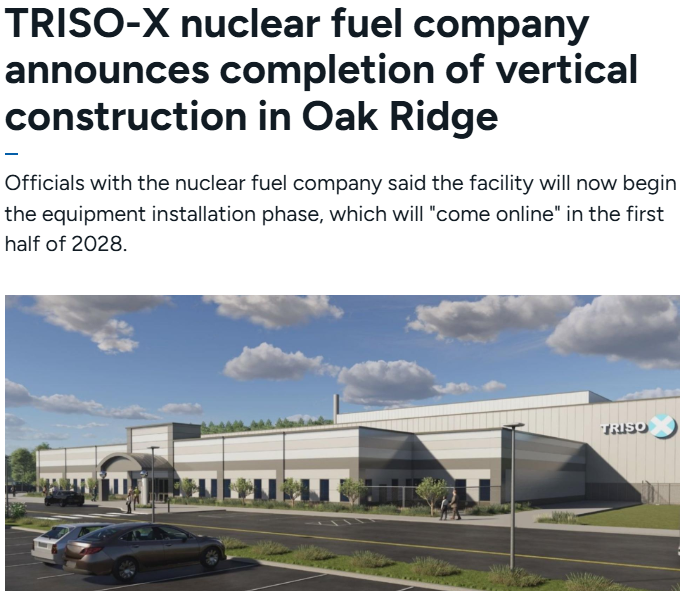
Construction of TRISO-X's TRISO fuel production facilities in Oak Ridge is moving forward. Fuel production is expected to start in early 2028. Article link in reply.
They're building three facilities, that are named "T1, T2, and T3".
Facility T1 will produce enough TRISO fuel to accommodate 11 Xe-100 reactors. Assuming that T2 and T3 have the same capacity, the overall facility will produce enough fuel for ~33 Xe-100s. That corresponds to 2.64 GW of nuclear capacity. The Xe-100 design produces 80 MW. It also produces 200 MW of heat, that can be used for various industrial processes.
I believe that the cost of TRISO fuel will fall significantly once it's produce at a significant scale.
3
4
28
1,024
A lot of this is old news, but this article is a good reference. It lists the five army bases that will host microreactors, along with the associated vendors. Article link in reply.
__________________________________________________
Fort Bragg, North Carolina, and Antares Nuclear.
Fort Campbell, Kentucky, and BWXT Advanced Technologies.
Fort Hood, Texas, and General Atomics Electromagnetic Systems.
Fort Benning, Georgia, and Radiant Industries.
Fort Drum, New York, and Westinghouse Government Services.
__________________________________________________
The first microreactor is expected to start generating electricity by 2028.
The army also has longer-term plans to procure more microreactors.
"The Army expects to build and operate more than 20 microreactors across U.S. military installations."

2
2
15
584
A Senate committee is considering a $50 billion plan that would fund three nuclear innovation campuses that would store (and/or dispose of?) used nuclear fuel. Article link in reply.
That would involve picking three of the six states that have shown interest (TN, LA, UT, OK, ID and WV).
In exchange for the used fuel, the states would get to host economically beneficial, large-scale manufacturing plants. The Energy Department estimates the economic impact of each hub at $10 billion in long-term local tax revenue and 25,000 jobs.

1
5
32
3,187
It's official! Italy has lifted its moratorium on nuclear plant construction. The Senate voted to lift the ban, with a vote of 81 to 51. The lower House already passed moratorium lift bill. The executive branch also supports building reactors. Article link in reply.

5
10
94
1,685
The plans for having the Koreans build eight large reactors in the US is being held up due to the plan to build two of their domestic APR-1400s, in addition to six US-designed AP1000 reactors. Article link in reply.
Heaven forbid letting the best nuclear plant builder (outside China) build their domestic reactors that they have the most experience with!
Are people afraid that the US AP1000 will look bad in the likely event that the APR-1400s turn out to be less expensive (per kW-hr) than the AP1000s?
This may be more about the battle between Westinghouse and KHNP concerning intellectual property. Would Westinghouse's intellectual property settlement with KHNP allow construction of APR-1400s in the US. One wouldn't think so.

10
25
154
6,572
Plans are solidifiying for construction of Poland's first nuclear plant. The plant would consist of three AP1000 reactors. Power generation is expected to start in 2036. Article link in reply.

7
16
92
1,683
Samsung C&T Engineering & Construction Group is getting around. They're working with Kairos to develop their molten salt reactor, and are working with GE Vernova, Japan's Hitachi on BWRX-300 development. Article link in reply.
A Sept 21 (also linked below) article announced the collaboration with Kairos, and two days later, there's an article announces an agreement to work with GE Vernova, Japan's Hitachi, and Poland's SGE on BWRX-300 development.
The reason they want to work with Samsung C&T?
"Samsung C&T's global construction expertise"

4
3
24
934
This German news outlet's article about renewed interest in nuclear in Southeast Asia presents several frustrating realities along with one profound good one. Article link in reply.
Frustrating things:
Southeast Asian countries had plans to build nuclear plants, but abandoned those plans after Fukushima. They went with fossil generation, coal in particular, instead.
This, despite the fact that coal is many orders of magnitude more dangerous and harmful than nuclear. Not only does nuclear have no impact under normal operation, even the Fukushima accident caused no direct deaths and had no measurable impact on public health. Meanwhile, fossil power generation, worldwide, causes ~1 million deaths every year and is a major source of CO2 emissions (global warming impacts).
Many people (most people in Indonesia) fear and oppose nuclear, and prefer even coal over nuclear. Why would people fear nuclear the most, despite the facts shown above and the scientific consensus that nuclear vastly better than fossil fuels (environmentally) and is as green as solar and wind?
One reason is the messages, from governments and experts, that subtlely suggest to the public that nuclear is uniquely dangerous. Decisions to chose coal over nuclear in response to Fukushima send such a message. The statements from quoted experts in the article, saying that nuclear requires a uniquely strict regulatory regime in order to operate "safely", sends such a message. The truth is nuclear is incapable of causing as much harm as coal does, regularly.
An encouraging thing:
The article has one profound quoted statement:
"Nuclear energy is deemed to be the viable solution to address both challenges of climate and energy security."
The experts and decision makers get it, particularly after the Iran war. The current high costs and insecurity of fossil fuels is changing minds, especially in countries that heavily rely on imported fossil fuels.

4
17
51
1,658
There's a proposal to deploy Terrestrial Energy's 390 MW molten salt reactor at the Aberdeen Proving Ground (a military base in Maryland). Article link in reply.

3
4
13
714
