

Analyst. Semiconductors, data centers & physical AI. Portfolio and investment theses on Substack Join 14,000+ readers: HyperTechInvest.com
Spain
- Tweets 8,919
- Following 337
- Followers 46,344
- Likes 3,017


Taiwan Leads the FOPLP Race, Production Ramps Up
Taiwan currently leads FOPLP, with PTI, $ASX and Innolux already in production
· PTI: 510 × 515 mm
· ASE: 310 × 310 mm
· Innolux: 620 × 750 mm
· TSMC: CoPoS pilot line, with mass production targeted for 2028
The main technical constraint is warpage and yield at larger panel sizes. Companies are using RDL stress balancing, CTE matching and stress-control films
Innolux demonstrated a 10-layer RDL sample without warpage
The longer-term shift is from glass as a temporary carrier to glass-core substrates with TGVs, creating demand for TGV drilling, metallization, inspection, handling and automation equipment
· Intel: Started glass development early but faces a more complex process and glass-breakage challenges
· Samsung: Using 415 × 510 mm panels and plans to outsource TGV glass. Mass production before 2030 appears unlikely
· Japan: Rapidus targets 600 × 600 mm glass packaging in 2028, while AOI Electronics and Sharp are also developing glass packaging

1
5
1,196


Game developers are so cooked
Maybe even more than CGI artists


$META LAUNCHES AI GAME-BUILDING TOOLS
Meta is launching Horizon Create and Horizon Studio, letting users build complete 2D or 3D games from AI prompts on mobile or in a browser.
Games can then be published across Facebook and Instagram, where users can jump from a clip directly into a multiplayer session without downloading a separate app.
Meta says the tools can generate gameplay systems, difficulty, art direction and multiplayer features, while still letting creators manually refine the experience.
The rollout is part of Meta’s broader shift to make Horizon a mobile-first platform rather than primarily a VR product.

2
1
7
2,862
I was so excited to hear that Claude had stopped being cringey
So I said, alright, let’s try this Opus 5.5
First phrase I get:
“Three takeover bids, all dead.”
For fuck’s sake, was this trained on an edgy teen?

3
2,230
Phison CEO Pushes Back on Acer’s DRAM Supply Comments
Acer CEO Jason Chen said supplies of mainstream DDR4 and DDR5 have increased and are no longer broadly constrained
Phison CEO K.S. Pua joked that media reports made it seem like Acer was the only company not suffering from the shortage, arguing that companies across the industry are still struggling with DRAM availability
Phison is looking to reduce this constraint through its aiDAPTIV+ architecture, which combines software with the company’s SSD technology to allow AI models to operate with less DRAM
On pricing, Mirae Asset Securities expects Samsung’s DRAM average selling price to rise 16.5% QoQ in Q3 and another 5.4% in Q4, pointing to slower price growth rather than an outright reversal
Long-term contracts are also becoming increasingly important. Samsung is seeking to lock in 60% to 70% of its memory production capacity through LTAs, while SK Hynix has finalized agreements with around 10 customers, including key strategic partners
These agreements give suppliers greater visibility over future volumes and can limit the capacity available for shorter-term negotiations, even as some products begin to see looser supply


Jason Chen, chairman of Taiwanese PC and IT hardware maker Acer, dismissed the memory Big 3's claim that memory prices will keep rising through 202X, saying it simply isn't true.
Specifically, he said the reason memory makers keep coming out and saying "the price uptrend will continue into 2027" is that antitrust rules prevent them from coordinating prices directly, so they use public statements to send a kind of "signal" to one another. He said a veteran like him can tell just by looking.
He also pushed back on the market narrative of a memory supply shortage:
"No. How could it stay short forever? Chinese capacity keeps coming onto the market. The supply shortage problem has already completely disappeared."
Chen also expects the cost of the SSDs and memory Acer holds in 2027 to be lower than this year. If that gets reflected in end product prices, he sees a possibility that prices at least stop rising and stabilize in the second half of next year.
Chen said prices could be raised further in 1Q27 as well. But since this is a period of pricing chaos, he expects the size of the increases to gradually shrink. He estimates component prices could peak around the middle of 2027, when the capacity that chipmakers have added is expected to start running in earnest.
After that, prices would enter a stable phase, and whether they can actually come down in the second half remains to be seen. He admitted, though, that nobody can know the exact timing of the reversal. Chen said PC selling prices coming back down is strictly "a hope."
He criticized component suppliers for treating price hikes like a fad. Countless suppliers are showing up to notify him of price increases, he said, and a whole series of components, from PCBs to glass fiber cloth to memory, are going up one after another.
He wrapped up by saying this chain of price hikes ultimately creates inflation, which in turn pushes central banks to raise rates, and that "this is not a normal phenomenon."
*This quote does not reflect my views and is shared solely for informational purposes.
1
1
5
3,352

$AMD is up 575% since I published this article
> In just 17 months
> As a megacap
How crazy is that?
hypertechinvest.com/p/can-am…
4
4
92
6,405
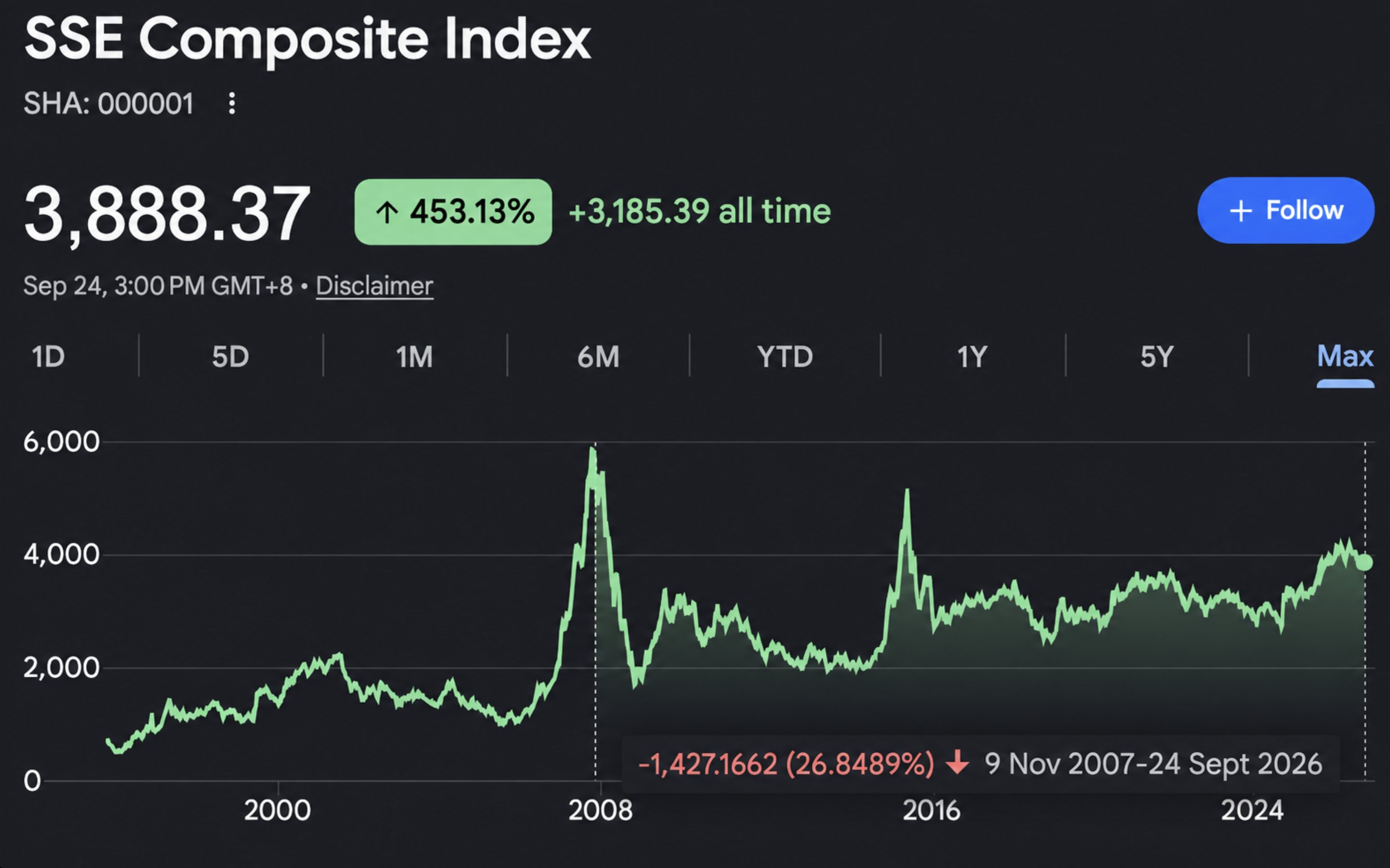
If you invested in China's main stock index at the peak of the 2007 bubble, you'd still be down 27% today
There's a reason why Chinese people don't trust stocks
They don't view them as a safe store of value the way Americans do
They've always preferred to store their wealth in real estate
However, that's changing too, and gold is now becoming much more popular
10
35
6,154
What? SemiAnalysis didn’t test $IREN at all?
They just went with whatever previous customers said, from God knows when?
SA needs better analysts, I’m afraid
Not serious
 𝐀𝐠𝐫𝐢𝐩𝐩𝐚 𝐈𝐧𝐯𝐞𝐬𝐭𝐦𝐞𝐧𝐭𝐬

7
4
136
11,462

Wouldn't it be poetic if the metaverse ended up making $META a $10T company?
I wonder about the potential of combining GenAI with the metaverse
I understand that the investment required to build these worlds was too high
But today? Marginal costs should trend toward zero
The metaverse failed because it was an idea that came in the wrong technological era
Once we can create hyperrealistic virtual worlds combined with brain-computer interfaces and advanced headsets, the potential is insane
Maybe 10 years from now, we're all hooked on some VR world, and Meta ends up being the company behind it all

7
2
38
6,789
At what yields would anyone under 35 even consider buying bonds?
7%? 10%?
Genuine question

100
3
182
35,623
The hype around Muse probably won't last...
Just saying
Neither will the Tamagotchi glaze
$META is doing things well but we've seen other hype jobs before

5
31
5,221
$HIVE could do great, for all I know
But their investor presentation has to be one of the worst I've ever seen
Why are they even doing a macro analysis in it lol

7
3,893
CPU demand is going to go bananas
And it's not just about AI agents
It's about physical AI
Welcome to the orchestration layer
Up until now, humanoid robots have depended on their onboard compute, or what you could call individualized intelligence
That's akin to a single chatbot
Just as we've moved from individual chatbots to swarms of AI agents, the next phase will be about large-scale robotic coordination
Imagine a factory where robots independently negotiate tasks, coordinate movements, share information and adapt production schedules
That creates demand for computing infrastructure beyond the processors installed inside individual robots
Now, you might think: we already have millions of warehouse robots, and they've barely made a dent in CPU demand
That's true, but that's because today's robots perform a very limited set of predefined tasks in structured environments, with no capacity to adapt
That's conventional fleet orchestration
The next wave of technology is AI-agent orchestration at the physical layer
In these next-generation systems, an AI receives a complex objective, develops a plan, delegates tasks to other robots, evaluates their results and modifies the plan as circumstances change, while each robot must individually adapt to its environment
That's millions of times more complex than what we have today, requiring inference capacity orders of magnitude higher
The result?
It wouldn't change the compute per robot, but it would require a CPU-heavy centralized brain to coordinate these deployments

20
9
104
9,464
Big push by $AMD into edge AI PCs
This time with Perplexity
They launched a great lineup last year and have been at the forefront of innovation
This is especially important in China, where restrictions on data center-scale compute make local AI a much more interesting market


The PC is about to become a lot more personal.
Today, I’m excited to announce a partnership between @AMD and @perplexity_ai to bring Perplexity Portable Computer to AMD Ryzen AI Halo.
This is more than running AI locally. We’re creating a new kind of agentic PC that can understand your work, reason through problems, and take action on your behalf, right on the device where your work happens.
With one click, users can bring powerful AI models and agents to their PC, work with local files and applications, and run recurring workflows on device. When a task needs more advanced research or reasoning, Portable can tap into the cloud with permission.
Your models. Your agents. Your data. Your stack.
For decades, the PC has been a tool for getting things done. Personal AI changes that. The PC can now become a true partner in the work, helping turn information into insight and ideas into action.
Big thank you to @AravSrinivas and the entire Perplexity team for making this possible.
The PC transformed how we work and create. Now we’re creating the platform for the era of Personal AI.
And this is just the beginning.

ALT AMD and Perplexity logos displayed side by side in partnership on a black background.
5
17
176
9,482
Palmer Luckey says Anduril will expand Taiwanese supply chain procurement 15-fold in 2026
The company added more than 15 Taiwanese suppliers over the past year, covering precision-machined components, batteries, motors, electronics, and optics
Potential beneficiaries include:
Coretronic (5371.TW): Drone systems, optical payloads, and cameras
Thunder Tiger (8033.TW): Drone platforms, motors, and propulsion systems
SimpLO (6121.TWO): Drone batteries and power management systems
Jinming (3230.TWO): Precision-machined components and drone parts
Taiwan is also acquiring 1,554 ALTIUS-700M attack drones and 478 ALTIUS-600ISR reconnaissance drones from Anduril

1
12
3,745
$TRT is getting crushed
For those surprised by the margin deterioration...
From their 10-Q, you could see that testing carries lower margins, while some people believed the opposite
Yes, the fastest-growing service, with AI exposure, is the thing causing the margin issues

4
1
35
5,813
I actually think data center/power plays are so undervalued
TrendForce expects demand to outpace supply, creating a 170 GW gap by 2030
Do people even understand what that means if true?
Look at how the gap widens. That's massive pricing power gains
It's not priced in

11
11
98
10,350
$META builds deliberately addictive technology that behaves much like an actual drug and is destroying the lives of millions of children
But some funky outfits, a cute render, and good returns for investors are enough to win over the American public
The sad reality

All of this is for PR reasons, backed by carefully planned marketing strategies
If you think any of these outfits, viral posts, and magical personality shifts are organic, you're way too naive
9
47
6,149