

Open-science Institute for learning, researching, and applying Active Inference.
Online
- Tweets 2,820
- Following 0
- Followers 5,173
- Likes 3,842


Pinned Tweet

Welcome 👋: welcome.activeinference.inst…
Join Discord: 💬 discord.activeinference.inst…
Explore Projects: 🔍 projects.activeinference.ins…
Active Inference Ecosystem: 🌐 ecosystem.activeinference.in…
Videos: 🎥 video.activeinference.instit…
Volunteer: 🌱 volunteer.activeinference.in…
Intern: 🎓 intern.activeinference.insti…
Newsletter: 📰 newsletter.activeinference.i…
Fellows Program: 📖 fellows.activeinference.inst…
Partnerships: 🤝 partnerships.activeinference…
Support the Institute: 💖 support.activeinference.inst…
Join us in advancing the field of Active Inference and be part of our growing community!

2
8
41
6,241
The Active Inference Institute is currently seeking applicants for the 2027/28 Board of Directors! Our board provides formal governance and oversight for the Institute as a non-profit organization, and in doing so serves the accessibility and applicability of Active Inference. In addition, we are a working board for a (mostly) volunteer organization, and require each board member to serve on a committee dedicated to institute development. If you would like to be considered, please complete this form before November 1st, 2026. Additionally, if you know someone who would be perfect for this role, feel free to pass this opportunity along to them.
More information: bod.activeinference.institut… . Application form: bodform.activeinference.inst… .

1
1
248
Do you have scientific or technical expertise you'd like to contribute to an open research and education community? The Active Inference Institute is accepting applications for its Scientific Advisory Board, a volunteer role that works alongside the Board of Directors and Officers and focuses on scientific direction and rigor. We welcome applicants from across the fields that Active Inference touches.
Details are at sab.activeinference.institut… and the application is at sabform.activeinference.inst…

2
237
Live now: piped.video/live/qqW975To1rk

Arun Niranjan is hosting a free online tutorial ahead of IWAI 2026 "Introduction to Active Inference"
Monday 21 September at 14 UTC. Live online session, streamed publicly on YouTube: piped.video/live/qqW975To1rk
Information on IWAI, October 14-16, 2026 iwaiworkshop.github.io/

2
297
Arun Niranjan is hosting a free online tutorial ahead of IWAI 2026 "Introduction to Active Inference"
Monday 21 September at 14 UTC. Live online session, streamed publicly on YouTube: piped.video/live/qqW975To1rk
Information on IWAI, October 14-16, 2026 iwaiworkshop.github.io/
5
717
GuestStream #131.1 ~ 10/2/2026 at 14 UTC
Federico Pigozzi and Michael Levin @drmichaellevin
"Causal Architecture Dynamics Prior to Arrival of Self-replicators in a Model of Catalytic Networks Relevant to Origin-of-Life"
piped.video/live/onxrJkX5xrY
Paper: arxiv.org/abs/2607.28250

222


🚀 Excited to share a major update to the Active Inference Journal! We’ve launched a new interactive web portal spanning 573 items and 744 video sessions from the Active Inference Institute library: activeinferenceinstitute.git…
Key features:
• Interactive Video & Transcripts: Click any dialogue cue or timestamp to seek the video to that exact second in real time.
• Chapters & Deep Search: Navigate timestamped discussion topics and search across all titles, speakers, and series in seconds.
• One-Click Transcript Export: Copy clean, speaker-labeled text directly to your clipboard.
Explore the live site at activeinferenceinstitute.git… and check out the open-source data and pipeline on GitHub at github.com/ActiveInferenceIn…

229
"Active Skillference: A Validated Prerequisite Graph, Computational Claim Registry, and SkillTree Delivery Contract"
Daniel Ari Friedman
Paper: zenodo.org/records/21865644
Code and all materials to run it locally: github.com/ActiveInferenceIn…
Active Inference and the Free Energy Principle (FEP) provide model-based accounts of belief updating, learning, and action under uncertainty. We present Active Skillference, a provenance-bound curriculum-generation and SkillTree-export system for teaching those formal ideas. The paper evaluates structural validity, quantitative provenance, citation-role coverage, and artifact reproducibility; it does not evaluate learner outcomes, establish a new theory of Active Inference, or present an intelligent tutoring system.The curriculum is expressed as code: a typed, validated directed acyclic graph of 630 skills across 111 subjects spanning all 8 strata (mathematics -> probability -> information theory -> variational methods -> the FEP -> active inference -> computation -> applications), connected by 1199 prerequisite edges with a maximum dependency depth of 75 (of which the substantive concept chain accounts for 33; the remaining depth is per-stratum review and mastery sequencing rather than conceptual prerequisite, as the methodology details). Its defining feature is content-provenance binding: every quantitative value shown to a learner is produced by a tested computational kernel and inserted through a typed claim token, never hand-typed, and the build refuses to export if a claim is unbacked or if a bare result number appears in learner prose, manuscript prose, or correct numeric quiz answers. The contribution is therefore a systems and curriculum-infrastructure artifact: it makes a formal subject inspectable and deliverable, but does not claim that the resulting path is optimal for every learner.The validated graph exports directly into SkillTree’s data model (Project -> Subjects -> Skills with learning-path dependencies and quiz-gated completion), includes a scripted REST seeding path for a configured instance, and is mirrored by a local dashboard that exposes generated artifacts, figures, claim ledgers, scholarship audits, and graph diagnostics without taking ownership of learner progress or scoring from SkillTree. The result is a curriculum with a validator-backed artifact chain: re-running the kernels regenerates the claim ledger, figures, manuscript variables, SkillTree export, and learner-facing numbers, so the platform’s teaching claims remain bounded by what the code, citations, validators, and documented limitations actually support.

1
4
364
The 6th Applied Active Inference Symposium 2026 will be held on 12-13 November, 2026.
Register to attend: registersymposium2026.active…
Register to present: 2026present.activeinference.…
All information, including on past Symposium and on Sponsorship: symposium.activeinference.in…
This online Symposium will focus on exploring the applications and frontiers of Active Inference. As with previous Symposia, the keynote address and panel will feature Karl Friston.

Made with AI
1
2
282
Announcements for week of August 10, 2026:
6th Applied Active Inference Symposium on November 12-13, 2026
The 6th Applied Active Inference Symposium 2026 will be held on 12-13 November, 2026. This online Symposium will focus on exploring the applications and frontiers of Active Inference. As with previous Symposia, the keynote address and panel will feature Karl Friston.
Register to attend: registersymposium2026.active…
Register to present: 2026present.activeinference.…
All information, including on past Symposium and on Sponsorship: symposium.activeinference.in…
---
“Fundamentals of Active Inference” textbook group
The first cohort of the “Fundamentals of Active Inference: Principles, Algorithms, and Applications of the Free Energy Principle for Engineers” textbook group is ongoing! Register for the Textbook group here — textbook-group.activeinferen…
---
Open Project Meetings this week:
See activities.activeinference.i… for the location of all events listed here.
* 8/11/2026, 17:00 UTC — “Fundamentals of Active Inference” ~ Textbook Group
* 8/13/2026, 13:00 UTC — RxInfer.jl ~ Learning session
* 8/14/2026, 13:00 UTC — “Fundamentals of Active Inference” ~ Textbook Group
---
* Join the Discord: discord.activeinference.inst…
* Learn more about the Active Inference Ecosystem ecosystem.activeinference.in…
* Make a Measurement to get your update included in the upcoming Newsletter: measure.activeinference.inst…
* We are a 501(c)(3) educational non-profit. Donate at: donate.activeinference.insti…
* Email blanket@activeinference.institute with any questions.
276


ModelStream #010.1 ~ 7/29/2026 at 19 UTC
Sharath Sathish: "Active Circuit Discovery: A Multi-Action POMDP Agent for Causal Feature Identification in Transformer Attribution Graphs" piped.video/live/U9Z0TIeq1Fc
Paper: mdpi.com/2073-8994/18/6/1043

2
231
GuestStream #130.1 ~ Live now
Alexander Hemming, Dylan Grove
"Understanding Integrative Complexity Through Active Inference"
piped.video/live/IOuJgpK9M_A

1
344
Live in 10 minutes:
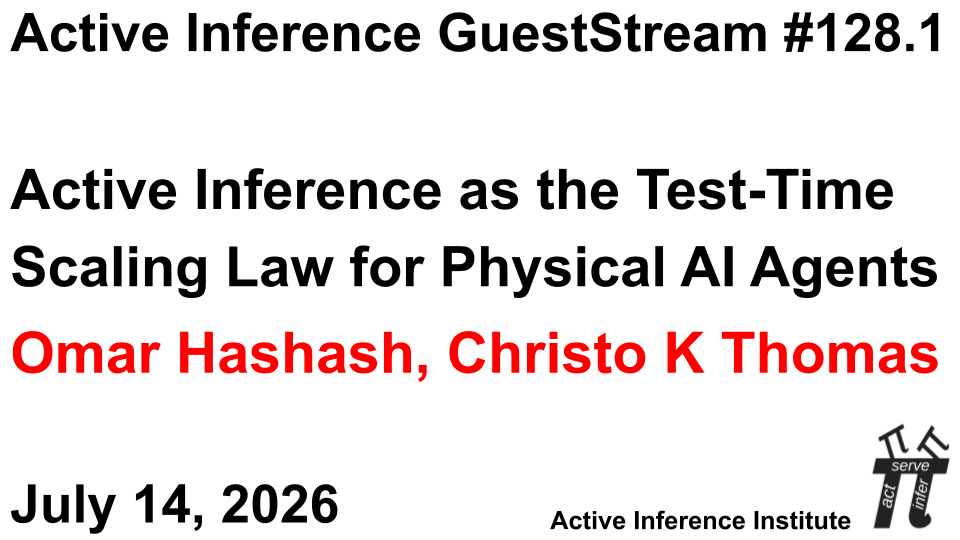
GuestStream #128.1 ~ Omar Hashash, Christo Thomas
"Active Inference as the Test-Time Scaling Law for Physical AI Agents"
piped.video/live/vjtYYbO9jCY
Paper: arxiv.org/abs/2606.22813
3
352
Active FractalRabbit: A Synthetic Benchmark for Belief Filtering Under Sparse Waypoint Observations
Daniel Ari Friedman
🔗 Code: github.com/ActiveInferenceIn…
🔗 Paper: doi.org/10.5281/zenodo.21330…
Sparse waypoint analysis is privacy-sensitive: it must separate movement from irregular reporting, missingness, spatial coarsening, and corruption while preserving uncertainty about hidden location. Active FractalRabbit provides a controlled, artifact-bound benchmark whose headline lane uses a deterministic project-local synthetic FractalRabbit-format fixture; a separately retained lane exercises pinned open-source software from the National Security Agency as an independent simulator surface. The benchmark converts sporadic reports into categorical evidence, fits explicit hidden-state generative models, and compares transparent temporal, Markov, sequence, state-space, neural, latent-state, and active inference predictors under matched information sets. Under noisy partial-observability, Active Inference is the lowest-loss implemented predictor: it clearly leads point-estimate and raw-observation families and sits in a statistical tie with the strongest non-AIF belief-preserving comparator. The shared mechanism is soft Bayesian marginalization, which preserves probability across plausible cells instead of committing early to one state. Point estimates suffice for clean observations, an online base-rate predictor leads under regime switching, transparent temporal and disclosed kinematic controls anchor sparse reporting gaps, and withholding location sharply limits specific-cell recovery from metadata. The partially observable Markov decision process (POMDP) formulation also exposes variational and expected-free-energy diagnostics for belief, minimization, and integrity. These results establish a regime-specific synthetic model map and a reproducible evidence chain. The present contract covers synthetic software behavior; separate evidence protocols govern privacy and empirical evaluation

1
434
Fundamentals of Active Inference (Coding + Agents, Session 25) July 7, 2026
piped.video/V46B4Xy1PeQ
Code: github.com/ActiveInferenceIn…
Using @NousResearch Hermes with free @OpenRouter LLM to Learn and Apply active inference.
"Fundamentals of Active Inference" is now published! mitpress.mit.edu/97802620509…
Textbook Group begins in April at the Institute, all levels of familiarity with Active Inference welcome to join: coda.io/form/Active-Inferenc…
1
559
Live now: piped.video/live/t2TgSuYH-K8
GuestStream #067.2 ~ 7/2/2026 at 12 UTC
Andrés Corrada
Who Judges the Judges?
piped.video/live/t2TgSuYH-K8
The problem of verifying experts that are smarter or more knowledgeable than us is ancient. Its modern incantation -- "When we use LLMs-as-Judges, who/what checks them?" -- should be amenable to all the strategies humanity has devised to ameliorate this curse of acquiring knowledge. We apply two of these strategies—ensembling experts and logical inconsistency—to evaluate classifiers when we lack the answer keys for their tests. Disagreeing experts allow us to logically exclude evaluations inconsistent with the counts of their differences. For example, if we all take a multiple-choice exam and disagree, we cannot all be 100% correct. This exclusionary logic for joint evaluations can be formalized as the integer solutions to a system of universally applicable Diophantine equations (axioms of classification). The newly released version of the Open Source NTQR Python package contains exact and random sampling generators for the logically consistent evaluation set given arbitrary number of questions, labels, or classifiers. We will demonstrate its simple use using Jupyter notebooks from the NTQR documentation. Considering the ubiquity of "who judges the judges?", this semantic-free counting logic should have wide applicability in helping ameliorate it. Some examples briefly discussed include: scalable oversight, correlated experts, self-evaluation, and no-knowledge alarms for misaligned classifiers. The talk concludes with the limitations of logic and its inability to answer scientific questions related to the safe monitoring of expert systems.

2
380