
Laboratory of Epigenetics and Immunology, @WeillCornell PI: Steven Josefowicz; acct run by lab members and do not reflect the views of Weill Cornell
- Tweets 187
- Following 149
- Followers 880
- Likes 174


PhD alert! Exceedingly proud to announce that Andrew Daman has successfully passed his defense and is now Dr. Andrew Daman! Congrats on a fantastic dissertation and phenomenal PhD career! We all know you’ll do great things!

2
4
49
4,953
Triple whammy of JLab talks recently with Andrew, Chenyang, and Michael all giving their dept rips!
Andrew: mechanisms of why BCG is used as a bladder cancer treatment
Chenyang: IKKa’s role in stimulation-induced transcription
Michael: our ongoing ImmGen cut&run efforts !


8
1,390
Big day for harvesting macrophages in the lab! Senior grad students and rotation students all ChIP-ing in!


1
28
2,303
A fantastic @ImmGen_ workshop this year! Always a great time seeing @GCloner and the @epicypher team!

4
1,337
.@NotABaleOfHay got a whirlwind tour of chromatin science this week and had a great time presenting his work with the ImmGen Consortium this week at @epicypher #Epi2023! Doing the @WCM_IMP program proud!

1
20
2,898
Thank you to @epicypher for the invite to tell everyone about our story in GC Bcells! It’s been an absolute dream of a meeting here in Cancun.

1
11
900
Made it to gorgeous Cancun for #Epi2023 with @NotABaleOfHay! Already a great slate of talks today and looking for to the rest of the week!

1
29
1,673

Always a treat to discuss our science!
Final shoutout to check out Jin’s poster today 457 to hear more if you have questions!
Finally of course a massive thank you to the lab, our collaborators, and the donors without whom this work wouldn’t be possible!

1
10
1,985

#NewProfilePic figured was time for an updated lab photo on the Twitter! From our recent lab outing bouldering!

11
1,313
We are absolutely pleased to announce and congratulate the first Josefowicz lab member to defend their PhD. Congratulations Dr. @Jin_Q_Cheong on a fantastic dissertation talk and we look forward to your inevitable success in your career.

4
2
39
3,977
Congratulations Dr. @TheBourneImmuno on an excellent dissertation and scientific career here @WCM_IMP. A fantastic scientist, amazing human, and fierce advocate for minoritized people in STEM we will miss you here in NYC but wish you all the best in your career with @Taabaman

3
21
2,656
Long overdue JLab outing today at Vital and dinner and book exchange at Tørst! Such a fantastic group to do science and hang out with! Also got to welcome (albeit a touch early) our newest JLab recruit - @TriIMDPhD student Tori Lawless!

2
33
3,063

Fantastic talk by @Jin_Q_Cheong at the 4th COVID-19 Immunology Symposium on his work defining epigenetic memory in response to severe SARS-CoV-2 infection in hematopoietic stem and progenitor cells!


1
6
Double whammy at the @WCM_IMP retreat this year with @andrewwdaman winning best presentation and Dughan winning the 3MT competition! Congrats to both!

1
31
Had a great time last week @FASEBorg’s Immune Cell conference! Great to see friends and colleagues and of course great science up in beautiful Nova Scotia!


2
29
In bittersweet news, we sent @arjunrshankar off to @YaleMed as he begins his Residency in Internal Medicine and our exceedingly talented lab tech Jessica to University of Pikeville's DO program! We will miss you both and wish you the best in your future endeavors!

1
1
14

Celebrating our newest PhD ✨C A N D I D A T E✨@ChenyangJiang1 after she passed her ACE with flying colors!

1
33
Got a couple of great action shots yesterday of Dughan and @andrewwdaman presenting posters at our in-person @WCM_IMP recruitment visit day!


2
26
Ok, whew! A lot here! Main takeaways below, but we hope you read the preprint in its entirety and see this study published soon! Of course, we can't end without thanking key players... 16/

1
3
We then sought to identify transcription factors that may drive these phenotypes, enabled by (1) DORC analysis (below, top) and (2) TF footprinting from scATAC (below, bottom) and identified prominent and durable alterations in AP-1 and IRF chromatin binding. 13/


1
2
By utilizing this metric combining both transcriptional and chromatin accessibility data, we noted a putative pseudotime-supported trajectory between HSPC and myeloid cells that was enriched in cells derived from those recovering from severe COVID-19. 9/

1
3
To harness the full potential of our combined scRNA & scATAC data, we - in collaboration with @JD_Buenrostro's lab - utilized a correlative metric to define genes with particularly active chromatin that matched Tx activity called a Domain of Regulatory Chromatin (DORC) score. 8/

1
1
5
Diving into the scSeq data inclusive of almost 30k HSPC (!) we see multiple interesting phenotypes. These include increased neutrophil progenitors (shown below) and monocyte differentiation that lasts up to 12 months following severe COVID-19. 7/

1
2
We recruited a cohort of participants with mild or severe COVID-19 followed for months to 1yr post-acute and both healthy + non-COVID-19 post-ICU cohorts for comparison. We performed multi-omic analysis of transcription and chromatin accessibility using a paired scSeq approach 6/

1
2
Importantly, peripheral HSPC assayed w/PBMC-PIE capture the heterogeneity + breadth of HSPC subclusters (below). We next set out to determine alterations in (a) hematopoiesis and (b) epigenetic and transcriptional landscapes following COVID-19 or non-COVID-19 critical illness. 5/

1
2
Enter: PBMC-PIE! Peripheral Blood Mononuclear Cell analysis with Progenitor Input Enrichment allowed us to enrich rare, circulating HSPC in peripheral blood, providing unique insight into hematopoiesis and epigenetic memory in HSPC w/o invasive sample collection methods! 4/

1
1
4
Important a JLab business post lab meeting: learning to use our aeropress. Coffee is very important

16
JLab was well-represented today @WCM_IMP retreat 2021 with poster presentations by Jin and Dughan with a 3min research blitz presentation by Andrew!


3
19
Hi all! A little late, but here's our official welcome to our newest PhD students in the lab: Chenyang Jiang and Michael Bale!


2
1
27
In summary, our studies link H3.3S31ph at stimulation-induced genes to augmented SETD2 activity, co-transcriptional H3K36me3, and ejection of ZMYND11, enabling rapid and high-level transcription of these genes
15/15

3
We rescued these DKO cells with WT H3.3, H3.3S31A (loss of function) and H3.3S31E (gain of function) transgenes before stimulation. LPS-induced gene expression in DKO macrophages was increased by WT H3.3, reduced by H3.3S31A (similar to H3.3 DKO), and increased by H3.3S31E
14/15

1
1
To study the function of H3.3 in inflammatory gene induction, we knocked out both H3.3 genes (DKO) in a macrophage cell line. Upon stimulation, the DKO macrophages showed decreases in LPS-induced gene expression
13/15


1
1
ChIP-seq revealed ZMYND11 is pre-bound within many stimulation-induced genes, and is ejected coincident with H3.3S31ph. siRNA knockdown of ZMYND11 resulted in increased expression of LPS induced genes
12/15

1
2
ZMYND11, a transcriptional repressor and tumor suppressor, is a K36me3 reader specific for H3.3 via interactions with unmodified H3.3S31. Structural, modeling, and ITC studies reveal potent ejection of ZMYND11 from dually modified H3.3S31phK36me3.
11/15


1
1
These SETD2 basic residues are conserved across metazoans, whereas other H3K36 HMTs feature acidic or polar amino acids at these positions.
Together, our findings suggest H3.3S31ph-augmented SETD2 activity as a feature of enhanced stimulation-induced transcription
10/15

1
1
The crystal structure of SETD2 catalytic domain bound to H3.3 peptide reveals H3.3S31ph interacts with lysines K1600 and K1673 of SETD2. These positive charges stabilize H3.3S31ph substrates and promote engagement of K36 at the active site for methylation
9/15


1
1
To understand the relationship between S31ph, K36me3, and SETD2, we assessed enzymatic activity of SETD2 on recombinant nucleosomes containing WT H3.3 or a ‘phospho-mimic’ glutamate at position 31 (S31E), and found that SETD2 activity was stimulated by the S31E mutant
8/15

1
1
Next, we focused on another co-transcriptional histone mark, tri-methylation of lysine 36 on H3 (H3K36me3) which is mediated by SETD2. We found that H3K36me3 is present at modest levels in resting macrophages and increases commensurate with H3.3S31ph after stimulation
7/15


1
1
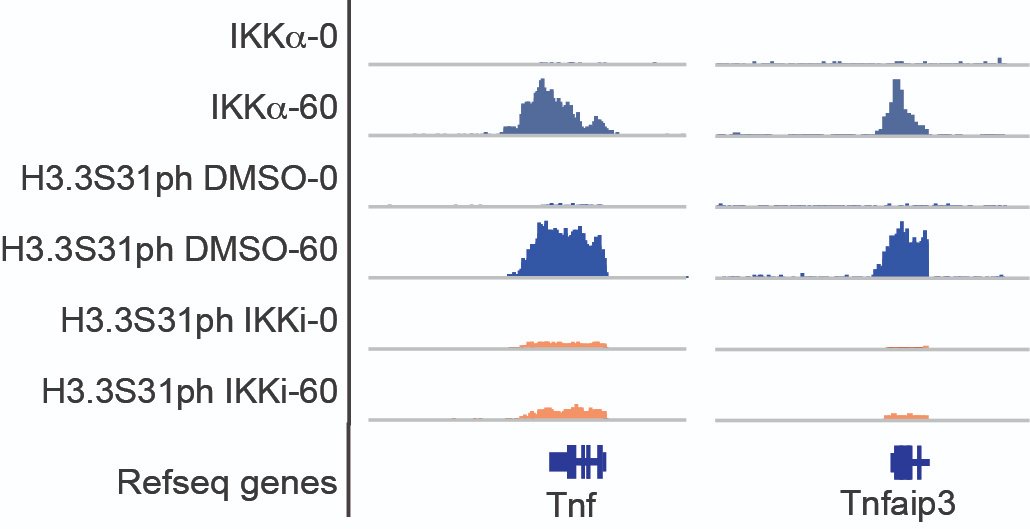
Various candidate kinases have been described for H3.3S31 including IKKa, CHK1, and Aurora B. We find that IKKa co-localizes with H3.3S31ph genes in a stimulation dependent manner. Pan-IKK inhibitors and shRNA for IKKa result in loss of H3.3S31ph at these genes
5/15

1
2
We sought to determine the relationship between S31ph and transcription-- H3.3S31ph is reduced upon treatment with various inhibitors of transcription, suggesting it is co-transcriptionally deposited
4/15

1
1
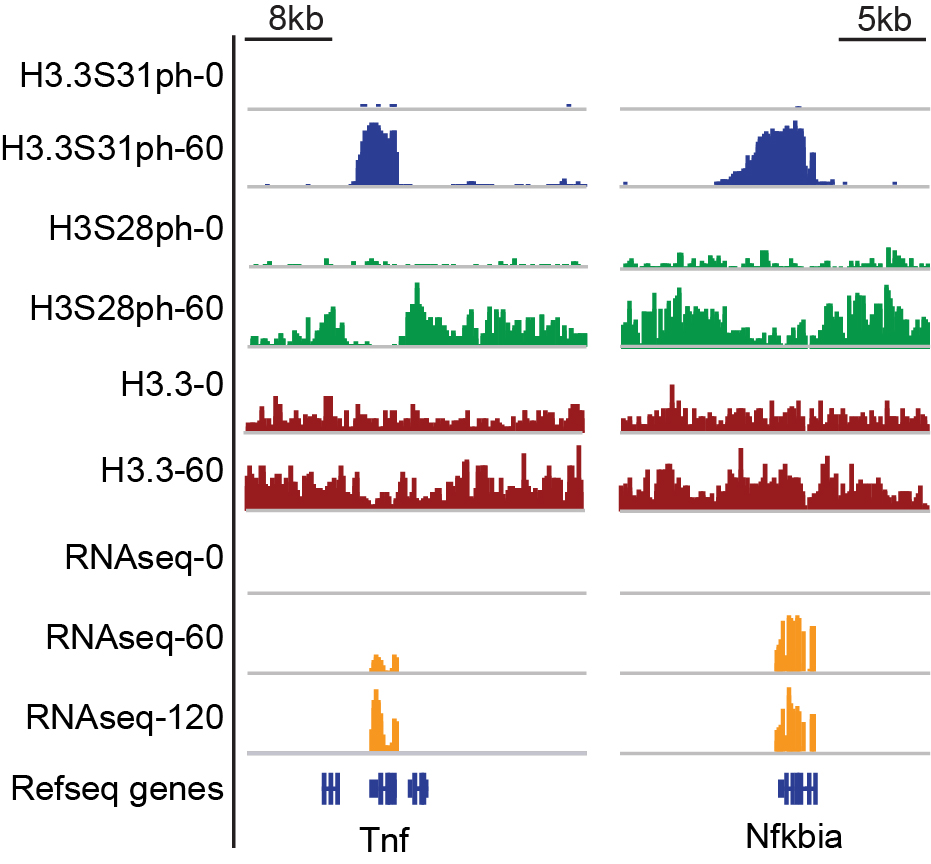
Phosphorylation of H3.3S31 (S31ph) is specific to gene bodies of LPS-induced genes, unlike H3S28ph, another stimulation induced histone mark which is deposited along enhancers, promoters, and intergenic regions
3/15
1
2
We show stimulation-induced phosphorylation of serine at position 31 on the N-terminal tail of histone H3.3 (H3.3S31). Our primary model system is mouse macrophages stimulated by lipopolysaccharide (LPS), but this is true across diverse cell types and stimuli
2/15


1
1
