

Liquidity and hedging infrastructure for institutional stablecoin–fiat flows.
Global
- Tweets 340
- Following 18
- Followers 310
- Likes 234


Can a payment be instant and still late?
Yes.
A stablecoin transfer can settle in seconds, while the wider transaction still depends on liquidity, FX execution, local settlement rails and reconciliation.
So the better question is not just how fast the asset moved onchain.
It is how quickly the full transaction can be completed and recorded.
A fast transfer is not always the same as a completed payment.
#Stablecoins #Treasury #Payments #CrossBorderPayments #PaymentsInfrastructure

1
36
Your business just received $250K in USDC. Would you convert all of it?
Probably not.
$100K → operating expenses
$75K → upcoming settlement
$75K → remain in USDC
Now the treasury team has to decide:
When should the $100K be converted?
Does the $75K settlement need a direct conversion or an RFQ?
Where should the remaining USDC sit?
And how will each transaction be tracked and reconciled?
That is where stablecoin treasury gets interesting.
It's not just about holding USDC. It's about managing each balance according to what the business needs to do with it.
#Stablecoins #Treasury #Fintech #Ledig

2
54
Not every stablecoin conversion should be executed the same way.
If the transaction is straightforward, you already know the pair and amount, and you simply want to review the available rate and execute, Instant Liquidity is the more direct path.
Select pair → enter amount → review rate → convert.
But some transactions need more than direct execution.
For larger or more specialised transactions, pricing may need to be discussed before anything is confirmed. That’s where the Dealing Desk fits.
Request a quote → review the rate → discuss or negotiate where needed → agree terms → execute with support from the Ledig dealing team.
So the distinction is simple:
Instant Liquidity = direct execution
Dealing Desk = RFQ and negotiated execution
Both are available via API, so businesses can bring either workflow into their own treasury, payment or settlement infrastructure.
Same liquidity infrastructure. Different execution paths for different transaction needs.
#Stablecoins #Liquidity #Fintech #Ledig

2
3
79
21 major financial institutions are building a stablecoin together.
Bank of America, Citi, Goldman Sachs, Wells Fargo, Santander, Deutsche Bank, UBS, MUFG, Standard Bank and others plan to establish a new company, starting with a USD stablecoin and eventually expanding into G7 currencies, with EUR a priority. Launch is targeted for H1 2027.
The interesting part isn't simply that banks are issuing a stablecoin.
It's where this puts the rest of the market.
Banks already have the customers, treasury relationships, compliance frameworks and distribution channels.
So as institutional issuance grows, the harder infrastructure problems become more important:
Liquidity. Settlement. Interoperability. Treasury. FX.
And if USD is followed by EUR and other currencies, moving between different forms of digital money becomes another problem to solve.
The question for stablecoin companies then shifts to:
"What infrastructure connects the token to everything else?"If banks control issuance and distribution, where does the strongest opportunity sit for the rest of the stablecoin market?
How are you reading it?
#Stablecoins #Fintech #Payments #Ledig

1
2
88
Stablecoins can be part of a company's treasury. But treasury isn't just about holding stablecoins.
Teams still need to know where funds are, which wallet or account they're sitting in, what each balance is for, and how every transaction is tracked and reconciled.
A business might have:
USDC wallet → customer payouts
USDT wallet → operations
NGN account → local settlement
USD account → international receipts
The challenge is managing these different balances without losing visibility.
Ledig provides businesses with fiat accounts and stablecoin wallets across supported currencies and assets, with balance visibility, transaction history, receipts and exportable records for reconciliation.
And when funds need to move between stablecoins and fiat, Ledig provides the liquidity and FX infrastructure around those flows.
If you're interested in how this can work for you and your business, visit ledig.io to learn more.
#Stablecoins #Treasury #Fintech #Ledig

1
3
59
What’s the biggest challenge for businesses using stablecoins across markets?
Vote, then tell us why. We'd love to see your reason in the comments.
#Stablecoins #Fintech #Payments #Ledig
0%
Reliable liquidity
0%
Local banking/payment rai
0%
FX & currency risk
0%
Compliance & regulation
0 votes • Final results
3
56
Stablecoins are becoming part of corporate finance. But how should they be treated on a company's balance sheet?
This is what FASB is trying to clarify.
FASB (Financial Accounting Standards Board) sets U.S. accounting standards under GAAP. Its latest proposal explains when certain digital assets, including some stablecoins, could qualify as cash equivalents.
The proposal looks at three main things:
1. On-demand redemption
Can the holder redeem the stablecoin for cash when needed?
2. Direct claim on the issuer
Can it be redeemed directly with the issuer, rather than simply sold on an exchange?
3. 1:1 liquid reserves
Does the issuer hold segregated, highly liquid reserves covering the stablecoins in circulation?
Why does this matter?
Because classification affects how companies report and evaluate their liquidity.
It also means “stablecoin” isn't enough on its own. The underlying structure and rights attached to the token matter.
The proposal is still being considered, but it could provide more clarity for institutions using stablecoins in corporate treasury and payments.
#Stablecoins #FASB #Accounting #Fintech #Ledig

1
2
42
What did people who visited the Ledig booth think?
We asked a few attendees at Nigeria Stablecoin Summit 2.0 to share their experience.
Here’s what they had to say. 🎥
#NigeriaStablecoinSummit #Stablecoins #Ledig

1
2
53
Money moves in different directions. Your infrastructure should keep up.
Receive. Pay. Hedge. Reconcile. Manage.
From cross-border payouts and stablecoin payments to FX and treasury operations, businesses often have to manage multiple financial processes across different markets.
Ledig brings these workflows together through one infrastructure.
#Fintech #Payments #Stablecoins #Treasury #Ledig

1
2
62
Paying across borders shouldn’t feel like opening a new project every time.
Different markets mean different currencies, banking systems, and payment rails.
Ledig helps businesses make cross-border payouts using both fiat and stablecoins, while managing the complexities behind each market through one infrastructure.
#CrossBorderPayments #Stablecoins #Fintech #Payments #Ledig

1
2
99
Stablecoin conversion ≠ settlement.
Consider a business that sends USDC and wants to receive NGN.
First, the USDC is converted into NGN at an agreed FX rate. But the transaction isn't complete yet. The NGN still needs to be transferred to the business's bank account through local payment rails.
So:
USDC → Conversion → NGN → Bank Settlement
This is why having access to stablecoin liquidity alone isn't enough.
Businesses also need competitive FX rates, reliable local settlement, compliance, and accurate reconciliation to complete the transaction efficiently.
The stablecoin is only one part of the payment flow. The infrastructure connecting it to the local financial system matters just as much.
#Stablecoins #Liquidity #Payments #Fintech #Ledig

1
2
72
Stablecoins make value easier to move. The harder part is connecting them to local financial systems.
Ledig provides the liquidity infrastructure that connects stablecoins to local currencies, helping fintechs and institutions move, settle, and manage value across markets.
#Stablecoins #Liquidity #Fintech #Ledig

1
3
120
As financial markets become increasingly connected to digital assets, the quality of the underlying infrastructure matters just as much as the technology itself.
Reliable liquidity, efficient settlement, strong compliance, and access to local financial rails are what turn digital assets into usable financial tools for businesses.
The infrastructure may sit in the background, but its impact is visible in how easily value moves.
#Fintech #Stablecoins #Payments #FinancialInfrastructure #EmergingMarkets

1
2
53
Virtual accounts are not all the same.
A standard virtual account can give a business local receiving details.
A named virtual account can go further by providing an account in the business's own name, even when that business isn't locally incorporated or banked in that market.
For businesses operating across borders, that can improve payment experience and reconciliation.
The key question isn't just "Do you offer virtual accounts?"
It's "What type, in whose name, and for what use case?"
#Fintech #Payments #VirtualAccounts #Ledig

1
2
64
Stablecoin adoption is becoming less about the asset and more about what happens around it.
A few years ago, much of the conversation was focused on questions like:
What is a stablecoin?
Why should businesses use one?
The questions are changing.
Today, businesses are asking more practical questions:
How do I get liquidity when I need it?
How do I convert it to local currency?
How do I settle into a bank account?
What happens when transaction volumes increase?
How do I manage FX and compliance across different markets?
That shift is important.
It suggests that the next phase of stablecoin adoption will depend less on awareness and more on the infrastructure connecting digital assets to the financial systems businesses already use.
Some moments from the Nigeria Stablecoin Summit 2.0, where many of these questions came up in different forms.
#Stablecoins #Fintech #Payments #Liquidity #DigitalAssets #EmergingMarkets


1
1
4
162
Having stablecoins doesn't automatically mean you have liquidity.
A business can hold $1M in USDC and still face challenges converting it to local currency, getting competitive FX rates, or settling large transactions.
Liquidity is about access, depth, pricing, and the ability to move value when needed.
That's why the infrastructure around stablecoins matters.
#Stablecoins #Liquidity #Fintech #Ledig

1
3
74
The first half of 2026 has been about building, refining, and preparing for what comes next.
In our blog, we look back at the progress Ledig made across our products, team, operations, partnerships, and market coverage, and share what we're focused on for the second half of the year.
And there is a lot already in motion.
From taking our stablecoin derivatives engine on-chain to expanding our currency corridor coverage and strengthening our infrastructure, the second half is firmly focused on execution.
Read the full review and what's ahead for Ledig:
ledig.io/blog?post=first-hal…
#Ledig #Stablecoins #Fintech #Payments #FX #EmergingMarkets

3
61
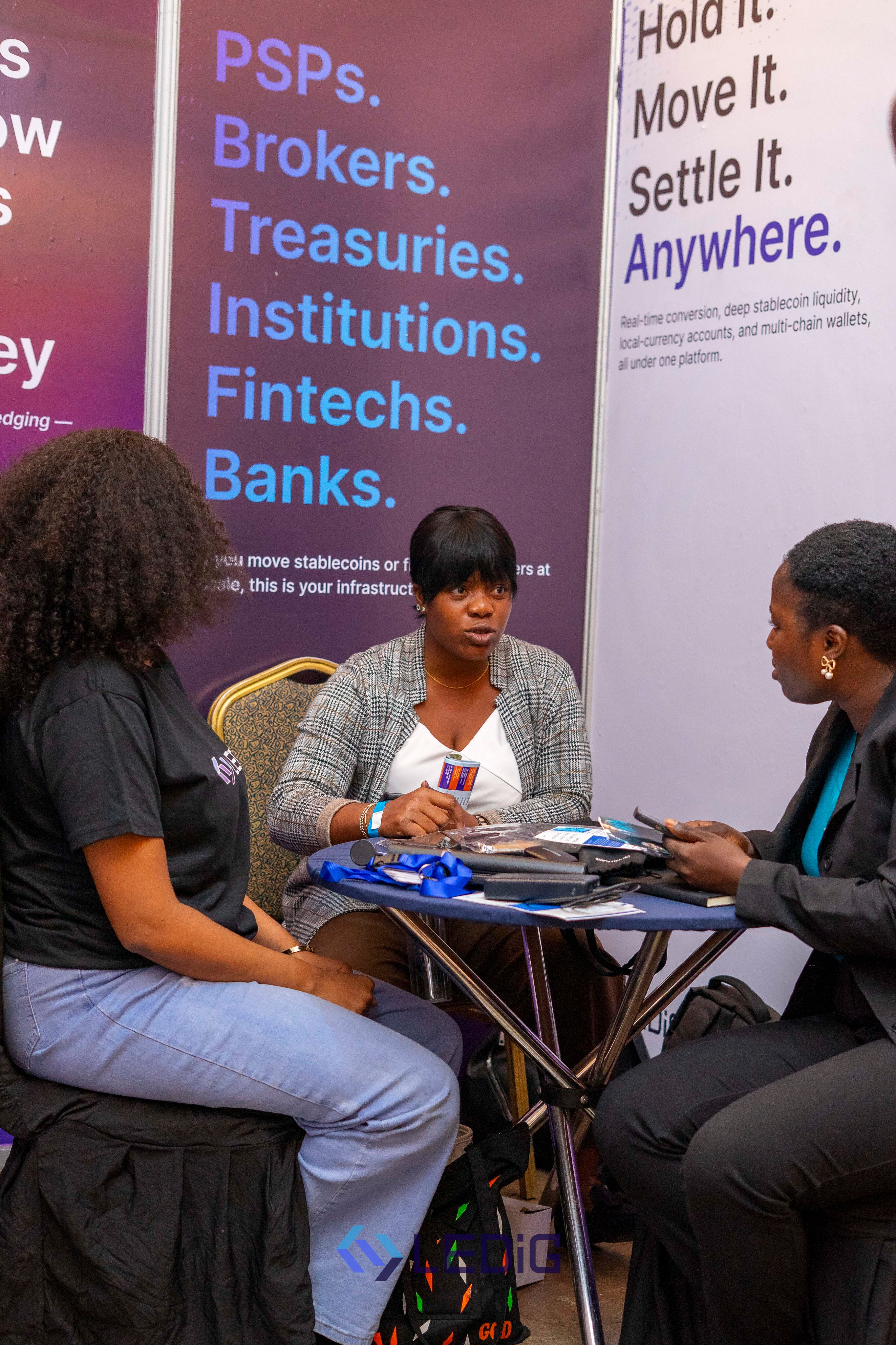
Conversations, connections, and plenty of questions.
Here's a look at our time at Nigeria Stablecoin Summit 2.0, where the Ledig team spent the day meeting founders, partners, and businesses exploring stablecoin infrastructure across Africa.
Thanks to everyone who came by to chat. We enjoyed every conversation.
#NigeriaStablecoinSummit #Stablecoins #Fintech #Ledig #africa

1
6
86


That's a wrap on Nigeria Stablecoin Summit 2.0.
Thanks to everyone who visited the Ledig booth and connected with our team. It was great discussing stablecoins, payments, and the infrastructure shaping financial services across emerging markets.
Until next time.
#NigeriaStablecoinSummit #Stablecoins #Fintech #Ledig


2
4
90