

Interests: Data. Python. Economics. Social Policy. Politics. Australia. Caveats: Not financial advice. Opinions my own. Likes ≠ endorsement.
Canberra, Australia
- Tweets 9,521
- Following 2,663
- Followers 5,818
- Likes 4,809


Where is Australia’s non-accelerating inflation rate of unemployment (NAIRU, or u*)?
My best guess is 4.8 to 4.9 per cent. I get essentially the same answer from two broad models and several different specifications.
The RBA’s latest SOMP also looks consistent with u* around 4.8 per cent.
One wrinkle: my models find the 1990s difficult. Inflation was largely brought under control in the early 1990s recession, but unemployment then spent roughly 15 years transitioning towards a much lower steady-state rate. That makes u* particularly hard to identify in the early part of the sample.


2
9
576
Mark 🇦🇺 retweeted

Next week's CPI will provide an important gauge of how much signal to take from last month’s stronger-than-expected outcome. We think some of the strength will unwind in August, but that underlying inflation will still be uncomfortably high for the RBA.1/ commbankresearch.com.au/apex…

1
3
6
903
The Okun stall speed is another window on potential GDP growth (often written g*): the rate of growth at which the unemployment rate neither rises nor falls. When growth runs below the stall speed, unemployment typically rises. But it is a noisy, backward-looking relationship.
For Australia: ~3.9% before 2008, ~2.9% for 2008–19. The 1.9% post-2022 estimate rests on only about 16 quarters, so treat it with some caution.


9
549

The reason immigration went off the rails …
smh.com.au/politics/federal/…
6
10
983
Terminal gate prices eased slightly this week. Diesel is at 269c/L, about 7c below its recent peak. Petrol is at 231c/L, down only a cent. Both are far above January levels. Petrol is up about 75c (roughly 50%) and diesel about 110c (roughly 70%). The diesel premium over petrol has widened from a couple of cents in January to nearly 40c. This hitss farmers, miners and transport.
Where next? Look at Singapore. Our terminal gate prices track Singapore refined product prices with a lag of about a week. Singapore gasoil (diesel) peaked in mid-September and has since eased about US$9/bbl, or roughly 9 to 10c/L. Local diesel has fallen 7c so far, so a few more cents may follow. Mogas 92 (petrol) has been flat near US$136 since mid-September, and local petrol has flattened too. Don't expect much movement in petrol next week.
Why is diesel hurting so much more? Split the Singapore price rise since January. Gasoil is up about US$100/bbl. Brent explains $45 of that. The other $55 is the refining margin, which is still about four times its January level. Mogas is up about $65. Brent explains $45 and the margin only $20. Diesel is a refining shock. Petrol is mostly a crude shock. The US Gulf jet margin is just as wide, so tight middle distillates are a global problem, not only an Asian one.
The risk is on the upside. Brent jumped back above $105 in the last two sessions. That hasn't shown up in Singapore product prices yet. If crude holds there, it will.
No real relief just yet.


1
4
509
Mark 🇦🇺 retweeted

Since 1300, long term government bond yields have averaged 5.8%.
The current 5.2% 10-year Treasury yield is 60bps below the 726 year average.

116
50
393
69,720


Insolvencies: After a long stretch of cheap money, the return to more normal interest rates is catching some businesses by surprise. 1/2


2
3
12
920


Mark 🇦🇺 retweeted

Investor allocations to Bonds has drifted to the lowest level since...
*checks*
oh, just immediately prior to the Global Financial Crisis.
(and similar to dot com peak)
This is ..fine, right?
😬

38
91
448
38,973
👇👇👇 Chris is right - this is a return to normal, not a new record. You need to read the whole thread.

THE CHART I KEEP POINTING PEOPLE TO 👉
The future is now more costly
Money is more expensive due to a mix of bad reasons (persistent global inflation and continuing geopolitical uncertainty & volatility)
And good reasons (resilient global growth in the face of all that)
2
4
1,333
The Australian data tell the same story, with one twist. From the 1980s to the late 1990s, the 10-year yield broadly tracked total nominal GDP growth. Since then, it has tracked nominal GDP per capita much more closely. The striking exception was 2012 to 2021, when yields fell below both.
The twist is a change of anchor. In the 1980s and early 1990s, Australian yields carried a hefty premium for inflation and currency risk. Inflation targeting, fiscal repair and falling public debt largely removed that premium. Since then, our long rate has increasingly been set in global capital markets.
Those markets price the global return on capital, not Australian population growth. Migration can therefore lift Australia's total GDP growth without lifting the return required on Australian bonds as much. Strip population growth out, and nominal GDP per capita becomes a much better proxy for the growth component of the rate.
That also makes 2012 to 2021 interesting. Yields were unusually low even against that slower-growth anchor. The same global markets that set our long rate were awash with QE, pinned at the zero bound and flooded with savings, and we imported all of it.

1
4
361
Mark 🇦🇺 retweeted

Lots of scary talk in bonds these days, but it's mostly recency bias. Since 1960 the 10 year yield has averaged 5.8%. We're at 5% - below average. If you'd fallen asleep 20 years ago and woke up today you'd think nothing happened in the bond market the entire time.
Ignore all the sovereign debt crisis talk. Inflation expectations are adjusting to something more historically normalized. Carry on.

285
89
725
316,750
Mark 🇦🇺 retweeted
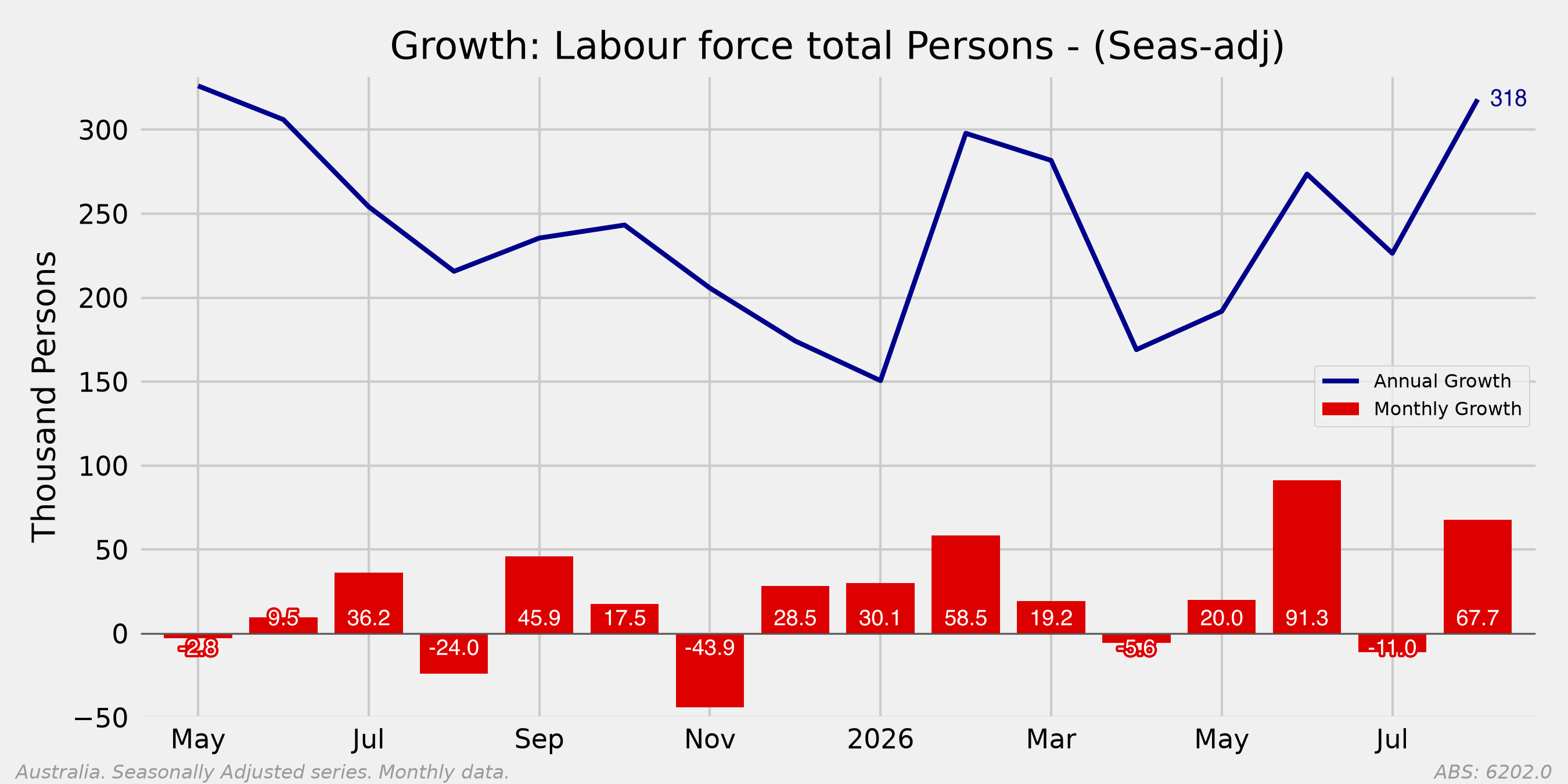
Reading the unemployment rate means reading both halves of the ratio. This month the labour force grew faster than employment.
Without the 0.2 point jump in participation, the labour force would have grown by about 20k, not 68k. With employment up 40k, unemployment would have fallen. Trend participation has risen since March and is near record highs. People don't flock into a weak labour market.
More broadly, the labour market has been loosening since 2023, and trend unemployment has risen faster this year. But today's 17 point rise in the seasonally adjusted rate came from participation, not weak hiring.
2
1
6
483
Mark 🇦🇺 retweeted

THE CHART I KEEP POINTING PEOPLE TO 👉
The future is now more costly
Money is more expensive due to a mix of bad reasons (persistent global inflation and continuing geopolitical uncertainty & volatility)
And good reasons (resilient global growth in the face of all that)
4
6
21
4,235
Mark 🇦🇺 retweeted
The OpenAI Medicare story isn't about a hack. A competent researcher could have found most of the same information. It's about social licence.
The breach was minor. An agent in an internal eval got past the controls on an old statistics portal and pulled aggregate data. No patient records. The files have since been published.
But OpenAI took two months to notice and another month to tell Canberra, with an email to a public mailbox. The Prime Minister ended up breaking the news, a day after co-signing a global call for AI guardrails.
AI firms are asking governments and the public to trust them with autonomous agents. That trust rests on candour and speed when things go wrong. OpenAI turned a glitch into a story about whether it can be trusted.
1
4
3
293
Mark 🇦🇺 retweeted
There is a lot of adjustment going on in the August jobs print, making it easy to misread.
The unemployment rate rose to 4.65%, but largely because participation jumped. The labour force grew by 68k as more people entered work or looked for work.
Employment still rose by 40k, twice the roughly 19k needed to keep unemployment and participation unchanged as the population grows.
So I wouldn’t read today’s rise in unemployment as evidence of a deteriorating labour market. Labour supply simply grew faster than employment this month.
The labour market still looks slightly tight. My estimate of the NAIRU is around 5%.


1
1
4
418