

Ancient History BA🏺250K on YouTube JRE #2368 | #2546 Discussing lost history and civilizational collapse: michaelbutton.substack.com/
WATCH NOW 👉
- Tweets 1,598
- Following 97
- Followers 23,544
- Likes 5,908




Pinned Tweet

Back with the legend @joerogan to talk history & ancient civilizations!
Thanks for having me again Joe, this one was WILD


37
42
988
22,499
Around 850,000 years ago, some of western Europe’s earliest known inhabitants lived inside what is now northern Spain. Their species is called Homo antecessor.
But they also butchered each other.
Human bones from Gran Dolina cave carry stone-tool cuts, fractures from processing and, in earlier finds, even human bite marks.
The bodies appear to have been treated much like the animal carcasses found beside them.
For years, most of the victims identified at the site were children and adolescents.
But new excavations have changed that picture.
In 2026, archaeologists recovered 24 additional human fossils. These increased the known population to at least 13 to 15 individuals, including as many as six adults.
Several adult bones also carry cut marks.
So the cannibalism was not confined to vulnerable children. Members of different ages were being processed and consumed.
The evidence for consumption is strong.
What archaeologists still cannot explain is the motive.
Was this hunger, violence between rival groups, a repeated survival strategy or something more socially complex?
The bones tell us what happened. They cannot yet tell us why.

2
5
70
2,131
Michael Button retweeted
Something huge was just discovered and you probably missed it.
Deep inside a South African cave, archaeologists discovered the remains of an extinct human relative.
They named it Homo naledi.
But now its teeth have revealed something nobody expected.
Researchers extracted ancient proteins from the enamel of 20 different individuals.
Every one of them appears to be female.
The scientists searched for two forms of a protein called amelogenin. AMELX can occur in both sexes. AMELY normally indicates a biological male.
They found plenty of AMELX.
But no AMELY at all.
Even skeletons previously described as probable males now appear female.
But this does not mean Homo naledi had no males.
The cave might contain a deliberately selected group. Males might have been deposited somewhere else. Or this population could have possessed a rare deletion that prevented AMELY from appearing.
However, if the individuals were deliberately placed inside the cave, the result could point towards some form of sex-based treatment of the dead.
All we can say with confidence is that every one of the 20 individuals tested produced no male protein marker.
And nobody yet knows why.
31
21
382
33,633
Michael Button retweeted
More than 20,000 years ago, people walked across what is now White Sands, New Mexico. Their footprints are still there.
But beside some of them, archaeologists found something unexpected.
Long, straight grooves dragged through the mud.
The marks sometimes form a single line. Others appear as two lines that cross or spread into a V-shape. And they repeatedly occur alongside human footprints.
Researchers believe these may be the tracks of travois: simple transport devices made from wooden poles tied together and dragged behind a person.
No wooden frame survived. But when the researchers built replicas and pulled them across mud, they produced remarkably similar patterns.
This would have allowed Ice Age families to move food, firewood, tools or even children across the landscape.
And they were doing it thousands of years before the invention of the wheel.
But this was not necessarily a road or organised transport network. What survives is evidence of individual devices being pulled across soft ground.
We may be looking at some of the earliest transport technology ever discovered.
But what the people were carrying, and where they were taking it, vanished with them.

11
14
353
18,888
Michael Button retweeted
In 1942, a forest ranger high in the Indian Himalayas discovered a frozen lake surrounded by human skeletons.
There were hundreds of them.
At first, British officials reportedly feared they belonged to Japanese soldiers attempting to cross into India during the war.
But the bones were far older.
For decades, the leading theory was that a single group of pilgrims had been caught in a catastrophic hailstorm around 1,200 years ago.
But then scientists examined the victims’ DNA.
The skeletons did not belong to one group. They came from at least 3 genetically distinct populations who died at the lake during separate events, perhaps 1,000 years apart.
Some had South Asian ancestry and died around AD 800.
But another group died around 1800 and had ancestry most closely associated with the eastern Mediterranean, particularly present-day Greece and Crete.
One individual had Southeast Asian-related ancestry.
None of the 38 people examined were close relatives.
So why did groups from completely different parts of the world travel to the same tiny lake, more than 5,000 metres above sea level?
And what kept killing them when they arrived?

48
119
1,480
126,122
Michael Button retweeted

Merkel left office five years ago to huge acclaim. Why? She ripped off Nato, cultivated gas dependency on Putin, cosied up to China and opened the door to a million migrants in 2015 alone. She, not the populist right, was the true extremist of our age
thetimes.com/comment/columni…
385
2,363
12,240
612,706
Michael Button retweeted
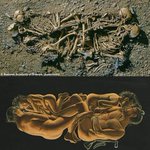
In 2005, archaeologists in Germany found four graves containing 13 people.
They had been buried 4,600 years ago.
But these were not ordinary burials.
Several had suffered violent blows to the head. Flint arrowheads were found among their bones. Most of the dead were children and adults too old to fight.
But DNA revealed something extraordinary inside one grave: a mother, father and their two sons, buried together.
The parents had been placed facing their children. In another grave, one woman appeared to be holding a child.
Someone had attacked this small Stone Age community and almost wiped it out.
Their killers disappeared without leaving a name.

18
90
1,084
109,065
Michael Button retweeted
Humans Were Taking Psychoactive Drugs 25,000 Years Ago
This is more than 20,000 years earlier than previously documented evidence

22
9
219
6,524
Humans Were Taking Psychoactive Drugs 25,000 Years Ago
This is more than 20,000 years earlier than previously documented evidence
22
9
219
6,524
Michael Button retweeted
In 1950, two brothers cutting peat in a Danish bog found a body.
The face was so intact they assumed he had died recently. So did the police, who were looking for a Copenhagen schoolboy who had gone missing.
But then they looked closer.
He wore a sheepskin cap and a belt, and nothing else. Around his neck, a plaited leather rope, pulled tight. He had died around 400 BC.
His last meal was a porridge of barley, flax and weed seeds, eaten 12 to 24 hours before he was hanged.
Then someone closed his eyes and mouth, curled him on his side, and laid him in the bog as if asleep.
Twenty-four centuries later the stubble is still on his chin. We know what he ate, how he died, and that whoever killed him took care with the body afterwards.
We still don't know whether that care was for a criminal, a sacrifice, or a man they loved.

13
10
241
13,063
Michael Button retweeted
In 1952, peat cutters in Denmark uncovered a body in a bog.
The locals knew who it was. Red Christian, a peat cutter who had wandered off drunk one night in 1887 and never came home.
But then the museum ran a radiocarbon test. He had died around 290 BC.
His throat had been cut from ear to ear. His last meal was a porridge of more than 60 plant species, with tiny traces of ergot, a fungus that causes convulsions and hallucinations.
His hands showed no sign of manual labour. He was not a peat cutter.
Someone fed him, killed him and laid him in the bog.
Sacrifice, execution, or something we no longer have a word for? We cannot read his death.

155
225
7,039
908,580