


You talking like only one state has startups 😅
Yes, one of the leading for sure but not the only one. Even ~90% startups are getting formed outside it.
Do you have any data to support your vague argument? Just curious.
And what is this 'own state'... are you living in some other country?... when the laws allows the free movement within the country for any work or to set up businesses.

1
2
31
Goa's current real estate cycle should be a case study in how a market once relentlessly pitched and sold on "scarcity" can eventually end up making headlines for "price correction".
Interestingly, they are now saying second-home sales and enquiries have fallen, that's why.
BUT the truth is, 2nd home demand was never anywhere close to how it was projected (10x inflated) to investors.
Moreover, they were given the false projections of continuous great AirBnB returns (without much efforts) or otherwise second home buyer will be waiting on its door to give them an exit.
Forget about AirBnB returns, most are facing high vacancy issues, and even finding it hard to find 2nd or any XYZ home buyer.
Truth is, they weren't there before, so they aren't there now. It was all created in meta world by 'reel estate' experts.
Also, Goa doesn't have big base of end user buyers who can absorb this much excess inventory, that too anywhere in the name of Goa and at any vague pricing.
Basically, all this frenzy was created by overexcited local builders from Delhi, Mumbai etc during the cycle by showing 2-3x land price increases while trapping numerous investors, only to justify highly overvalued properties through hollow narratives.
Also for those who keep saying property prices only stagnate can now see how "price correction" has started making into the headlines... and that too in once "scarce" market...😅
But, importantly, correction % being reported right now may be nothing compared to what actual is there or could still come.
Of course, the reason they are telling you about the correction is... ab toh le lo... buy the dip!😄
And it's not just Goa's story.
Have seen the same "reel estate" experts pitching the similar stories to sell Mumbai, Gurgaon, Dubai, Dholera etc etc... but have stopped even talking about Goa like they never pitched this story.
Now, imagine the realty check their investors are in for...


News of “oversupply” in Goa’s real estate is now making headlines.
But if it’s reached the news cycle already, just imagine the actual oversupply on the ground.
Is Goa’s decline in tourism (as several reports suggest) the main reason?
Or
Is it the continuous supply of overpriced villas, dragging down both rental occupancies and yields?
Whatever the trigger, the reality is that the high-rental yield and infinite-capital-appreciation narrative that lured investors post pandemic, from all around the country, mostly from North, has been hit hard.
Many investors are now looking for urgent exits, only adding to the glut in the resale market.
That’s why the selling playbook is shifting:
From pitching “high Airbnb or rental yields” to marketing Goa as a second home or even primary home destination, hoping to attract some buyers and give existing investors a way out.
However, it will be interesting to see how this new playbook plays out.
What’s your take?

6
18
2,968
See how Trump’s childhood home, fully renovated on a ~533 sq yd plot in one of the affluent neighbourhoods of New York City, sold for just ~ ₹18.5cr, which includes whatever history/prestige premium comes with the Trump connection.
Meanwhile, a 360 sqyd villa in gated Emaar Palm Springs, Gurgaon is asking around ₹30 Cr, ~1.5x the price for a plot that is 32% smaller! And even a 500 sq yd kothi in DLF-1, Gurgaon can cost more now. And much lesser than Mumbai's match box apartments in a tower surrounded by slums.
And no, this isn't some comparison with rural America. This is New York City itself.
Clean air and surroundings, adjacent to a 358-acre Cunningham Park, ~15-20 minutes from JFK Airport, and walkable access to public transport to multiple employment hubs, and most importantly, unmatched overall 1st world quality of life indicators, where there is no "inside the gate vs outside" contrast.
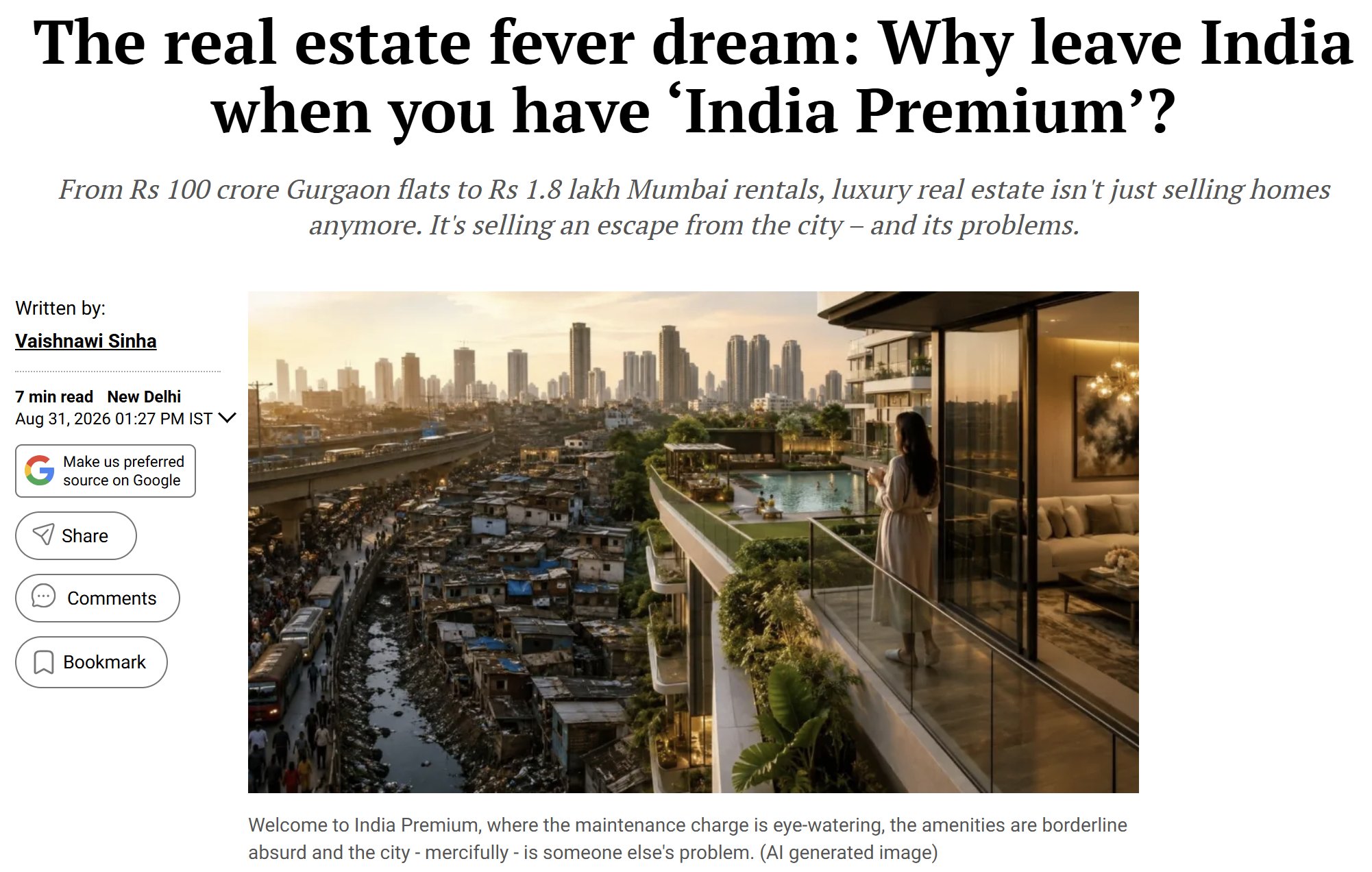
So again, for those who can afford to move, why pay a huge premium to live inside a bubble here, only to step outside the gate and keep breathing toxic air while dealing with urban apathy?
At some point, the "India Premium" starts looking less like a premium and more like a "TAX" on staying.

Because if the "India Premium" has become so high that housing prices here can match or even surpass several 1st world locations, but the moment you step outside the gate you still face 3rd-world livability, for e.g. still breathing toxic air in 100+ cr flat so-called ultra-luxury flat!
Then for those who can afford to leave, why not leave India altogether?
They could potentially spend less to not have to pay a fortune to build a private bubble around themselves, and importantly live a genuinely "luxury" life.
So, this is where the India Premium has started looking more absurd than ever.
6
6
31
2,873
Because if the "India Premium" has become so high that housing prices here can match or even surpass several 1st world locations, but the moment you step outside the gate you still face 3rd-world livability, for e.g. still breathing toxic air in 100+ cr flat so-called ultra-luxury flat!
Then for those who can afford to leave, why not leave India altogether?
They could potentially spend less to not have to pay a fortune to build a private bubble around themselves, and importantly live a genuinely "luxury" life.
So, this is where the India Premium has started looking more absurd than ever.
Don't know if Indian cities will start improving drastically tomorrow, but this is the sad reality of living in today's India...
1st WORLD HOUSING PRICES WITH 3rd WORLD LIVABILITY INDICATORS.
1
1
9
5,239
When 27.6 lakh homebuyers are stuck in RERA-registered projects, is there really any question left about whether the regulator is doing its job?
But weren't we assured by builders and their brokers... "Saar, don't worry. Nothing can go wrong. And if sth does… RERA hai na..."
Now where is RERA?
Yet all we get to hear are the glorious stories around projects being "sold out"... BUT what happens after that? Hardly anyone gets to know unless citizen groups manage to find a voice.
Just go back into the recent past, you will find how the token of "RERA registered project" has been misused as a "sales & marketing tool" by builders and brokers to sell God knows how much garbage!
And these 27.6 lakh delayed-home numbers are just the tip of the iceberg. Once you start looking beyond delay complaints, you'll find another lakhs of issues around poor construction quality, maintenance, handover, builder control and power abuse, endless litigation and what not.
The deeper you dig, the more the entire under-construction real estate ecosystem starts looking like another hell hole in this country.
So what's the use of simply continuing to grant building licenses to crooks when there is no system capable of fixing accountability and delivering speedy justice and moreover?
Only to keep trapping more and more people by exploiting their emotions in the name of home?
If not, then why not simply make a rule to sell 100% completed projects?
At least then buyers would have far more certainty about delivery, and could actually assess the construction quality, surroundings, common areas, amenities, maintenance arrangements and the overall post-handover reality before blocking a huge chunk of their wealth.


etvbharat.com/amp/en/busines…
@PropertyDecoder @VishalBhargava5 @GauravGupta_RE
Honest Tax Paying Middle Class Dream Shattered by Builders and Bureaucracy
5
11
1,580

It's because NDMC is quite proactive about such civic lapses in Delhi's Lutyens' Zone, whereas most other municipal bodies across India seem to have no soul left.

1
11
850
In India, homebuyers don't just have to fight to get the home they paid for, but also to prove that they are not liable for the builder's defaults / sins 😅
Same happened with one of my school friends, now settled in the US, bought a flat in one of such under-construction projects in Noida ~13 years ago, from a builder once touted as one of the best there.
He put a significant part of his accumulated wealth from his early working years into it, thinking that maybe one day, if he came back to India, he might live there.
13 years later, he kept paying EMIs but the project kept getting delayed and eventually got completely stalled. Yet he continued receiving one demand notice after another.
Ghar toh aaj tak nahi mila...
But what made this experience truly horrendous wasn't just the delayed home BUT the delayed justice.
He never thought he would have to spend years fighting not just to get the home he had already paid for, but funnily also to prove that homebuyers wasn't at fault, despite having done everything expected of a homebuyer.
Going through this experience made him feel guilty every single day for years. Eventually, he decided he would never come back to live in the same country where you not only have to fight for decades to get the home you paid for, but also have to prove that you weren't responsible for builder's failure.

4
2
17
1,540
You actually don't understand the core issue here. It’s not about whether additional parking or green area is good for the residents on that road strip or not. It’s about "misrepresentation" at the time of sale and what they actually received at the time of delivery. That's why the homebuyers have been fighting the case against the builder.
First, they were shown two 24-metre through roads in the brochure. One is still unconstructed, while the other one, which seems to provide access, is said to have a part of the road constructed on pvt land, taken on lease, rather than being permanently acquired.
Therefore, homebuyers argued that if the lease ended or the landowners withdrew access, the project could potentially become landlocked.
And secondly, yes, as per this stupid policy, builders were supposed to build the 24-metre road within their own project land, have been exploiting this loophole. But shouldn't they have marked only that proportion of the road which they were actually delivering within their own land, and shown the rest as "conditional/ under other jurisdiction"? At least that would have been fair to homebuyers paying crores for probably a landlocked, not just a gated, locality.
Moreover, the road is only one major issue. Read the buyers' arguments in court about how they have been living without municipal water, electricity and promised amenities despite paying charges for years.
And please don't come up with some other vague logic like... agar buyers ko thoda time bina bijli-paani ke rehna bhi pad gaya toh kya ho gaya?... they get the taste of enjoying a more "self-sufficient" lifestyle while paying crores for a supposedly premium project 😂
So the point is simple... if sth was shown/promised at the time of sale, buyers have every right to question why it wasn't delivered as represented?
And if the argument is that govt. need to build the full road stretch as shown and connect it to the 24-metre stretch already built inside the project, then fine... show that as a future/conditional possibility, not as something that already exists or is assured.
Because buyers weren't paying crores for a rendering of what might exist someday BUT based on what was represented to them at the time of sale.

1
28
And that's why even the SC has dismissed project brochures as "mere marketing" material, and instead considered them as actual promises.
So, good to see SC pulling up builders for not delivering what was shown/mentioned in their brochures and setting up a precedent to follow.
But what about those who market them - their realtors, full on organised marketing machinery, who many times go even beyond the brochures to market projects with false claims/promises, that too with extraordinary fake confidence?
Once I caught a "realtor" on X claiming some road would come up from one area to another, where he might have been selling some project. But then I countered him with the fact that there was actually no such road notified in the official govt. master plan... 😂
Ya, then he blocked me. But now the same smart fellow has become an "expert" giving real estate advice on under-construction projects. Just imagine how he might have misguided many, either out of his poor knowledge or deliberately, and still continuing.
And he is not the only one, but just one of a case that came up openly. Because mostly such false claims are propagated under the radar through their call centres... peddling numerous such misleading claims and promises as facts, to influence and trap as many buyers as possible, just to earn hefty commissions.
Actually, this industry is filled with such builders' salesmen disguised as real estate experts, who market "false/lies/misleading things" much more than builders' brochures.
So, until accountability goes beyond the marketing brochures and reaches the huge "marketing machinery" - those who are actually marketing and selling these projects... more and more people will continue to get trapped.

When this is the condition of one of country’s top builders…
...now you can imagine how most industry players play the game with homebuyers in India, in what they promise while launching their new projects and when they actually deliver them.
They show you all the best things in the brochures and sell you the dream.
And we keep hearing brokers and builder fanboys saying... "top builder can do this, top builders can do that for homebuyers or their investors..."
Yes.
Until the project is sold.
But what after that…?

8
829
When this is the condition of one of country’s top builders…
...now you can imagine how most industry players play the game with homebuyers in India, in what they promise while launching their new projects and when they actually deliver them.
They show you all the best things in the brochures and sell you the dream.
And we keep hearing brokers and builder fanboys saying... "top builder can do this, top builders can do that for homebuyers or their investors..."
Yes.
Until the project is sold.
But what after that…?
2
3
16
1,941
Most know that GCCs have been leading India's office leasing sector for quite some time now, BUT the more interesting shift is what is driving that GCC demand, and it is no longer IT/Tech.
BFSI GCC leasing has jumped sharply ⏫70% YoY, reaching 7.32 million sq ft in H1 2026 and accounting for 36% of total GCC leasing, making it the largest segment.
At the same time, IT/ITeS GCC leasing has declined 📉28% YoY, around 20% share. Manufacturing-led GCC leasing, meanwhile, is already broadly in the same range.
This shift seems to be quite big, when back in 2022, BFSI accounted for just ~7% of GCC leasing, while the IT/Tech sector was at 44%, and now being reduced to 15-20% in recent quarters.
So while overall GCC demand itself remains strong, the share of its traditional major occupier, IT/Tech., is clearly reducing.
Is the impact of AI already beginning to show up in this data, with companies recalibrating their requirements and tech. being affected the most?
Maybe not directly. But it is difficult to ignore that the sector historically associated with the largest tech-driven employment is now seeing much slower office expansion, while BFSI and other non-tech sectors are scaling rapidly.
Perhaps the next phase of India's GCC story is less about "IT jobs coming to India" and more about global companies moving more diversified functions to India.
And that could have a very different impact on India's housing sector and urban-growth story around these GCC hubs.

9
875
Max Estates' acquisition of ~85 acres in Najafgarh is probably one of the most notable (probably the biggest) residential land acquisitions Delhi has seen in recent decades.
And interestingly, at a land cost that is a fraction of what similar parcels would command elsewhere in Delhi, and even in most parts of NCR.
Maybe that's precisely why they went for it.
But here lies a BIG challenge of perception of the area, coz Najafgarh has long been seen as the rural edge of Delhi, which gradually became semi-urban, more through villages and unauthorized colonies, while more or less retaining the same social character.
Don't know how builder and their brokers will break the perception around it.
Will they start naming it "New Dwarka" or sth similar, or will they simply keep banking on its brand name and heavy marketing on its proximity (30-40 mins) to the Aerocity office hub and Delhi Airport?
That's how some builders have tried to change the positioning and character of rural/peripheral areas after buying cheapest land available in peripherel areas, like what DLF did with Gurgaon once.
So, is "Najafgarh" going to be the "Next Gurgaon" of Delhi?
Like the kind of positioning we see builders and brokers doing for places like Kharkhoda, Naugaon etc as next Gurgaon to sell projects there?
Will be interesting to see.

5
1
36
4,083
And there are still people saying... it happens only once or twice a year...
But they don't understand that for those who actually have to deal with it, even 1-2 such incidents can feel like a trauma.
Moreover it doesn't end here... pollution season is just a few months away, and it will lock us and our kids indoors again.
And when these incidents keep recurring and nothing much changes, one question keeps coming to mind...
Is this really growth, if the overall basic quality of life isn't actually growing with it?
Also, when you decide to leave a city, where do you even go in this country?
Because almost every major city is grappling with one or the other livability issue.
Unfortunately, you escape one problem, only to find another waiting in the next city.


‘Gurgaon not worth living in’: A man’s rain ordeal to bring daughter home
indianexpress.com/article/ci…
1
24
2,550
To hell with those who keep saying... this is our Dubai, Singapore or New York in the making!

Today, again, just 1-1.5 hours of rain has crippled the whole of Gurgaon.
Yes, nothing new... many roads get flooded. But what's worse is seeing the panic in school groups when buses don't reach on time, while many kids take 4+ hours to reach home through flooded roads.
Even parents who decided to pick up their own kids have to literally walk through flooded streets outside some of the city's most prestigious schools.
Jo log kehte hain na... gated society ke andar rehne se bahar kya hota hai, itna farak padta hain... ek baar ye sab bhi dekh lo...
Despite earning well, sending kids to expensive schools and buying homes worth crores, overall quality of life just refuses to move forward.
People living in some of Gurgaon's most luxurious localities are actually losing hope and feeling that the city is actually collapsing.
Because real life exists beyond drone videos and luxury clubhouses... they are nothing more than a distraction until the on-ground infra gets fixed, which we all have to first pass through to reach those luxurious homes.
And yes, none of this is new, but year after year, things haven't improved much... have actually gotten worse. Just look at the street outside the same school, where flooding have become even more severe in recent years with no permanent solution in sight by the PE funded school or our esteemed authorities.
So maybe it's time to ask for at least minimum livable infra before trying to justify crores of property value through random, useless narratives as a growth cope.
Because it's honestly beyond understanding how even 1-2 crore homes in a city can be justified when the infra outside is barely functioning at a 5th-class level?


6
24
1,627
Today, again, just 1-1.5 hours of rain has crippled the whole of Gurgaon.
Yes, nothing new... many roads get flooded. But what's worse is seeing the panic in school groups when buses don't reach on time, while many kids take 4+ hours to reach home through flooded roads.
Even parents who decided to pick up their own kids have to literally walk through flooded streets outside some of the city's most prestigious schools.
Jo log kehte hain na... gated society ke andar rehne se bahar kya hota hai, itna farak padta hain... ek baar ye sab bhi dekh lo...
Despite earning well, sending kids to expensive schools and buying homes worth crores, overall quality of life just refuses to move forward.
People living in some of Gurgaon's most luxurious localities are actually losing hope and feeling that the city is actually collapsing.
Because real life exists beyond drone videos and luxury clubhouses... they are nothing more than a distraction until the on-ground infra gets fixed, which we all have to first pass through to reach those luxurious homes.
And yes, none of this is new, but year after year, things haven't improved much... have actually gotten worse. Just look at the street outside the same school, where flooding have become even more severe in recent years with no permanent solution in sight by the PE funded school or our esteemed authorities.
So maybe it's time to ask for at least minimum livable infra before trying to justify crores of property value through random, useless narratives as a growth cope.
Because it's honestly beyond understanding how even 1-2 crore homes in a city can be justified when the infra outside is barely functioning at a 5th-class level?
9
8
40
6,747
One new "Luxury Sapno Ki Soceity" is going to be launched soon, and funny thing is that it's being promoted by brokers as a sequel (season-2) of a successful season-1 of a series, when actually most things are not even anywhere near the original one.
Entry from a 90-metre road vs 30-metre...
Golf Course view vs Chakarpur view...
One is part of a serene, peaceful, green ecosystem vs being part of one of the most noisy/congested/ concrete ecosystems in the city...
And there are lots of other things that actually make this kind positioning into a mockery.
Maybe new "Luxury Sapno Ki Society" can work/sell on its own because of its own attributes. But don't fake it to make it look like Season 1 of a entirely different series, which many times actually becomes the reason for major disappointment once the hype fades.
But haan, kuch log naach-gaana karke isey bhi justify karenge... ultra-luxury clubhouse/ lobbies/ ka churan bechte hue... 😂
Because maybe they are trying to whatever margin benefit they can extract from the positioning built around original series success.
Or possibly, it could also be that they're overstating things now so that they can serve you a "discount" at launch.
Either way, do evaluate whether "Luxury Sapno Ki Society-2" actually has what it takes to justify the positioning of a original-1, rather than believing any assumption- full of hollow narratives.

5
2
18
3,194
Yes, because in the absence of any proper pedestrianisation policy along conversion of residential streets into mixed-use, parking issues and congestion actually make the upper residential floors lose their living charm - so the value, while the ground floor becomes disproportionately valuable, sometimes approaching ~50% value of the entire building, (depending on the location).
That's why I said there is a need for a pedestrianisation policy to convert these streets into public places also, so commercialisation of the lower floors can actually work positively for housing demand, rather than killing the residential value above, like what has been happening in several European cities.
Like Amsterdam is full of streets with mixed-use living, and even some studies found that people are willing to pay a premium to live in diverse mixed-use neighbourhoods.
Moreover the city has been exploring the policy to convert thousands of upper floors in commercial buildings into housing to fulfil the housing demand.
So somehow it also proves there is less issue with mixed-use policy but more about how it's implemented on the ground to make it work positively for both commercial as well as for residential use.


Allowing commercial activities on ground floor comes with the persistent problem of parking.
Commercial establishments open and customers come in and park their vehicles. Suddenly, the driving space on the road reduces. There needs to be a solution to this problem while allowing commercial activities.
2
6
917
Don't know how much we should get excited about Delhi's new Master Plan 2047, considering the track record of implementation of previous Delhi Master Plans.
But one thing that can directly impact plot/ground floor owners today is the provision allowing mixed land use on Ground floor along 30+ meter roads, depending on the location.
That can potentially change the valuation and capitalisation proposition of such plots almost overnight.
I still remember when some residential streets were notified for mixed use and commercial activity almost 2 decades ago. The valuation of those streets changed almost overnight, creating significant wealth for many property owners.
Yes, it also changed the character of large parts of Delhi, something many urban planners have criticised because of increased congestion and pressure on already saturated utilities.
Don't know what's absolutely right or wrong here, but mixed-use feels like a natural progression of how humans want to live. Some of the world's best high streets have evolved around mixed-use environments only.
The difference is that they prioritised pedestranisation along such streets like walking, cycling and connect through non-motorised transport, while we largely forgot that part.
If Delhi can get that balance right like mixed use + better pedestrianisation + public transport + adequate infra, I think even urban planners might have less to complain about.
And Delhi's people might actually love walking and living on these streets too.

4
1
17
1,997
One of the most questionable forms of discrimination in some housing societies is blanket discrimination between tenants and owners, especially when both are already paying the same maintenance charges.
Now some Noida societies are reportedly imposing additional fees specifically on tenants, with the justification that tenants allegedly use or abuse common amenities more than owners.
But how is that actually established?
If a particular tenant damages or excessively abuses a common facility, why should every tenant be penalised for it?
And if a few owners are found guilty of the same behaviour, would we start charging every owner extra as well?
So why not just charge the person responsible, not the entire occupant category they belong to?
Normal wear and tear of common amenities is already part of society maintenance. But if anyone, tenant or owner, causes damage or unusually heavy misuse beyond normal wear and tear, they should be identified and made to pay for the repair or replacement.
Otherwise, this isn't really about protecting common amenities.
It is simply collective punishment based on whether someone owns the home or rents it.

1
11
2,126
Imagine... almost half the money homebuyers paid to the builder diverted for building builder’s own assets, instead of building homes, for which they get paid for.
Ya, that was the last upcycle, when social media was still nascent, but organised broker networks and "real estate experts" on news/radio channels were heavily invested in making builders’/brokers' claims look legitimate... many of whom project as saints today.
Aur inki pitch kuch aisi hoti thi...
"This builder has launched several big projects... all selling like hotcakes... nothing can happen to this builder.... has such big land parcels in great locations... heading different real estate associations... and finally silently projecting them as...
BIG builder = God. Sir!"
But then what happened?
Several projects (5 lakh+ housing units) got stalled, and ONLY Rs. 400 crore was provisionally attached for recovery against 32,000+ crores despite regulations in place for last 9 yrs, while lakhs of homebuyers are still running from one court to another for their homes for last 15+ years.
Kahan gaye BIG land parcels/projects wale BIG builders?
Even today, the same narrative still sells...
"Builder ke paas ye hai, woh hai... huge land bank, investing thousands of crores, big developer..."
But ask the basic question...
If the builder is so BIG, with so much land and resources, why is it raising money from you to build your home in the first place?
And whenever you see headlines saying "Builder invests ₹X,000 crore in a project", remember....
Most of the time, it isn't the builder’s own money being invested BUT homebuyers’ money being put into the project.
And if the builder is primarily raising money from you to build your home, then economically, it is not very different from being a 'construction contractor'.
And you know how small % of contractors might be actually reliable when it comes to claims, accountability and delivery in our country.
So, always do your own due diligence before choosing the contractor to build your home.
And always be cautious of recommendations from those who earn commissions for convincing you to award that 'contractor' the contract.

4
2
25
2,084
Don’t know if many know this, but some brokers often claim that builder do some form of buyer profiling, especially for their "lias" projects, before any new sale or resale.
Don’t know how much truth there is to that.
But at the same time we often hear "lias" marketing pitch, starting with the names of 2-4 startup founders like just imagine who your neighbours could be, or who you could have drinks with at the club... to the extremes... even one can raise funding while meeting in the lift or gym... and all the usual blah blah.
But what about the many unknowns?
They don’t come out until another incident makes headlines from the same ultra-luxury ecosystem.
And at the same time, they are revealing a very dark side of it.
Every time I see such news, it actually reminds me of a conversation I once had with a resident of one of ultra-luxury lias condominiums.
I asked him how the living experience was, and this was his response...
“You don’t know how many people living here have very dark behaviour. New money has attracted all kinds of aspirational billionaires. There’s been a huge influx of big builders, brokers, also who turned into new builders, new money, people close to power circles, and people involved in all sorts of things you wouldn’t want to be associated with. Things have changed a lot in recent years. I’ve stopped going to the in-house social events completely because of this…”
Don’t know what kind of profiling this is, or maybe how much of it can actually be done?
Because don’t forget... when something becomes highly cult-like and status-driven, it can attract every kind of person chasing that status, especially when it is close to a power centre.
Maybe that’s why many say when huge wealth meets power, you can have almost anything.
And perhaps they’re right, there’s no place quite like India for that combo.
Well… maybe the "lias" are a pretty good microcosm of it.

4
8
2,276
“High demand".... “Rare".....
And then, in the same post.... “Negotiable".... “Special discounted rate".... "Immediate sale"....
Kuch samajh aaya? 😏
And I must tell you that brokers-builders/investors were quoting as high as 15k/sqft here till few months ago and justifying it while dancing on reels... and even few transactions happened around 14k/sqft also.
But now... the similar units are available below 11k/sqft... and that too, around possession.
But were we not told that prices go 2x as soon as possession approaches?
We were also told that real estate prices may stagnate, but they don't fall...?
And were also told that atleast prices of best/scarce units within the project like park facing ones can't go down... even when whole market goes down...?
Then why prices are coming down?
Why same narratives have stopped working now?
Dear Reel Estate experts, care to explain? 🤔

4
26
8,170
While Noida and Gurugram were topping the property appreciation charts... Bengaluru, Hyderabad and Pune were topping the GCC leasing growth charts in last 6-7 years.
Interesting, isn't it?

Hyderabad, Bengaluru and Pune keep making headlines for one GCC after another choosing to set up or expand there.
Meanwhile, Delhi NCR seems to make headlines mostly for yet another ultra-luxury or branded residential launch.
Maybe that's because Delhi NCR needs more ultra-luxury homes than those jobs... which, in any case, probably can't afford to buy these projects ;)
8
3
20
7,721
From rushing to declare every project "Sold Out" to now "Not for Sale" to "By Invitation Only"...
...is this the evolution of marketing strategy or a reflection of market sentiment?

12
31
3,058
Branded residency project... backed by an global brand... and still couldn't sell?
So, is the reality of the luxury housing market finally coming out?
Or are these news reports are peddling negative news only?
Because weren't we constantly being told by realtors....
"luxury homes were flying off the shelves? All sold out...
their buyer segment never slows down? Infinite money supply...
luxury housing is the only segment performing well? grand clubhouse... branded interiors... premiumisation...
luxury housing cycle is different? Has another 2-3 years to run because there is very limited or "no supply"? Big alpha making opportunity sir...
We were also told that... branded residences iconic projects elevate a city's image....
But what will happen now? Why these narratives are not working?
But yes, they can still do one thing to again run their show.
Since they've spent years selling this narrative, they could all come together and buy 1 or 2 units each in this project to declare it sold out.
That way, they can protect not just the city's image, but their own credibility as well😉

If every hotel chain or fashion brand starts lending its name to builders, and every other project is marketed as a "branded residence", doesn't that also suggest the concept may have already peaked?
Perhaps developers have found it to be an effective strategy to position projects as ultra-luxury and command a much higher premium.
And at the same time, hospitality and luxury consumer brands get a lucrative business opportunity through facility management, often to be able to charge maintenance charges at 3-4x of normal residential projects.
The bigger question is... will 'all' these branded residences be able to justify both the hefty upfront price premium and the significantly higher recurring maintenance costs over the long term?
Only time will tell.

5
3
25
6,151
View from another angle.
Sometimes I wonder whether "luxury living" has gradually been reduced to a project or just what's inside it... brand, its clubhouse, amenities, or interiors.
Has it become completely disconnected from everything outside the boundary wall?
Is that the new definition of "luxury living"?
Like if someone tries to sell you a home with expensive interiors but in a crumbling locality, and ask for a massive premium while calling it the benchmark of luxury living, does that alone justify any valuation?

Elevated road may still be manageable.
But imagine discovering after buying that from your house (in some towers), you'll be looking at a waste dumping site, every morning while sipping your tea or coffee in your balconies.
And this is after paying around 10-12 crore (launch price + 3-5 crore premium being asked).
Because the surprising part is that when the project was launched, this mini landfill site was reportedly concealed behind blue sheets. Neither the authorities, nor the builder's marketing, nor even the countless realtor drone videos showed you.
But why?
How long will people keep justifying every premium by repeating the builder's brand name?
And if a view of the Aravallis 2.5-3 km away is used to justify a premium, even though it may barely be visible for 3-4 months each year due to air pollution, then shouldn't a clearly visible dumping ground (at few 100 meters) also be part of the discussion around how much premium these units can lose or may even challenge the launch price itself, if not removed?
So, if investors truly want to protect the long-term value of their investment, they should collectively push for the dumping site to be removed or relocated, especially where it is directly visible from affected towers.
Because ultimately, it is buyers who have to live with the consequences for years, not the builders, authorities, or realtors who market, sell, and move on.
Buying a home worth 10+ crore luxury home shouldn't come with unpleasant surprises that were never part of the sales pitch.

4
6
22
7,355
Elevated road may still be manageable.
But imagine discovering after buying that from your house (in some towers), you'll be looking at a waste dumping site, every morning while sipping your tea or coffee in your balconies.
And this is after paying around 10-12 crore (launch price + 3-5 crore premium being asked).
Because the surprising part is that when the project was launched, this mini landfill site was reportedly concealed behind blue sheets. Neither the authorities, nor the builder's marketing, nor even the countless realtor drone videos showed you.
But why?
How long will people keep justifying every premium by repeating the builder's brand name?
And if a view of the Aravallis 2.5-3 km away is used to justify a premium, even though it may barely be visible for 3-4 months each year due to air pollution, then shouldn't a clearly visible dumping ground (at few 100 meters) also be part of the discussion around how much premium these units can lose or may even challenge the launch price itself, if not removed?
So, if investors truly want to protect the long-term value of their investment, they should collectively push for the dumping site to be removed or relocated, especially where it is directly visible from affected towers.
Because ultimately, it is buyers who have to live with the consequences for years, not the builders, authorities, or realtors who market, sell, and move on.
Buying a home worth 10+ crore luxury home shouldn't come with unpleasant surprises that were never part of the sales pitch.

There is an approved project of an elevated road that is likely to pass in front of this prestigious.project. Pls study that fully before you deep dive
NHAI Plans Rs 5000 Cr Elevated Corridor To Ease Delhi Gurugram Highway Congestion - PT Pulse | Projects Today share.google/KID5HIKRRwdzs4h…
I think as a responsible institution NBCC should have disclosed this but they did not
5
7
32
21,919
Her observation is very much in line with the ground reality of Gurugram.
Just move a few hundred meters inside the much-celebrated Golf Course Road, and the contrast becomes hard to ignore.
Yesterday, while passing through Sector 56 market, saw cattle wandering around the shops, their front with stinking sewerage wetland, and dust blowing around everywhere.
It made me stop, take this picture to record how despite being hyped so much in selling most costliest luxury housing, most of Gurugram is still stuck in Gur'gaon'.


It's year 2 of me living in Gurgaon, the so-called global city and here are a few observations. Trash is everywhere. On the streets, in front of homes, metro stations, malls. There are more thekas( shops selling alcohol) than pharmacies, and medicine shops. The closest pharmacy
3
8
54
7,923
Read about this case and know how some builders can effectively escape accountability simply by obtaining the OC through sweets exchange and handing over the keys to homebuyers, even when essential infra remains incomplete.
In many cases, it's not just clubhouses or lifestyle amenities that are delayed. Even basic utilities such as water supply, power connection, backup etc remains incomplete, leaving residents to struggle for years.
But how is this possible?
Because builders know how to exploit loopholes in the rules and the system. Dragging residents through years of follow-up and litigation can become far cheaper than delivering everything they originally promised.
This is precisely why stronger safeguards are needed. Like good part of builder's receivables should remain withheld until all promised infra, amenities, and common facilities are completed to the required quality standards and independently verified.
If the builder fails to deliver within the stipulated timeline, the Homebuyers' Association should have the legal right to terminate the builder's role, use the withheld funds to complete the remaining work, and recover any additional costs from the builder.
Because until the cost of non-compliance becomes higher than the cost of compliance, accountability in the real estate sector will remain the exception rather than the rule.

How about linking atleast 25% of a homebuyer's payments to the actual quality of construction, instead of merely the project's construction progress till OC?
Final instalments should be released only after the project has been delivered and its construction quality has been independently certified by a reputed third-party testing agency, not merely because an Occupancy Certificate (OC) has been issued by the authorities.
Because we tend to see a lot that builders even after receiving OC, delivers project with sub-par finishing quality, opposite of what was shown in 3D renders.
If builders are truly confident about the quality of what they deliver, they shouldn't have any objection to such a system.
Govt. should do this. No?
2
7
1,161
Everyone in our country knows that builders are rarely held accountable, whether for failing to deliver projects or for delivering poorly constructed, unlivable housing developments.
Yet there are still some who keep defending and glorifying builders... sab inko de do ye manage karenge country...
But when they can't even build the 'livable' homes they have taken advance money for, how can they be trusted to manage everything else?


"Someone Could Have Been Killed": Noida Ceiling Collapse Triggers Outrage Online
ndtv.com/noida-news/someone-…

3
13
1,535
But the sheer audacity of the same builder - Chintels, whose project was declared unsafe and ordered for demolition after a structural collapse killed 2 residents in their sleep, is simply hard to comprehend.
Because they are now advertising “luxury” 3 BHK apartments in another project for 3.5cr!
Meanwhile, buyers stuck in the unsafe project are being offered compensation is even lesser than half of the market value they are asking for their another "luxury" project in the same sector.
And the promoters are still free.
Laws exist. Orders get passed. But justice can take years, sometimes decades.
And this is where even spending crores on a home seems to offer you little protection.
If something goes terribly wrong, your home, your money, your safety and years of your life can all get trapped in an endless legal battle.
Sometimes, it feels like even crores of rupees have no value here. Once something goes wrong, the entire system turns your tragedy into a joke.


There is a simple truth you need to know about the entirety of Dwarka Expressway.
And it has to do with water. Plain, simple, untreated water withdrawn from the ground, mixed with sand, cement, and aggregate to form concrete.
The water available all along the Dwarka Expressway has very high fluoride content. When this water is used to make concrete, it doesn't cure and set well. Year after year, you will hear of more and more projects all along the Dwarka Expressway having such kinds of structural issues as life goes on.
Chintils Paradiso, an entire multi-tower project, has been written off, and lawsuits are going on between residents and the builder, even in the Supreme Court.
And you know what the Supreme Court has told them? The residents and the builder need to work it out between themselves.
The builder's solution to residents is to vacate your house (now forcibly vacated due to orders by the GMDA or MCG), take some minor rent from me and pay me more money when I build the new towers at today's price.
I have talked about the importance of introducing class action and tort laws in India.
Because in India, your risk is not only that the builder will not deliver. Your real risk is that they will deliver something which may not stand the test of time, even across a decade.
Dwarka Expressway is the country's largest example of engineers not following basic material science and delivering something which is not substandard by design, but by its very existence.
4
1
15
2,563
India's retail leasing continues to defy the rise of e-commerce and quick commerce, with another strong quarter.
Perhaps because online and offline are no longer competing the way we once assumed.
Data suggests that online-first brands are increasingly turning offline, omnichannel way, for their next phase of growth.
As per CBRE data, D2C brands accounted for ~27% of retail leasing in 2025, up from 18% in H1 2025 and just 8% in H1 2024.
Meanwhile, quick commerce may be hurting neighbourhood convenience retail markets far more than destination and experience-led retail, adding further pressure on weaker retail locations already struggling to attract footfall.
But overall, online-commerce has not killed physical retail, only changing its character.
Because many of the online brands that were once expected to disrupt physical retail are now becoming some of its biggest growth drivers.

2
8
1,100
EIU Global Liveability 2026 Ranking of India's Major Cities:
Delhi - 120
Mumbai - 121
Chennai - 123
Bengaluru - 127
Out of 173 cities globally.
All four firmly in the lower half of the global liveability rankings.
Yet, we see the same cities increasingly feature among some of the world's most expensive housing markets, while becoming more unaffordable over time.
And what gets even more funny is when some people start justifying this irony by saying...
"Housing prices here are still half, or even one-third, of those in New York, London or Singapore. So there is still plenty of room to rise."
But what many don't realise is that housing prices in India's major cities are already touching, and in some cases competing with or even surpassing, parts of these global cities and their suburbs, which rank among the most liveable globally.
But have they ever checked whether liveability has improved anywhere close to the pace at which housing prices have risen to now compete at global levels?
Many of the world's most expensive cities at least continue to rank among the world's most liveable, backed by superior public transport, healthcare, civic infra, urban environment and basic public services.
So perhaps the real comparison shouldn't just be housing prices per sq. ft. vs New York, London or Singapore.
It should also be in terms of what quality of life you are actually getting for the housing cost per sq. ft.
That's where the price vs liveability disconnect becomes hard to ignore.
And if we are benchmarking our housing prices globally, shouldn't liveability be benchmarked globally too?

Delhi NCR's Housing EMI-to-Income ratio (~67%) is now equaling Mumbai's (~69%), which regularly features amongst the most costliest housing markets in world.
Maybe much of this is due to Gurgaon, but shows now overall Delhi NCR is not far behind and breach the critical 50% affordability threshold.
Also that's how Delhi NCR, especially Gurgaon, gradually ceases to be the 'home' for most salaried households, getting increasingly unaffordable to buy formal housing.
Similar happened in Mumbai after last upcycle, when housing became unaffordable for much young professionals, 1st time homebuyers and even middle managers increasingly found it difficult to justify spending decades paying for a modest house.
As housing costs kept rising, businesses also began diversifying beyond Mumbai.
Bengaluru, Hyderabad, Pune, Gurgaon/Noida all benefited as companies sought locations with more affordable housing and lower operating costs.
So could Gurgaon eventually face the same challenge?
Because highly speculative housing inflation doesn't just hurt homebuyers. It also pushes up land prices, making it increasingly expensive for companies to acquire large parcels for campuses, offices and future expansion and even pause industrial development on the periphery due to its ripple effects.
When a city is increasingly marketed as a hub for luxury/ultra-luxury housing, more land tends to go into building high-end residential projects instead of productive commercial/industrial uses that generate broad-based employment.
It also becomes harder to attract and retain talent over the long term. Many professionals are reluctant to relocate or build their careers in a city where home ownership is far beyond what their incomes can realistically support.
What's striking is that Gurgaon, or overall NCR is approaching Mumbai-level housing costs despite still being a city/region with much of its development ahead of it, unlike the far more mature and land-constrained Mumbai.
1
10
1,963
Oberoi Realty has been restrained by the Punjab & Haryana HC from creating any third-party rights or making fresh allotments in its 360 North project until the Haryana DTCP decides on AIPL's complaint.
What's interesting is the backstory.
Not many know that before Oberoi entered the picture, Gurgaon based AIPL was reportedly in advance stage with IREO to take over and complete the stalled IREO Residences project.
However, IREO is believed to have received a big offer from Oberoi, after which the deal with AIPL did not materialize. And then AIPL also challenged the transaction in 2024, and that matter is reportedly still pending before the SC.
Interestingly, AIPL itself took over IREO's stalled 500-acre township in Ludhiana, formerly IREO Waterfront, rebranded as AIPL DreamCity Ludhiana after settlement of old buyers.
Similarly, Oberoi also acquired the stalled IREO Grand Hyatt Residences project land while settling existing buyers, with the key difference being that it is redeveloping the project from scratch.
So, it will be interesting to see how these competing arguments and regulatory issues evolve in the legal discourse over the coming months.

2
2
26
6,335
Builder pulled up by RERA for charging maintenance even before possession, ordered to refund it with 11% interest.
Similar ordeal happened to one of my friends recently, who bought a ready-to-move office space in a new building in Gurgaon for self-use.
Although the building looked largely complete from the outside, work on the corridors, partition walls of the office units, and a few common areas was still pending.
2-3 months later, developer called him for possession. I suggested that he first verify the actual carpet area before signing the possession letter.
It turned out that not only was the pending work still unfinished, but the delivered carpet area was also around 5% lower than what had been mentioned during the sale and in the agreement.
Buyers are already billed on super area (scam), 50% of which already don't exist. And if promised carpet area falls short, they're simply paying for space that doesn't exist.
But he rather than cancelling the deal, believing that recovering his money from the developer would be another exhausting big fight, continued pursuing the matter with a hope. And then after 2 more months, developer agreed to only a partial compensation.
But by then, he was exhausted. Rather than prolonging the fight, he chose to move on again, complete the registration, and focus on building his new office on a positive note.
But then another surprise came after registration.
He received a maintenance bill for those same 5 months. Developer kept justifying this by saying that buyer had "deliberately delayed" taking possession, even though the space wasn't fully ready and the carpet area dispute was still unresolved.
This time, he prepared to fight the matter legally after highly frustrating experience. Only after sustained pressure did the developer finally withdraw the maintenance charges.
But now think about it.
If a buyer has to fight over unfinished work, a shortfall in carpet area, and maintenance charges before possession, one has to ask, why are such practices still so common?
Zero ethics.
No professionalism.
Negative customer service.
After all, without buyers' money, most projects wouldn't get built in the first place. Yet, builders often end up ill-treating the very people who fund their projects.
Maybe builders know how to keep playing with them by making them more tiring, who are already exhausted.
And then they proudly call themselves 'builders', yet indulge in such petty practices and end up building much more horror stories for customers per sqft than any lasting value.

1
1
17
1,779
After hearing Oberoi's 20cr+ apartments project in Gurgaon getting sold out quickly, many traders/investors holding 5-10cr+ units, even in top developers' luxury projects, but still looking for "buyers" be like...

Oberoi Realty plans to launch the second phase of its Gurugram project, Three Sixty North, next year, says Vikas Oberoi 👇
The first phase launched on June 29, comprising six towers, had more than 800 apartments. “We have fully sold everything we had in the first phase,” Oberoi told Hindustan Times Real Estate.
#GurugramRealEstate #OberoiRealty

3
1
18
5,023
India's office market seems to be showing its first signs of moderation.
After delivering record office leasing over the past 2 years, Q2 2026 leasing reportedly declined by 14.5% YoY, marking the first quarter of decline in the post-COVID recovery era.
Some reports attribute this to a combination of global macroeconomic uncertainty, high base in recent years and limited availability of Grade A/A+ office space in some micro-markets.

1
1
11
1,372
If every hotel chain or fashion brand starts lending its name to builders, and every other project is marketed as a "branded residence", doesn't that also suggest the concept may have already peaked?
Perhaps developers have found it to be an effective strategy to position projects as ultra-luxury and command a much higher premium.
And at the same time, hospitality and luxury consumer brands get a lucrative business opportunity through facility management, often to be able to charge maintenance charges at 3-4x of normal residential projects.
The bigger question is... will 'all' these branded residences be able to justify both the hefty upfront price premium and the significantly higher recurring maintenance costs over the long term?
Only time will tell.
2
11
13,292
Seeing these sponsored ads for DLF's The Westpark in Mumbai nowadays.
But wasn't Phase 1 of the project declared completely sold out within days of launch last year? Or are these campaigns now aimed at building demand for its Phase 2 launch?
Also, a genuine question... which launch created more buzz... DLF's Mumbai debut or Oberoi Realty's debut in Gurgaon?

Some are saying Oberoi's project is going to be next or better than Camellias or upcoming Dahilias.
Maybe but still a BIG difference is a 'location'.
From drone view, its location might look good but when you travel from Golf Course Rd to reach this project on left of the Golf Course Extension Rd, then you get to know how much 'extension' is there in travel time.
In peak hours, it easily takes around 20 mins to cross 3 traffic junctions starting long tail from sec-54/56 roundabout that too just in 2.5 kms.
And it's when many new projects launched in recent years in golf course extn area are yet to be delivered and much of the area is still vacant and will continue to attract more habitation in years to come. But this small stretch looks highly saturated even today.
Imagine what will happen to this small stretch then, which DLF/HUDA left the Golf Course Rd revamp at the roundabout, maybe to leave the Gurgaon's emerging areas into 2 parts- one (with lias) looking developed and the other one to start/live with chaos.
Sec-54/56 roundabout may remain the big pain point always with very less options to make it congestion free.
Therefore, revamp of Golf Course Extn Rd, metro extension, improvement of existing or building of new access points to the extension area will be the key to this project and many other yet to come.
Coz ghar pohochte pohochte ultra-luxury feeling dent nahi honi chahiye...
4
12
2,885
Oberoi's new launch might be selling well, which was largely expected given the hype built around it over the past few months. Also being offered at a attractive price point compared, especially relative to a recently delivered branded project by colourful builder in a weaker location, where sellers are now asking for similar prices.
But what's surprising is seeing some people, like one overexcited equity analyst, even more enthusiastic than the brokers themselves 😆treating the success of a single project as a proxy for the health of an entire city's real estate market.
If that's how he analyses real estate, it certainly raises questions about the credibility of his analysis.

1
26
15,510
Housing sales in India haven't just slowed, they're now being reported as the slowest in 3.5 years, since January 2023.
But if you can ignore the reported % decline for a moment, let me tell you what the ground reality has looked like in the Delhi NCR real estate market this quarter.
This hasn't merely been the slowest quarter since the post-COVID recovery. In many parts of the primary market, transactions have virtually disappeared.
Brokers with reasonably decent size call-center teams have been able to do 25-30% of the transactions, that too with best of their spamming and dancing reels, they were doing during the same period last year.
Moreover many of them have laid off up to 40% of their employees, while smaller broker firms appear to be under even greater stress.
To survive, some have diversified from selling residential launches into commercial projects, pitching places like Dholera, and even towards leasing just to keep their teams and businesses running. Because as per them primary residential reality market ka dum nikal chuka hain...
Several developers have been dealing with facing cancellation requests from investors who booked units expecting quick exits but are now unable to even sell 10% below their booking price, forget generating any alpha.
Whether you believe it or not, headline figures showing only a 14-17% decline in Delhi NCR sales (as per several reports) seem far too mild compared to the severity of what many stake-holders on the ground say they have experienced this quarter.
And still same reports are claiming that prices have risen even upto 13-15% in NCR despite slowest quarterly sales in recent years 😄
This gap between reported market statistics and on-ground sentiment has rarely felt this wide.

Indian housing market is reported to be cooling further, with sales falling, unsold inventory rising, and supply exceeding demand... as per several reports.
It's just that everything is being wrapped under cute little percentage bands.


6
13
87
12,880
Indian housing market is reported to be cooling further, with sales falling, unsold inventory rising, and supply exceeding demand... as per several reports.
It's just that everything is being wrapped under cute little percentage bands.
1
8
60
19,281
India still looks incredibly serene and beautiful in those corners that haven't yet been touched by the crowds❤️
Spent almost 2 weeks exploring different parts of the country, and for the first time ever, I took a completely social media-free vacation.
Just to be fully present with my family and with the places we were visiting... without notifications, without scrolling, without any urge to post anything.
Initially, it felt like a challenge.
But after coming back, I honestly didn't even feel like returning to social media.
Then someone sent me a few reels from some realtors, or rather, real estate actors and lot of spammy call msgs/call started bombarding again with the crap...
...and that was enough to wake up my subconscious again 😄and remind me why I started this account in the first place and have spent good time and resources from my own pocket building something around it.
But ya this break gave me time to pause, reflect, slow down, stay undistracted, be more calm, and regain clarity.
And also now I believe everyone should try to take long social media breaks often so as to live more real than stuck in reels.
So, I am back again... refreshed, recharged, and more focused than ever.
Looking forward to continuing the mission of decoding real estate, challenging narratives, separating facts from hype, and sharing real insights that genuinely help property buyers make informed decisions :)

2
16
1,606
Why has Delhi's tallest residential project, nearing completion, reportedly sold only ~17% of its units?
What's interesting is that this project seems to tick many of the boxes we keep hearing are guaranteed drivers of housing demand.
We're told that projects near metro connectivity get sold out quickly and appreciate the most. This one isn't just near a proposed metro line, it's next to not 1 but 2 already operational main metro routes, allowing residents to reach almost any part of Delhi NCR without needing to use their own vehicle.
We're told buyers want an X-factor. This is being marketed as iconic Delhi's tallest residential tower.
We're told buyers are looking for larger homes. It offers spacious 1,500+ sq ft 2 BHK configurations.
We're told buyers want more open spaces and amenities. It may not have a grand clubhouse building, but it does offer a big 5-acre park, arguably more green space than many new launches today, along with a decent set of usable amenities.
Yes, concerns have been raised about past construction quality. But this time, Mivan construction technology has reportedly been used.
Pricing and ticket size seems to be fine, if comparing to the recent year launchings in Delhi's surrounding cities and actual end-user housing demand.
But also despite multiple relaxations, removal of parking charges, lock-in restrictions, and previous ownership conditions, still couldn't move much.
And if it's about image, then at the same time, we see the projects in very weak locations, by private developers with questionable or even NO track records, get sold out within days of launch.
So in comparison, this seems to be the decent overall housing package with a good livable location, so why those drivers of housing demand are not working here?
So before I share my own view:
Why do you think a seemingly decent housing product is struggling to sell, while many other projects claim record sales?

18
2
24
4,733
If you visit Chennai, you'll quickly notice that its high-street retail landscape feels quite different from other major Indian cities.
There is an unusually high concentration of jewellery and saree retailers compared to high streets in Mumbai, Delhi, Bengaluru, or even Hyderabad (currently India's largest jewellery leasing market) having good tenant mix.
While most cities confine such category dominance to 1 or 2 retail markets, but Chennai appears to have a much broader presence of these categories across its commercial landscape, commanding a substantial share of both retail frontage and built-up retail space.
Moreover, many of these aren't typical shops but large multi-storey standalone retail buildings in a row, often dedicated almost entirely to a single category.
Which is why it's quite fascinating to see how just two retail categories can end up dominating an entire high-street ecosystem.
Perhaps their ability to generate exceptionally high sales volumes/revenue per sqft allows them to justify some of the highest rentals and occupy larger spaces in prime locations.
And as jewellery and saree retailers absorb more prime real estate, other retail categories find it increasingly difficult to compete for the same locations, often settling for smaller units, narrower frontages, or secondary market areas.
Somehow also highlighting how deeply local culture and consumption patterns can shape a city's retail landscape.

2
13
1,761

As per channel partner's msgs, a top developer is all set to launch a Senior Living project with 4,000+ sq ft 4BHK apartments in Gurgaon.
What's even more interesting is that these units are reportedly larger than many configurations in the regular luxury residential project associated with it.
Ya fine, affluent seniors may certainly be able to afford such homes.
But the real question is... do they actually need them?
Yes, post-Covid there was a shift towards larger homes driven by work-from-home requirements, lifestyle upgrades, and the desire for more private space by families.
But what is the trigger here for seniours?
Also over time, many families have started right-sizing again as their needs evolved and the cost of maintaining excess space became harder to justify.
Which makes me wonder... who is the target customer for a 4,000+ sqft senior living apartment?
Wouldn't 2000-2,500 sq ft or at max 3000sqft (3-3.5 BHKs), closer to Max Antara, be sufficiently big or luxury enough for most senior couples, even with occasional visits from children and grandchildren?
In many ways, this reminds me of an older housing cycle.
There was a time when multi-generational families lived in big houses/bungalows in Delhi.
Over time, families became smaller, children moved out, managing big houses became difficult, and moreover unnecessary maintenance expenses increased.
Then natural trend for families and even seniours was to move to manageable 2-3 BHK homes that matched actual household needs.
Now, after a brief post-Covid shift towards bigger homes we saw with young and relatively big families due to the need, are we seeing the similar kind of demand in seniours to move to oversized configurations?
Or is this less about how seniors actually live and more about creating a differentiated luxury product with a larger ticket size?
Because senior living is projected more about convenience, accessibility, community, healthcare integration, ease of maintenance and ya obviously a decent size home.
Not necessarily maximum square footage.
The more I think about it, the more it looks like a product designed around developer economics rather than senior living requirements.
Bigger apartments mean bigger ticket sizes, higher maintenance collections and higher revenue/sq ft.
But what do you think... are these 4,000+ sq ft senior living apartments solving a genuine need/demand?

6
1
17
2,880