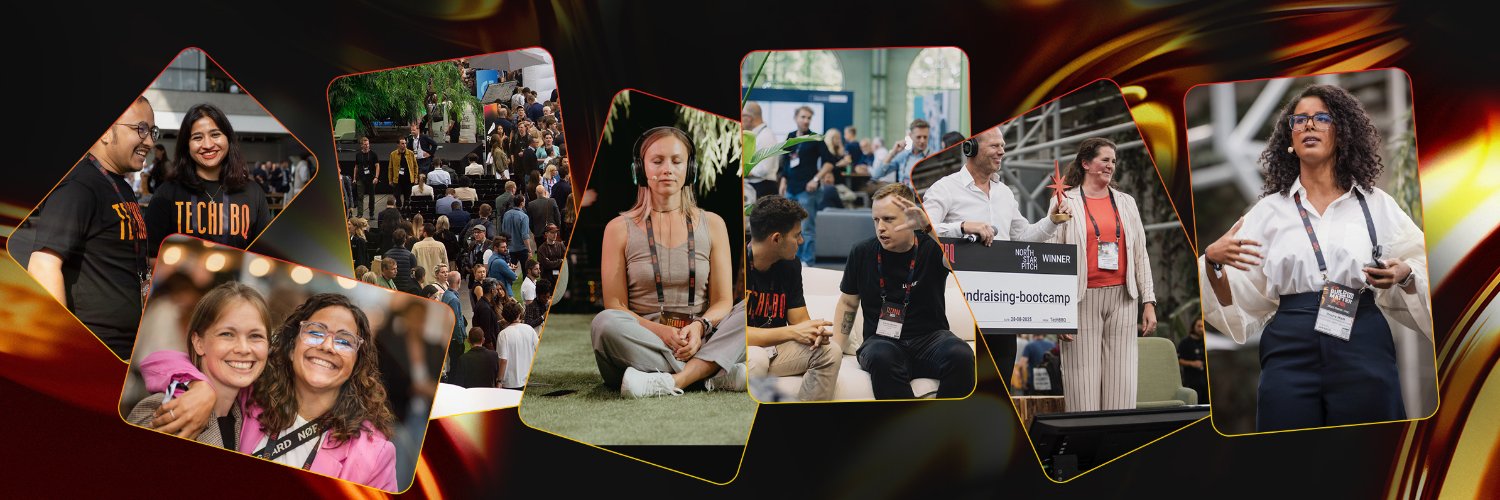

#TechBBQ - the home of founders, builders, and bold ideas
Copenhagen, Denmark
- Tweets 2,470
- Following 2,313
- Followers 3,840
- Likes 3,454


TechBBQ 2025 - this is what happens when builders meet 🔥
Founders. Investors. Operators.
Real conversations. Real signals.
Now we go again.
→ 26–27 Aug 2026
→ Bella Center, Copenhagen
Be there.
Tickets in comments
#TechBBQ #Startups #Builders #Copenhagen

2
1
11
742


10,000+ founders, investors and builders came together in Copenhagen.
Between the stages, meetings and late-night conversations, one thing became clear:
Europe is not short on ambition.
Now we need to turn it into companies, technologies and momentum.
Register TechBBQ 2027 →
forms.techbbq.dk/priority-ac…

2
88
TechBBQ retweeted

#WATCH | 🇮🇳 “Why shouldn’t every Indian citizen have an agent?” 🤖🤔
In an exclusive conversation with @chandrarsrikant on the sidelines of @TechBBQ in Copenhagen, Emad Mostaque, Co-founder, Stability AI and Founder, Intelligent Internet, says India should turn India Stack from a payments and identity stack into a full-fledged “intelligence stack”. 🧠
He recommends giving every Indian access to an AI agent 🤖 while ensuring that India retains sovereignty over its intelligence infrastructure. 🇮🇳
#AI #IndiaStack #IntelligenceStack #TechBBQ | @EMostaque | @StabilityAI

2
2
8,131
TechBBQ retweeted

Using @specsfordevs to help visually impaired people navigate & avoid obstacles @TechBBQ
My submission for the CLAD @specs @lenslist Summer Hack Week #2

4
18
1,532


TechBBQ retweeted

Yesterday, I had the privilege of attending the @TechBBQ Policy Stage!
The event focused on important policy debates in Europe, particularly on how to support the growth of native startups and foster European innovation. Three big topics came up on nearly all panels:
1. Europe still depends heavily on US and Chinese technology to grow its most innovative companies, and recent geopolitical developments make this option increasingly unsafe.
2. While Europe is not bad at creating startups and funding them at early stages, those that do want to scale generally prefer to go abroad, meaning that Europe is effectively subsidizing its geopolitical rivals by exporting its human capital.
3. There are some success stories in Europe. Sweden came up repeatedly as a country with an above-average rate of success in scaling its startups.
I was particularly interested in two ideas that came up regarding how to address the bottlenecks Europe faces.
The first was how to channel pension funds into startups. Europe, and especially Denmark, has a large amount of pension capital that could be invested in its own growth instead of going abroad or into legacy companies.
The second was the EU 28th regime. I was mesmerized during this specific panel when the panelists asked who thought it would properly address the scale-up problem Europe faces, and no one raised their hands.
I also share this skepticism about the 28th regime, largely based on the argument made by Professor Luis Garicano (@lugaricano ) from the LSE. The current proposal still requires companies to comply with specific tax and labor regulations in all 27 EU countries. A true 28th regime would create a supranational company structure with specific rules that would be valid across all EU countries, generating healthy competition between national and EU legislation.
If a country truly believes that its model is better, then it would attract more companies than the EU model, fostering a race to the top in terms of regulatory quality.
While I did leave the event more knowledgeable, I did not leave more hopeful about Europe.
My personal assessment, given how bureaucratic the EU is and how bitter political infighting has become (two topics that were raised by multiple panels, especially those featuring politicians) gives me little hope that the continent will address its bottlenecks and become the AI continent.
I do not see any leader currently able to rise to the challenge of our time.
My hope is that some group of countries, like the Nordics or the Baltics, will try to implement their own solutions, but on a smaller scale, maybe replicating the Swedish case. Hopefully, their success will inspire other countries to do the same.


1
1
6
250
TechBBQ retweeted

Interesting discussion held at #TechBBQ on ‘The Third Way of Digital Sovereignty – Lessons from India Stack’, organized by ICDK Bangalore in Copenhagen
Moderated by Ms Inayat Naomi Ramdas (Innovation and Research Officer, ICDK Bangalore) with Amb @ManishPrabhat06, Jeppe Dørup Olesen (Kitchen, Aarhus Universitet), and Yvonne Dittrich (IT University of Copenhagen).
Amb @ManishPrabhat06 highlighted how #IndiaStack’s open, interoperable public digital rails (Aadhaar, UPI & more) deliver presence-less, paperless, cashless services at population scale driving financial inclusion for 1.4 billion people, enabling private innovation without monopolies, and offering the world a true Third Way of digital sovereignty.
Panelists concluded that a similar system would be very useful for Europe where "India Stack" has always been sighted as a useful model.
Inspiring insights on public infrastructure that builds resilience and global impact.
#IndiaStack #DigitalSovereignty #TechBBQ2026 #Innovation #ICDK #IndiaDenmark


2
3
203
TechBBQ retweeted

Still processing this one…🥹🇩🇰
Me, Chukwuakasiemobi, painting Prince Joachim of Denmark..GOD DID🙏🏾😭
A beautiful reminder of Proverbs 18:16:
“Your gift makes room for you and brings you before the great.”
Grateful. Honoured. Blessed. 🙏🏾🎨
Tack TechBBQ & see you next year! ❤️

20
36
124
6,226
TechBBQ retweeted

Copenhagen's tech scene is on fire right now! 🇩🇰
I went to @TechBBQ last week with the Scaling Europe team Marika and Aino to enjoy the last of the Nordic summer.
It was so GREAT to meet a lot of people and jump on the stage as a speaker in two panels with Jacob and Faateh.
Mikael Hansen, @Keyvanowich and the TechBBQ team did a spectacular job pulling it all together!
Thanks to @christina_v_s and @charles_maddock for joining us on the video.

4
2
25
4,730
TechBBQ retweeted

@TechBBQ 2026 deserved more than one post 🇩🇰
So we put the full LILIDi AI story together ↓
lnkd.in/e3sUYRCW
2 days at booth E-S12. The Startup Showcase. Dozens of conversations with founders, investors & operators — plus @Google for Startups, AWS , @nvidia for Startups and @nebiusai .
But the best part? The people and the feedback shaping what comes next for Lilidi Twin. 💜
20+ real photos from Copenhagen and the full story ↓
lnkd.in/e3sUYRCW
See you at the next AI conference 🚀
#TechBBQ #AI #Startups

2
1
11
402

👀 ICYMI: @NEA’s @luke_pappas was recently featured on stage at @TechBBQ to chat with @werwerfqw about Spektr, an AI-powered platform handling the manual work behind compliance.
👉🏽 To learn more about NEA & Spektr, check out our blog about leading the company’s Series A: nea.com/blog/how-spektr-is-b…


2
2
3
2,499
TechBBQ is changing.
And our new website is one of the first places you can see it.
More European.
More ambitious.
More representative of the ecosystem we’re building.
From first conversation to launch in four months with Humandone.
The next chapter starts here.
→ techbbq.dk

3
78
TechBBQ 2027 Flash Sale tickets. Gone.
Missed it? Join Priority Access for the next release.
8–9 Sep · Copenhagen.
Link: forms.techbbq.dk/priority-ac…

2
128
POV: TechBBQ 2026 is officially a wrap.
Two days of founders, investors, builders and a lot of organised chaos.
Captured by the brilliant Kevin Lui, one of our VJ volunteers.
Kevin — you nailed it.
TechBBQ 2027 is already on the calendar.
And yes… a few 50% flash-sale tickets are still left. 👀
#TechBBQ #Startups #Founders #Copenhagen #StartupTok

4
149

TechBBQ 2026 is done.
Now help us build 2027.
What worked?
What should change?
What should we never lose?
Share your feedback ↓
forms.techbbq.dk/post2026
There’s a small thank-you waiting at the end.

1
117
3 DAYS LEFT.
TechBBQ 2026 starts Wednesday.
Few tickets remain.
See you in Copenhagen.
Get your ticket → techbbq.dk/buy-tickets/
#TechBBQ2026

2
2
223

