
#Genetic Researcher @unitartu, visiting researcher @kuleuven. Interested in #aDNA #human evolution & diseases. Loves #music, humour & #nature !
Tartu, Estonia
- Tweets 2,212
- Following 1,128
- Followers 648
- Likes 7,876


🎓 Big day at the @genomicstartu : our colleague @KaiTatte is defending her PhD— agnst @AnnaSapfo.
Defenses are high-pressure, but she’s handling it with courage and focus.
Rooting for you, Kai—make us proud! 💪
🇪🇪 #PhDDefense @unitartu @researchestonia #AcademicTwitter #popgen

2
4
230
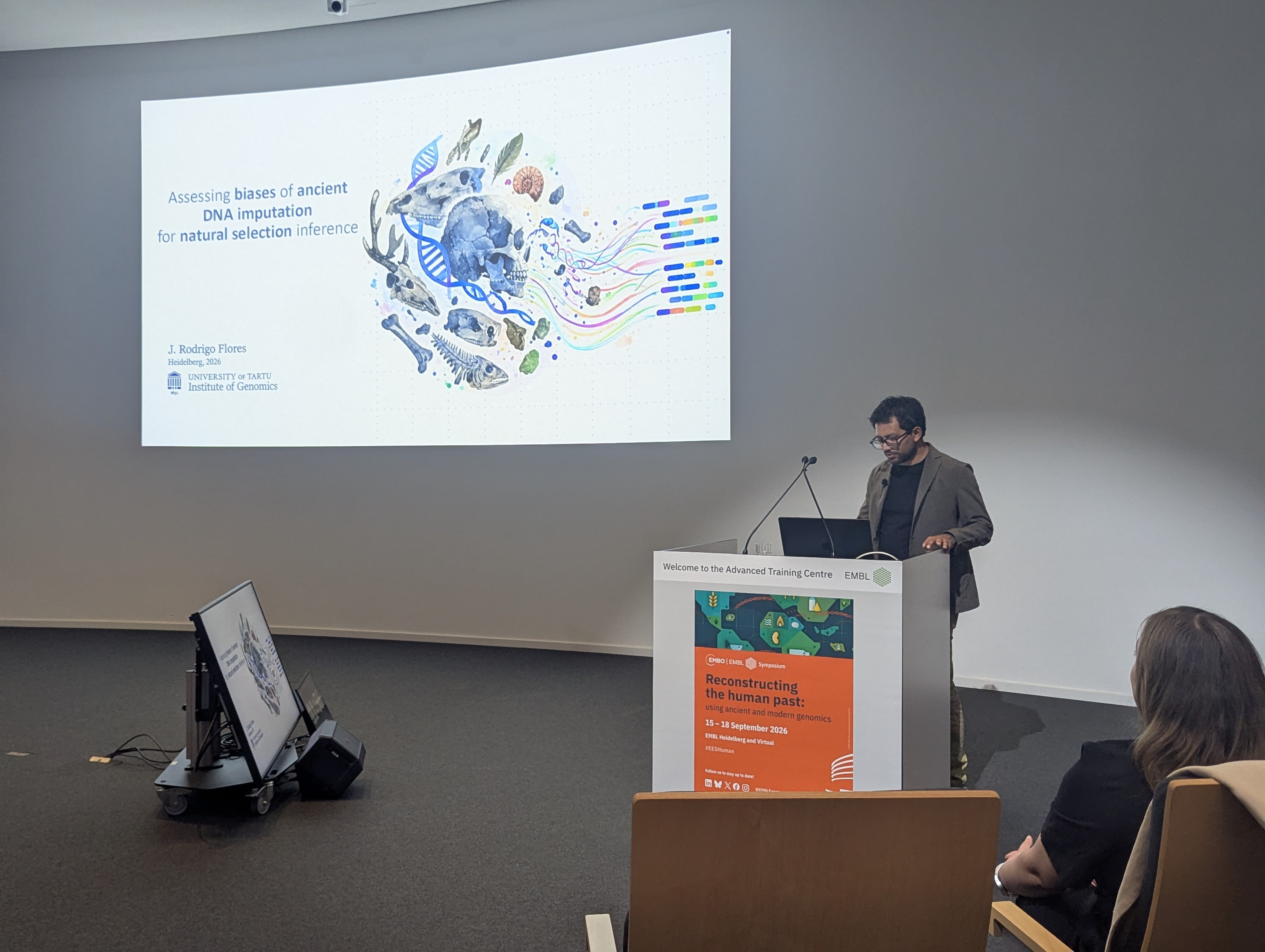
Representing @genomicstartu on Day 3 of #EESHuman, @EMBO @EMBLEvents. Presented my work on pop-specific haplotype fingerprint, while @JRodrigo_F abt biases in #aDNA imputation for selection inference.
Great science & new perspectives on human past! 🧬
#HumanEvolution @unitartu



4
14
830
Very entertaining & insightful talk by @maitbb on Day 2 of #EESHuman, @EMBO @EMBLEvents "Reconstructing human past"! Fascinating look into how #ancientHumanDNA from chewed birch bark tar is revealing the origins of the first settlers of #Estonia . 🧬🇪🇪
@genomicstartu @unitartu


1
3
18
928
Day 1 of #EESHuman @EMBO @EMBLEvents "Reconstructing human past" symposia set off wth a bang 🧬
#JohannesKrause unpacked Europe's history from first settlement to medieval times, followed by great talks of archaic & human history by @MatejaHajdi n #DavidReich.
#aDNA #Genomics


1
1
6
484
That followed multiple interesting presentations, including the ancient modelling and Himalayan ancient history talks, respectively by #LSkov & @NirajRai3 .
#EESHuman @EMBO @EMBOPress @embl Heidelberg.
#humanhistory #paleogenomics #SouthAsia #India


1
6
331
Ajai Pathak retweeted

India Converted Half of Asia Without an Army.
One of the largest cultural expansions in history was carried out almost entirely by merchants waiting for the monsoon wind to change.
Over roughly a thousand years India gave much of Asia its religions, its epics, its scripts and its ideas of kingship, using convoys timed to the monsoon's twice-yearly reversal rather than armies. Buddhism set aside caste and the food laws that made travel among strangers difficult, and it moved east in the holds of merchant ships until, by one count, China had thirty thousand monasteries and close to two million monks. The courts of Southeast Asia adopted Sanskrit, Indian law and Indian statecraft by choice, judging it the best system on offer to a king who wanted to look legitimate at home and abroad. The former Thai capital Ayutthaya took its name from Ayodhya, the city of Rama. Angkor Wat, the largest religious monument on earth, is a working diagram of the Indian cosmos, its moat standing for the ocean that surrounds Mount Meru.
The era's other great power took a different route. China's Confucian order required a foreign ruler to acknowledge the emperor as his superior before exchange could happen, tribute, not trade. The ports of the region answered to Chinese demand while its temples, script and kingship were Indian-influenced.
It wasn't wholly peaceful. The Indianised kingdoms fought each other readily enough. What the pattern lacked, for the better part of a thousand years, was an Indian conqueror.
I've written up the full story, with sources and further reading. Link to essay in the comments below.

104
1,056
4,205
179,303
Ajai Pathak retweeted

THE BOYS FINALLY DID IT!!!!!! 🏆🥹
- Defeated the Chinese pair at home and won the China Masters for the first time ever!
WHAT A MOMENT!!! 🇮🇳❤️
🔥🔥🔥🔥🔥🔥🔥🔥🔥🔥🔥🔥

134
3,050
22,930
351,977
Ajai Pathak retweeted

For much of India, Isro’s mission in the wee hours of September 4 was just another rocket launch. But for the space agency, it was a bigger moment. Here’s why. 🧵
1
1
35
15,099
This is a really huge achievement, congratulations to the team #ISRO

Mission Success!
GSLV-F17 has successfully accomplished its mission, placing EOS-05 into the intended orbit.
Sharing a few memorable moments from the lift-off.
For more information:
isro.gov.in/Mission_GSLVF17.…
#GSLVF17 #EOS05 #ISRO


1
64
आसमान में उड़ान, या बोलें कोई जुबान।
हर शख्स के दिल में है धड़कता हिंदुस्तान! ✈️🇮🇳
स्वतंत्रता दिवस की हार्दिक शुभकामनाएं।
जय हिंद!🇮🇳🇮🇳🫡 #UnityInDiversity
#independencedayindia #स्वतंत्रतादिवस #JaiHind #HarGharTiranga #ProudIndian। #15august @highlight #india

3
199

The findings suggest that the rise of agriculture triggered linguistic diversity, before these languages were lost
go.nature.com/45jNxy7
5
57
192
39,018
Ajai Pathak retweeted

A new analysis in Science of more than 116,000 bird songs has revealed that the astonishing variety of passerine birdsong is built from just eight basic acoustic motifs, like trills, whistles, and harmonic notes.
The findings also reveal that local environments greatly shape how birds communicate around the world. Learn more: scim.ag/4wYoVXE

32
1,047
3,221
265,714
Ajai Pathak retweeted

Genetic trade-offs in fertility and longevity explain the maintenance of disease-associated alleles in humans | Nature Ecology & Evolution nature.com/articles/s41559-0…
2
10
23
10,194
Ajai Pathak retweeted

Young football champs return home after conquering Europe. Minerva Academy won 2 chamionships, Helsinki Cup, Finland and Gothia Cup, Sweden. With Gen Z building rockets and Gen Alpha excelling at sports, India is in safe hands 🇮🇳


Future of Indian football is bright. These young lads from Minerva Academy, won their 2nd final to clinch Gothia Cup in Gothenburg, Sweden after the Helsinki Cup 🇮🇳

17
502
2,766
35,477
Ajai Pathak retweeted

🚨 Kabeer Chillar, an IIT Bombay Computer Science student, who secured a perfect 300/300 in JEE Main 2026, earning AIR 1, followed by AIR 2 in JEE Advanced with an incredible 329/360.
He won a gold medal for India at the International Chemistry Olympiad (IChO) 2026. 🏅 👏

130
1,490
14,401
278,677
Ajai Pathak retweeted

Another Golden Sweep by India as our Chemistry team bags 4 Gold medals securing Rank #1 (jointly with China, Vietnam, and Individual Participant (Russia)) at the 58th International Chemistry Olympiad, Uzbekistan (icho2026.uz).
1/5

53
852
3,412
204,828
Ajai Pathak retweeted

𝐁𝐑𝐄𝐀𝐊𝐈𝐍𝐆: 𝐏.𝐕 𝐒𝐢𝐧𝐝𝐡𝐮 𝐖𝐈𝐍𝐒 𝐉𝐚𝐩𝐚𝐧 𝐎𝐩𝐞𝐧 (𝐒𝐮𝐩𝐞𝐫 𝟕𝟓𝟎) 𝐭𝐢𝐭𝐥𝐞 🔥🔥🔥
STUNS reigning three-time World Champion Akane Yamaguchi 21-17, 21-17 in Final.
#JapanOpen2026

81
895
4,472
76,832
Ajai Pathak retweeted

ORBIT ACHIEVED. 🚀
Vikram-1 Test Flight-1 has reached orbit. India's first privately developed orbital rocket has completed its final burn and injected its payloads into a ~450 km orbit, making India the third country in the world with private orbital launch capability.
History is made. 🇮🇳
#Vikram1 #JourneyToOrbit #SkyrootAerospace
2,057
12,584
54,870
3,388,935
Ajai Pathak retweeted

Ambassador @ashishifs and DG MFA Ms Kristi Karelsohn welcomed Hon’ble Minister of Commerce and Industry of India @PiyushGoyal upon his arrival in Estonia for an official visit. Hon’ble Minister will hold bilateral meetings, will address the business leaders and interact with Indian community in Estonia.
@MEAIndia @MFAestonia @DoC_GoI @IndianDiplomacy @PIB_India @mygovindia

7
14
412
४६°C की जानलेवा गर्मी में १५ घंटे की बिजली कटौती! भारी लोड से ज्यादा ये इंफ्रास्ट्रक्चर फेलियर, जीरो एडवांस प्लानिंग व प्रशासनिक सुस्ती का नतीजा है! 😡
हर साल पीक समर में ये कहानी दोहराई जाती है। जब समस्या का पता है, तो समय से इंफ्रास्ट्रक्चर अपग्रेड क्यों नहीं होता?@myogioffice
1
1
3
173
विदेश से आने वाले लोग भी हैरान हैं कि सालों बाद भी कुछ नहीं बदला।
इस भीषण उमस में बुजुर्गों की जान खतरे में है, और स्थानीय प्रशासन कुंभकर्णीय नींद में लीन है! अब बहानेबाज़ी बंद हो, जवाबदेही तय हो! 📢
#Jaunpur #UPPowerCrisis #बिजलीसंकट #उत्तरप्रदेश @DMjaunpur @myogiadityanath
2
40