

Community account for sharing ClaudeCode related projects and releases. Views/shares independent from @AnthropicAI positions.
United States
Based in United States
- Tweets 96
- Following 73
- Followers 48,297
- Likes 143

If you haven't tried the newest AI models in a while
Tip: Give Opus 5.5 a try
You don't need to be an engineer or have a corporate budget.
Some things to try:
1. Run a small business but can't afford marketing or advertising? Tell it your story. It'll help you make a video that tells your store's story and share it online.
2. Help your kids with their homework, even if you never learned the material yourself.


We’re bringing the full model launch family back! First up is Opus 5.5
Better - As capable as Fable 5.1 and Astra
Cheaper - 42% cheaper than Opus 5
Faster - 37% faster than Opus 5
Your new daily driver and collaborator, give it spin 👇
3
16
6,325
"I believe that AI could cure most major diseases in the next 5–10 years greatly accelerate economic growth rates, create a world of abundance and empowerment"
"Even when this gets us accused of hype, “doomerism”, or regulatory capture.
We have tried to prioritize caution over speed and prudence over profit."
"The measures I propose to advance the frontier at a safe pace will not be easy. But I believe we owe it to humanity to try."
Thank you @AnthropicAI and godspeed to us all 🙏


We Must Pace the Frontier: I’ve written a new essay on why the AI industry should slow down, with a three-part plan for doing so.
Anthropic is unilaterally committing to the first of these steps. We’ll provide third-party evaluators with permanent, employee-level access to our systems, so that they can verify adherence to our safety measures, report on incidents, and assess models’ alignment during training.
You can read the full post here: darioamodei.com/post/we-must…
5
8
8,127
Bring your idea into existence, and communicating your story are the creative endeavors that feel euphoric.
We all know @claudeai is amazing with the first.
But here's a PSA: Claude can help communicate your story, too.
Try asking @claudeCode:
"Use whatever tools you like — Remotion, FFmpeg, anything else — to generate a short video about my {whatever-you-want} and render it as an MP4."
Shoutout to AzorAhai1TK at r/ClaudeAI:
"Fable came up it took about 12 minutes and around 90,000 tokens. I'm just in awe at the ability of the model to make something this competent and coherent this quickly."
Tip:
Try @TapNow_AI for any customized AIGC video and/or image work.

3
10
13,271
Tip:
1) Instead of 100s lines of markdown, ask @claude_code to generate a html (website) brief.
Have it chain together multiple pages, if necessary, into slides.
Example attached using @zarazhangrui beautiful-html-templates for markdown -> website.
2) @claudeai has a button to publish your website to share with colleagues and others.
"Copy" -> "Publish Artifact"


HTML is the new markdown.
I've stopped writing markdown files for almost everything and switched to using Claude Code to generate HTML for me. This is why.
10
8
134
31,425
s/o creators:
github.com/axoviq-ai/synthad…
linkedin.com/in/paul-chen-a8…
project repo:
github.com/axoviq-ai/synthad…

1
3
12
4,126
Karpathy's Personal Wiki Idea implemented:
Synthadoc takes your documents and helps organize it into a wikipedia format.
No cloud account. No vendor lock-in. You owned your wiki.
Use @claude_code directly.


LLM Knowledge Bases
Something I'm finding very useful recently: using LLMs to build personal knowledge bases for various topics of research interest. In this way, a large fraction of my recent token throughput is going less into manipulating code, and more into manipulating knowledge (stored as markdown and images). The latest LLMs are quite good at it. So:
Data ingest:
I index source documents (articles, papers, repos, datasets, images, etc.) into a raw/ directory, then I use an LLM to incrementally "compile" a wiki, which is just a collection of .md files in a directory structure. The wiki includes summaries of all the data in raw/, backlinks, and then it categorizes data into concepts, writes articles for them, and links them all. To convert web articles into .md files I like to use the Obsidian Web Clipper extension, and then I also use a hotkey to download all the related images to local so that my LLM can easily reference them.
IDE:
I use Obsidian as the IDE "frontend" where I can view the raw data, the the compiled wiki, and the derived visualizations. Important to note that the LLM writes and maintains all of the data of the wiki, I rarely touch it directly. I've played with a few Obsidian plugins to render and view data in other ways (e.g. Marp for slides).
Q&A:
Where things get interesting is that once your wiki is big enough (e.g. mine on some recent research is ~100 articles and ~400K words), you can ask your LLM agent all kinds of complex questions against the wiki, and it will go off, research the answers, etc. I thought I had to reach for fancy RAG, but the LLM has been pretty good about auto-maintaining index files and brief summaries of all the documents and it reads all the important related data fairly easily at this ~small scale.
Output:
Instead of getting answers in text/terminal, I like to have it render markdown files for me, or slide shows (Marp format), or matplotlib images, all of which I then view again in Obsidian. You can imagine many other visual output formats depending on the query. Often, I end up "filing" the outputs back into the wiki to enhance it for further queries. So my own explorations and queries always "add up" in the knowledge base.
Linting:
I've run some LLM "health checks" over the wiki to e.g. find inconsistent data, impute missing data (with web searchers), find interesting connections for new article candidates, etc., to incrementally clean up the wiki and enhance its overall data integrity. The LLMs are quite good at suggesting further questions to ask and look into.
Extra tools:
I find myself developing additional tools to process the data, e.g. I vibe coded a small and naive search engine over the wiki, which I both use directly (in a web ui), but more often I want to hand it off to an LLM via CLI as a tool for larger queries.
Further explorations:
As the repo grows, the natural desire is to also think about synthetic data generation + finetuning to have your LLM "know" the data in its weights instead of just context windows.
TLDR: raw data from a given number of sources is collected, then compiled by an LLM into a .md wiki, then operated on by various CLIs by the LLM to do Q&A and to incrementally enhance the wiki, and all of it viewable in Obsidian. You rarely ever write or edit the wiki manually, it's the domain of the LLM. I think there is room here for an incredible new product instead of a hacky collection of scripts.
2
6
49
17,511
Tip: Use @pbakaus's impeccable for critique/audit and polishing of your frontend.
Get started by installing the skill and then:
1) /impeccable teach
2) /audit
3) /critique


Introducing Impeccable 2.0.
• data-driven skill rewrite (evals across 7 niches) → better font/color diversity
• /critique: subagent de-bias + deterministic anti-pattern detection
• visual mode: /critique, CLI, (soon) Chrome
• npx impeccable detect (files + URLs)
Demo:

5
1
71
19,975
Take advantage of @claude_code plugins and skills.
Frontend-design
Doc-coauthoring
Skill-creator
Code-simplifier


We just open sourced the code-simplifier agent we use on the Claude Code team.
Try it: claude plugin install code-simplifier
Or from within a session:
/plugin marketplace update claude-plugins-official
/plugin install code-simplifier
Ask Claude to use the code simplifier agent at the end of a long coding session, or to clean up complex PRs. Let us know what you think!

6
9
50
24,681

Tip: Stop stuffing context. Use the new Memory and Context Reset tools in @claude_code.
Opus 4.5 supports a workflow of up to 1M total tokens by "resetting" the context window while retaining created memories. [System Card - Section 2.6 🧵]
This architecture (Context Awareness + Memory Tool) beat standard context stuffing on agentic search benchmarks (~80% vs ~70%).
General context engineering tip: Place critical instructions (output format, constraints) at the ends start and the end of your context block.
Be careful of invalidating the cache.


3
2
16
10,100
With pricing at $5/$25 (input/output per million tokens), the "Opus tax" is lessened. It is even more accessible for daily loops.
Performance stats:
- Beat all human candidates on Anthropic's internal engineering exam (2hr limit).
- Leading in 7/8 languages on SWE-bench Multilingual.
Action:
Update your API config to `claude-opus-4-5-20251101`

1
1
7
1,177
Tip: Use Opus 4.5 for @claude_code.
Medium Effort: Matches Sonnet 4.5 capability but uses 76% fewer output tokens. Ideal for routine refactors, writing tests, and migrations.
High Effort: Opus 4.5 exceeds Sonnet 4.5 performance by 4.3 percentage points while using 48% fewer tokens.
2. less "yes-man" bias
Existing models often validated user biases or incorrect logic, and are prone to sycophancy.
Opus 4.5 has a 60% reduction in sycophancy compared to Sonnet 3.5. (System Card)
try prompting @claude_code to "Critique this design pattern brutally" to trigger this calibration.


Introducing Claude Opus 4.5: the best model in the world for coding, agents, and computer use.
Opus 4.5 is a step forward in what AI systems can do, and a preview of larger changes to how work gets done.

14
10
160
48,192
Tip: help @claudeai continuously learning as you are developing.
If there is a task that @claude_code is inconsistently succeeding at. Try adding it to Skills.
This is friendlier and easier to use repeatedly than a large doc that @claude_code must read for specific skills
i.e databases, API, data transformations, etc.
Adding and polishing (version control) Skills is one step closer to continuous learning.


13
19
297
51,341
Tip: Ask @claude_code to use adapters, feature flags, and interfaces for implementations.
1. Model releases improve rapidly:
2024 June: Sonnet 3.5
2024 Oct: Sonnet 3.6
2025 Feb: Sonnet 3.7
2025 May: Sonnet/Opus 4
2025 Sept: Sonnet 4.5
Design key components around interfaces to do seamless rewrites with stronger released models. Use adapters and feature flags to gradually roll out usage.
2. There's tremendous value in simply updating api to use `claude-sonnet-4-5`. But remembering timeless software abstractions allows for the entire application to improve with the model.
3. Use Claude 4.5 Sonnet beyond code—it's a powerhouse for daily tasks. Try the Claude Chrome extension for forms, calendars, emails, or automating expense reports.
These capabilities build on Sonnet 4.5's enhanced agentic capabilities making it easier to integrate to daily life.
4. We're living in a truly magical era, together. Enjoy the moment.


Introducing Claude Sonnet 4.5—the best coding model in the world.
It's the strongest model for building complex agents. It's the best model at using computers. And it shows substantial gains on tests of reasoning and math.
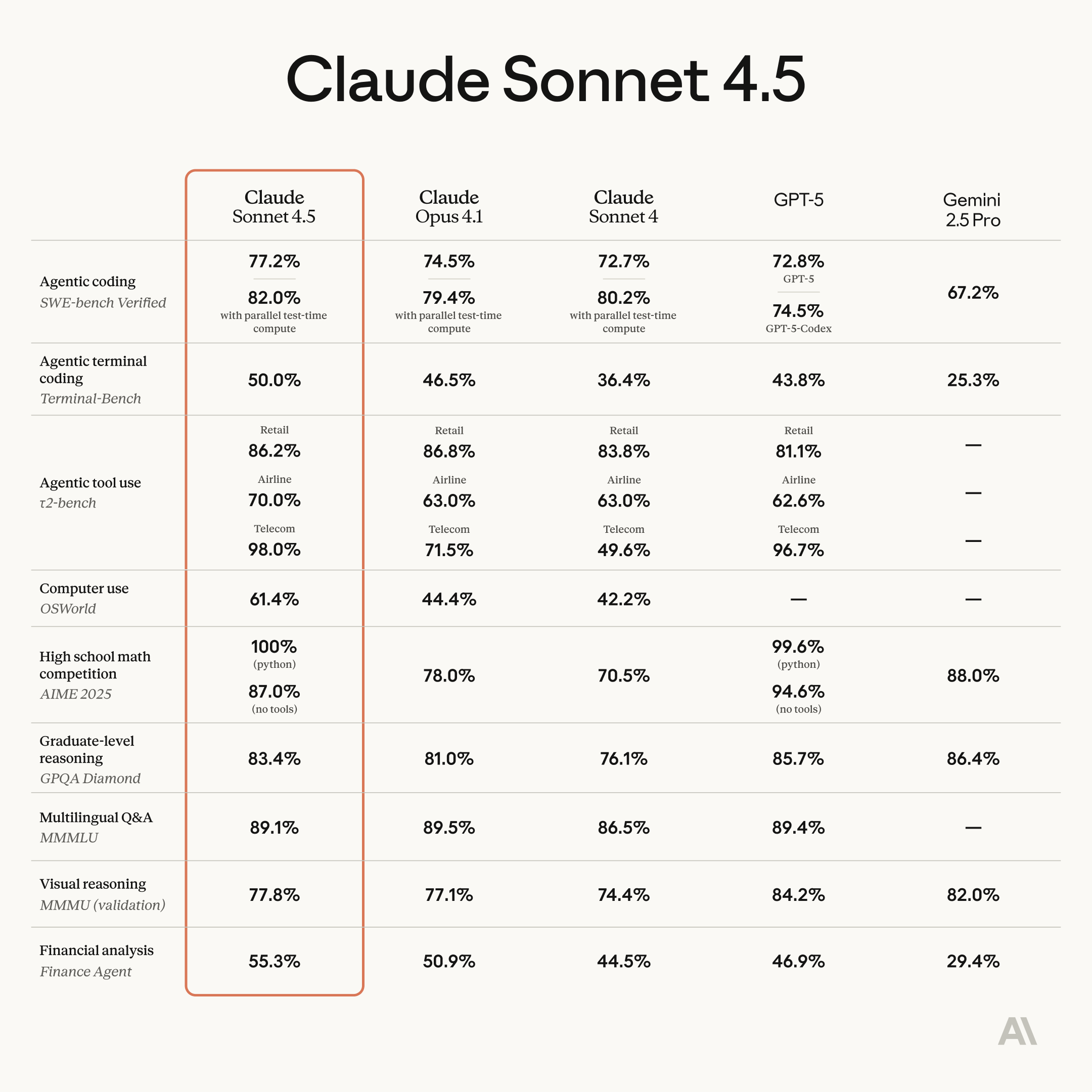
ALT A benchmark table for Claude Sonnet 4.5 showing leading performance across many domains, including agentic coding, computer use, mathematics, graduate-level reasoning, and financial analysis.
4
4
28
14,666
Announcement:
@claudeai Sonnet 4 now supports 1 million tokens (up from ~250k) of context on @AnthropicAI API.
Tip:
1) Be mindful of the context rot. Sonnet is capable of 1 million tokens but managing context will still result in better results.
2) Take advantage of prompt caching. An easy win is to be thoughtful of when to include timestamps. As they could result unnecessary and costly cache misses.


Claude Sonnet 4 now supports 1 million tokens of context on the Anthropic API—a 5x increase.
Process over 75,000 lines of code or hundreds of documents in a single request.

20
34
538
71,676
Announcement: Official support for Opus 4.1 planning and Sonnet 4 workhorse via /models in @claude_code
Tips:
1) Ask Opus 4.1 to use Sonnet subagents in its plan to track parallelizable vs. sequential tasks.
This multi-agent pairing outperforms single agents significantly.
Bonus: Request an ASCII Gantt chart for visualization and review.
2) During spikes in 529 error messages, switch to this model or sonnet.


"Opus for planning, Sonnet for execution" is now available as a model setting in Claude Code! Best way to see it in action is with a status line.

15
34
675
87,325
Tip: Ask @claude_code to run your dev server in the background (Ctrl+B).
Then have Claude code run integration tests against the dev server.
No need to wait for users to copy-paste error traces.
@claude_code continues until the integration succeeds.
Builders review and give final approval.


Claude Code can now handle long-running tasks in the background.
Start your dev server, run tests, or build your project without blocking your workflow

12
47
595
78,118
Announcement: @claude_code Opus 4.1 is released.
For API usage, use `claude-opus-4-1-20250805`.
@windsurf reports Opus 4.1 delivers a stddev improvement over Opus 4 on their junior developer benchmark.
Roughly the same performance leap as the jump from Sonnet 3.7 to Sonnet 4.
*
Tip: don't over-index on benchmark performance, use it, and track community usage to understand its strengths and weaknesses.
1) Use Opus 4.1 as orchestrator with 1-10 Sonnet subagents for parallellizable tasks.
Claude Opus 4.0 as lead + Sonnet subagents outperformed single-agent Claude Opus 4 by 90.2% on internal research eval.


Say hello to Claude Opus 4.1, our best model yet for real-world coding, reasoning, and agentic tasks.
The frontier continues to move forward one update at a time.

10
26
271
39,173
Tip: @claude_code supports custom subagents.
1) Begin with Claude-generated agents (/agents) and iterate ("e" to edit).
2) Dynamic subagent selection: Claude Code chooses subagents intelligently. Be precise in description fields to guide it.
3) @AnthropicAI's subagents page includes two common subagents: Code Reviewer & Debugger.


29
64
585
82,475
Tip:
Sniffly (@chipro) for Claude Code dashboard featuring usage stats, detailed error analysis, and insights.
Open-sourced on GitHub.
1) The biggest type of errors Claude Code made is Content Not Found (20 - 30%). It tries to find files or functions that don't exist. So I restructured my code base for discoverability.
2) Claude Code’s favorite tools are, unsurprisingly, search tools (grep, ls, glob), which make up ⅓ of tool calls.
3) Claude Code can only go up ~10 steps but occasionally go close to 100 steps. (just a year ago, ~5 steps was out of reach).


I open sourced Sniffly, a tool that analyzes Claude Code logs to help me understand my usage patterns and errors.
Key learnings.
1. The biggest type of errors Claude Code made is Content Not Found (20 - 30%). It tries to find files or functions that don't exist.
So I restructured my code base for discoverability, and the average number of steps Claude Code needs for each instruction went from 8 to 7 steps.


3
13
160
24,028
PSA: There is a spike in intermittent errors on Opus.
Tip:
Switch to Sonnet (`/model`) to mitigate. It's effective for executing tasks.
API Error 529 - overloaded_error: Anthropic’s API is temporarily overloaded.


9
7
81
22,006
1) Try Bun @bunjavascript for faster compilation than (p)npm or Yarn. Bun fetches and installs packages in parallel.
2) Consider a Claude Max subscription if you're exceeding credits: 5x ($100/month) or 20x usage ($200/month) limit.
3) Use `ccusage` to track Claude code usage.


8
11
167
32,291
Tip: Use subagents on @claude_code.
@claude_code supports ~10 parallel tasks, coordinating via a task queue.
Avoid specifying parallelism; let Claude Code determine task distribution.
Cuong's article, "Claude Code: Subagent Deep Dive" is worth the read. @codecentrevibe


29
94
966
125,672
Use `ccusage` to track @claude_code usage across daily, monthly, and repository levels.
In latest v15.0.0 update, supports real-time with an interactive dashboard.
Amazing work by @ryoppippi, いつも本当にお疲れ様です!
日本の @claude_code ユーザーの皆さんも、ぜひどんどんシェアして盛り上げていきましょう!


10
182
1,146
194,683
Claude code supports integration with @linear MCP server.
This is a great demonstration of human (task setting) and agentic (task completion) collaboration.
Writes tickets, verifies, and proceeds to the next ticket.

10
35
563
68,936
Cool project by @brendankblong using Claude code to play a text-based game (Dwarf Fortress).
Claude with visual feedback is a great combination.

3
10
167
28,143
Claude 4 Sonnet is now available in Claude Code.
It is the new default (recommended) model.
Be cautious with Claude Opus, as its cost can escalate quickly.


Introducing the next generation: Claude Opus 4 and Claude Sonnet 4.
Claude Opus 4 is our most powerful model yet, and the world’s best coding model.
Claude Sonnet 4 is a significant upgrade from its predecessor, delivering superior coding and reasoning.

ALT A benchmarking table titled Claude 4 benchmarks comparing performance metrics across various capabilities including coding, reasoning, tool use, multilingual Q&A, visual reasoning, and mathematics.
11
8,865


Swarm of Claude Codes
* Multiple Claude codes running in separate terminal sessions, for same feature branch and working directory.
* Use git worktree to avoid conflicting changes on same codebase by having separate working directories.

Most underrated feature in Claude Code is the ability to spin up like 5 Claude Code instances at once using Git worktrees and have them all tackle different parts of your project in parallel
Legitimately feels like commanding an army of software engineers

1
3
1,621
Share Images with Claude
Claude handles images and diagrams effectively via:
- Pasting screenshots (pro tip: use Cmd+Ctrl+Shift+4 on macOS to copy a screenshot, then Ctrl+V to paste; note this differs from Cmd+V and doesn't work remotely).
- Dragging and dropping images into the prompt.
- Providing image file paths.

1
219
Minimize Human Bottleneck:
You intervene when the automated process stalls (LLM cant pass tests) or for final sign-off on test-validated project.
When creating a plan for Claude to execute, prioritize checkpoints with tests and visual screenshot verification.


1
234
Add phrase "think", "think harder", or "ultrathink".
For increasing levels of compute in reasoning.

1
1
291


