

I explain crypto/AI market events in plain English. ex-@scale_AI | ex-@Chromia | ex-@SentoraHQ Software Engineer
The Metaverse
- Tweets 10,010
- Following 876
- Followers 1,533
- Likes 725




Docker has released its first official skills for AI agents that work with code: github.com/docker/skills
They help agents handle Docker-related tasks, with the collection set to expand over time. Available skills and installation instructions: docs.docker.com/ai/skills
2
70
LLMs are becoming part of everyday workflows.
Skills let you define a document or report workflow once and reuse it, while voice agents using the Realtime API can converse and call tools like file search or CRM systems in real time.
At Yandex Scale, Yandex showed both directions: reusable skills and a new speech synthesis model in AI Studio, plus skills, plugins and MCP connections to internal services in Alice AI Pro.

1
42
Odyssey trained a world model on Diablo II with no game engine underneath. The AI generates every frame in real time.
Up to 4 people and 16 agents can share one session. Each sees their own view, but everyone inhabits the same world, so one participant’s movement or combat changes what the others see. Agents can already chase players and navigate around obstacles.
Agora-2 shows how multi-agent worlds could become training grounds for AI agents, robots and drones where real interaction data is hard to collect.


45
Google is sending TPUs into space next week aboard a SpaceX Falcon 9 to test AI data centers in orbit.
The experiment will test whether TPUs can handle radiation and extreme temperatures while running AI workloads. Google says low Earth orbit could provide up to 8× more solar energy than comparable panels on Earth, potentially enabling large AI compute clusters in space.
In 2027, Google also plans to test laser links between satellites.

1
1
161
System One’s new models are worth watching if you build your own harness systems.
First Jev, now Contrastive Language Model (CLM), which runs 9× faster. CLM also appears better suited as a verifier, especially for long-horizon tasks.
Jev uses RLCD; CLM uses contrastive learning to embed situations/actions, compare similarity, then rank or select the best option. Code and weights are Apache 2.0.

1
36
ChatGPT may get a new $500/month Pro Max plan. It’s currently only an internal configuration, with no official announcement.
Pro Max, $500/month before tax (~$600 incl. VAT)
“Fastest Work + Fastest Codex”
2.5× the current $200 Pro plan
Added 5 days before DevDay on Sept. 29
Higher limits and possible Cerebras access remain unconfirmed.


1
64
OpenAI is preparing a $500/month Pro Max subscription.
Dataminers found references to the new tier in ChatGPT’s frontend. Unique features include “faster Codex and Work,” likely meaning Cerebras access. The limits are still unclear, and it could be unveiled at DevDay next Tuesday.
Meanwhile, the $200 Pro subscription still can’t be purchased.
1
1
67

Yandex has released the weights for Alice AI Foundation LLM, its own MoE pretrained from scratch with no starting weights from other open models.
It has 80B parameters, with 3B activated per token. Despite the lower active count, benchmark results are on par with or sometimes better than other open pretrains. It’s Apache 2.0, with over 2,000 Hugging Face downloads in just a few days.
1
1
106
DeepSeek has released the official Harness desktop client for Windows and Mac. No Node, terminal, or browser setup is needed—DSH now launches with a double-click.
Windows 64-bit and Mac Apple Silicon builds are available. The official docs are on GitHub. Version 0.1.7-rc.1.20260924.1 carries today’s date, so the release is brand new.

90
Russian startup Kodacode outperformed Claude Code in a DeepSeek agent benchmark.
Using the same DeepSeek V4 Flash with the same reasoning level, Kodacode scored 52.2% on Max harness, vs. 48.2% for Claude Code and 47.6% for OpenCode, across 261 practical tasks from bug fixes to full projects.
The takeaway: running DeepSeek isn’t enough—the agent harness matters.


1
82
Qwen has released Qwen-Image-2.1, an open 7B image generation and editing model that surpasses Nano Banana 2.0.
It supports up to 10 reference images, local editing, and native transparency—so you can generate transparent backgrounds or cut out objects without a separate mask.
The community has already made an uncensored version too.

170
Autonomous AI agents can now work directly in GitLab 👀
SourceCraft lets teams assign agents their own accounts: give one a task in a GitLab discussion, and it can write code, check security, ask the team for missing info or approval, then return the result for developer review.
You can also connect a custom agent, such as one built in Yandex AI Studio.
58
Apple has released a new model on Hugging Face: LensVLM-9B, a fine-tuned version of Qwen3.5-9B.
It analyzes compressed document-page images, then selectively expands only the pages needed to answer the user’s question in their original quality. 🤖
52
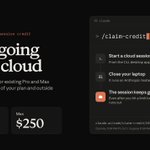
Claude Code cloud sessions have officially left preview and are now available to everyone. ❤️
They let Claude Code keep working even when your laptop is turned off or closed, using Anthropic’s infrastructure instead of your computer.
Current subscribers get a one-time test credit: Pro — $100 Max — $250
Cloud sessions can be started via claude.ai/code, the Claude mobile app’s Code tab, the desktop app, or `claude --cloud` in the terminal.
The promo credit is used first and does not affect your normal plan limit. It must be claimed by October 7 with a connected GitHub account.

2
86
Anthropic says Claude helped uncover a previously unknown molecular system that could represent a new mechanism for gene editing.
About 950 Claude agents analyzed more than 200,000 reverse transcriptases over 21 hours. One spotted a repeated DNA sequence near an enzyme, similar to the clue that once led researchers to CRISPR.
The system, named ART, was validated in Anthropic’s lab. Its exact function is still unknown, but early evidence suggests it may be programmable like CRISPR. If developed into a gene-editing tool, ART could expand approaches to treating genetic and other diseases.

67
Qwen has introduced Qwen Intelligence for smartphones, with three frontier agents: Mobile Planner, Mobile-Use and Mobile Creative.
Mobile-Use scores 82.1 on MobileWorld, 92.2 on MobileWorld-Real and 97.2 on AndroidDaily, with 90% end-to-end task success. Image generation takes ~3 seconds.
Qwen also opened its full benchmark suite. Honor is the first partner; Magic9 launches globally on September 28.


85
Claude Opus 5.5 wrote code that created this 32-second animation frame by frame.
It starts with a tiny funny cube, then moves through cosmic orbits, prism light dispersion, a particle vortex, a black hole, and finally a view of Earth from the Moon. All 32 seconds were created by AI.

1
184
Anthropic’s guide to using Opus 5.5 has one central rule: stop asking it to think. Eddie Osmani says Opus 5.5 already thinks before every answer and decides how much thinking is needed. “Think carefully” or “step by step” can delay the response without clearly improving quality. For simple questions, ask it to “answer directly”; in Claude Code, change effort level instead of the prompt.
The bigger shift is autonomy. Give long tasks in one message, define what “done” means and when it should stop for you. Early testers ran code for hours with little supervision. If you remember something, send another message while it works. For long projects, Anthropic recommends putting continuation/stop rules in CLAUDE.md and tracking tasks in TASKS.md, since chat history gets compressed. Ask the model to verify changes before human review and, for audits or migrations, split work among subagents and check each result.
Opus 5.5 also handles images better than Opus 5, including charts, calendars and schema changes. Don’t rewrite numbers from screenshots; ask it to deliver actual spreadsheets rather than plans. For research, have it note what it couldn’t verify and where it searched.
There’s also a safety change: Opus 5.5 launched with Fable-level protections for biological and cyber threats. Restricted messages are usually handed to an older model. In Claude Code, /fast provides earlier text at a higher per-token cost.
The overall advice: stop controlling every step and intervene only when the decision actually depends on you.

1
115
