

Golang/observability hacker changing the world @typesafeai. alum @docker @honeycombio @Bauplan_labs
San Francisco, CA
- Tweets 18,352
- Following 3,437
- Followers 5,789
- Likes 36,497


Pinned Tweet

still seems expensive to me

If you want to understand how fast AI is improving, look at intelligence per dollar.
1.5 years ago:
o1 Pro: $150 / $600 per M tokens
Today:
GLM-5.3 Flash: $0.15 / $0.50
That’s a ~1000x collapse in price in under 1.5 years, while GLM-5.3 Flash is more intelligent than o1 Pro.
5
34
15,214
this feels directionally correct

some good data here about model routing
first cursor model router, now openrouter + jev. people keep trying to build routers at _request level_ which is not going to work
the fundamental problem is that a prompt without surrounding context is simply not enough signal to judge complexity
easiest example to understand this - if you ask “how does this work” in a toy repo with just one html file, any dumb model can do it. but if you send the exact same prompt in linux kernel repo, hell breaks loose. how do you route that prompt?
the second problem is prompt caching. it means we can’t frequently change the model during a session in an economic way. one or two missteps here and there, and you find yourself spending more cost than simply using the best model all along
the right way to build a router is to do it at task level, not request level. this cannot be done by a model gateway which has to assume everything is a single continuous session. it needs to be a harness layer capability which can make use of a multi-agent architecture
a smart enough model first needs to do some digging and understand the complexity of the ask, then delegate substantial sub tasks to models with appropriate intelligence - even this is very hard to get right
9
1,484
Nathan LeClaire retweeted

I made Jev do a stupider thing, be a NAND gate, so it can run a 4-bit ALU.
Adding 7 + 5 = 12 takes 116 gates, 7.6 seconds, $0.0018, and a compound 84% probability.
Billions of these will play Doom one day.
I've asked Opus 5.5 to make a video about it, Nolan style.

21
44
1,076
283,953
Nathan LeClaire retweeted

jev in production, starting with the most important use-case.


11
14
723
41,866
うっす、JEVブロのみんな!!TypeSafe HQでは日本の #jevgang
のことをマジでずっと考えてる。今日、レイテンシが改善するはずの変更をぶっこんだぜ。もしJEVのスクリプトとか数字とか、ぜひ試して、効いたかどうか教えてくれ頼む

2
311
do you feel what’s about to happen yet?


It’s been a week since I moved one of eval datasets from Gemini 3.1 to Jev by @typesafeai for LLM judging. The results so far:
- No meaningful change in scoring accuracy
- ~200× cheaper (~$0.01 → ~$0.00005 per judge)
- ~50× faster (~10s → ~0.2s median)
- ~50% fewer input tokens, 87% fewer output tokens
But not everything’s perfect, more details in the thread
2
8
873
Nathan LeClaire retweeted

we have been running jev in prod for a week
and for the things it's good at, it absolutely mogs the oss models
receipts attached in the blog
polylane.com/blog/we-swapped…
11
18
192
19,490
Nathan LeClaire retweeted

you can use Jev judgments to build your own “embedding” of agent traces where every dimension has a name.
E.g. conversation signals from chat agents:
[user_frustrated, follow_up, corrected_agent, satisfied]
[0.7, 0.8, 0.1, 0.0]
Now you can cluster or search sessions like “frustrated users who had to correct the agent,” and see exactly why each one matched.
Works both ways too: search for the happy users. Just as important to see what’s going right :)


14
19
257
35,013
Nathan LeClaire retweeted

On four agent benchmarks, Jev Router solved 82% more tasks than our Auto Router (237 vs 130 of 423).

4
2
103
27,457

Nathan LeClaire retweeted

From a practical point of view, you should be using Jev today in your rubric-grading workflows (eval, RL rewards). The next release of Autorubric (landing tomorrow) will natively support Jev-style models in addition to regular LLMs.
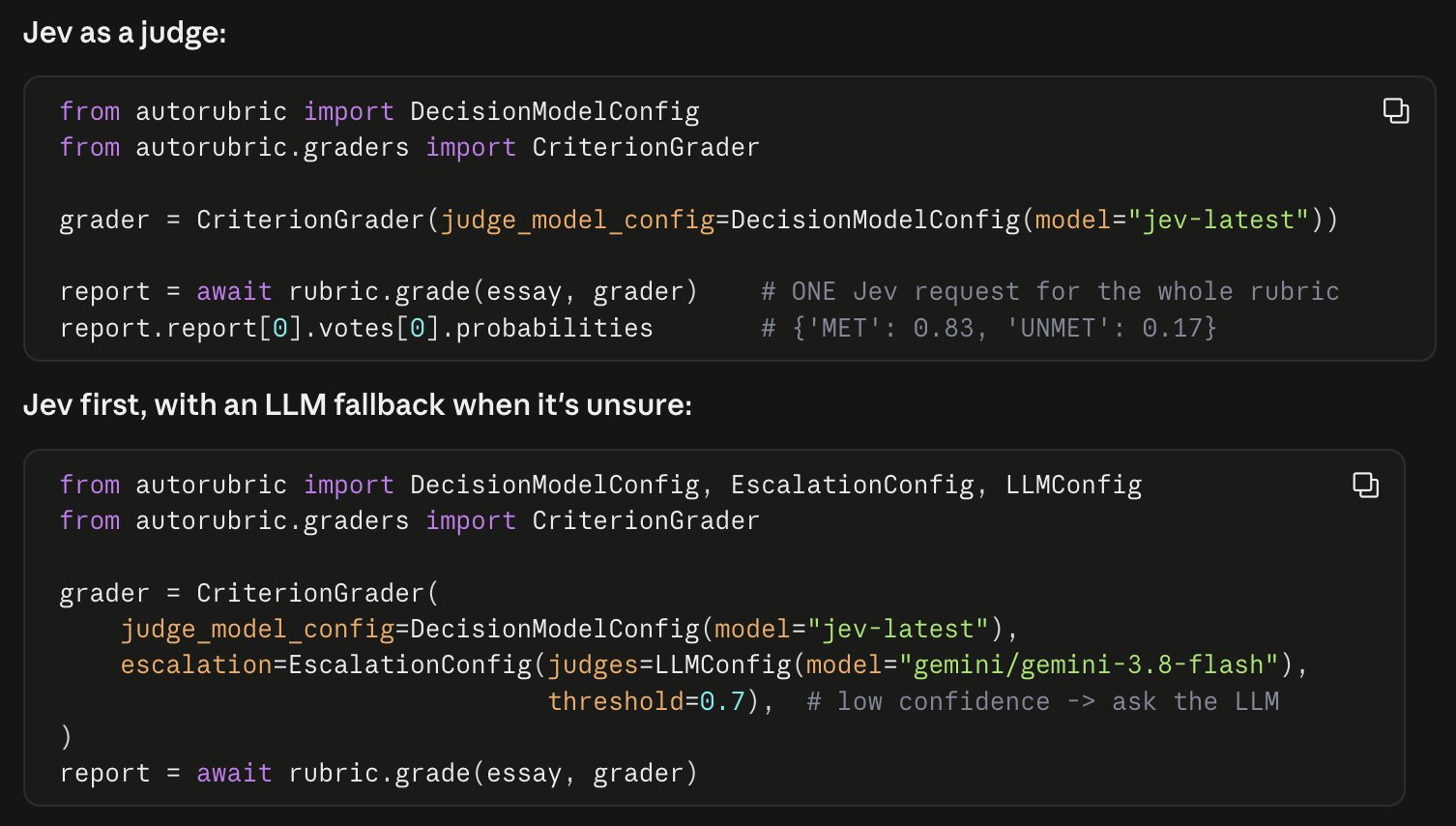

I spent some time investigating @typesafeai's Jev and striking to see them use a similar abstraction as autorubric -- released 8 months ago and to be presented at @COLM_conf next month. Our criterion types map 1:1 to Jev's Noul/Score/Choice: arxiv.org/abs/2603.00077

3
26
3,903
Nathan LeClaire retweeted

The Jev Router is our most transparent router to date, and it benchmarks very well!
See how it picks the model in the Chatroom sidebar, including cache-aware cost tradeoffs:


Introducing typesafe/jev-router: a cache-aware model router powered by Jev and @typesafeai
The Jev Router picks the best model and reasoning effort for each request, balancing quality, speed, and cost.
Here's how it works 👇🏻

14
9
120
18,869
YES! THIS IS WHAT I'M TALKING ABOUT!
We should be able to leverage both decision making and K/V cache by scoring and deliberately making tradeoffs
Jev Router keeps a model that works for the rest of the session.
It can raise or lower effort without switching models. It switches only when the expected gain is larger than the cost, including the cached chat it would lose.
1
1
18
1,812
Nathan LeClaire retweeted

How to use jev #1: As an embedder


I've been using Jev for all kinds of things. This morning I had a realization I kind of like:
Use it to make non-black-box embeddings.
Instead of an embedding model spitting out 1,536 numbers that mean nothing, you ask Jev questions about each document. The answers become the vector.
An email in Cora:
"I got charged twice this month, pls fix asap"
[is_customer, urgent, about_billing, needs_reply]
[1.0, 0.9, 1.0, 1.0]
A newsletter:
[0.0, 0.0, 0.0, 0.1]
A friend asking about lunch:
[0.0, 0.1, 0.0, 0.7]
Then it's just old-school cosine similarity search. Search "billing issues from customers" as [1, 0.5, 1, 0.5] and the double charge comes out on top.
Same idea for our articles at Every:
[is_tutorial, about_ai, contrarian, beginner_friendly]
Or support tickets:
[is_bug, angry, churn_risk, enterprise]
Every number has a name, so you can see why something matched. Need a new dimension? Add a question. Want urgent stuff first? Change the query vector.
Trying this in @CoraComputer now to make search fast.
29
62
1,059
238,433
We couldn't do what we do @typesafeai without our partners at @modal 🙏 thanks Modal team!

11
9
327
29,103
Nathan LeClaire retweeted

You've never routed like this before.
@OpenRouter is bringing Jev to all of your LLM calls, so your agentic workflows never have to waste a token again.
As always, faster, cheaper, more intelligent. Go build the future.
Introducing typesafe/jev-router: a cache-aware model router powered by Jev and @typesafeai
The Jev Router picks the best model and reasoning effort for each request, balancing quality, speed, and cost.
Here's how it works 👇🏻
93
224
3,403
407,457
Nathan LeClaire retweeted
DSPy methodology 🤝 System One
Program, don't prompt!

DSPy 3.4.0 was just released!
This release includes native support for Jev and System one models inside of DSPy! Use it with compatible signatures. This release also includes a brand new optimizer, ReAnchor, specifically for calibrating outputs with confidence.

12
31
325
36,308

Nathan LeClaire retweeted

DSPy 3.4.0 was just released!
This release includes native support for Jev and System one models inside of DSPy! Use it with compatible signatures. This release also includes a brand new optimizer, ReAnchor, specifically for calibrating outputs with confidence.
32
71
462
119,340

jev + opus 5.5... i simply can't comprehend why everyone isn't building this yet.
in my workflow, this cut costs and time by ~80%. i think it's one of the best ways to use it.
→ pick relevant project notes before loading the context
→ route suitable tasks to a faster worker
→ choose a recovery path when a tool fails
→ run focused checks before the full test suite
opus handles the hard reasoning. jev picks from options the harness prepares and validates.
i explain how to build the decision layer in the article below:


everything you need to start building with jev, in one article.
code, architecture, diagrams... everything you need to follow the build and make it your own.

170
419
5,221
998,693

