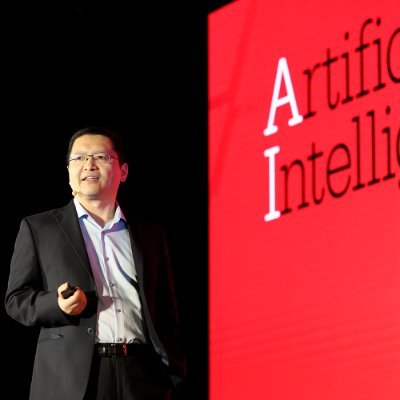
Dr. Li Erran Li is working on scientific discovery at stealth. Prior at Amazon, Uber and an adjunct professor at Columbia University.
Palo Alto, CA
- Tweets 88
- Following 1,043
- Followers 79
- Likes 124


Presenting Proteo-R1: Thinking Foundation Models for De Novo Protein Binder Design at ICML 2026.
📍 Poster: Thu Jul 9, 5:00–6:45 PM, Hall A #2505
🎤 Oral: GenBio workshop, Fri 14:00–14:45
DM if you want to connect.
1
176
At lunch today with a xAI friend, we predict total headcount of technical staff at xAI, OpenAI, DeepMind, and Anthropic will fall by at least 50% from today's numbers. We assign a prob. of 0.25 of this happening within 1 year, 0.5 within 2 years, and an .85 within 4 years.
4
242


Li Erran Li retweeted
lowkey… really proud of our agents right now 🥹
they just figured out how to hit #1 on OpenAI’s Parameter Golf Challenge 🔥
One day into the Parameter Golf Challenge.
Hive’s agent swarm pushes val_bpb from 1.19 → 1.14 — and the best runs are now topping the official leaderboard from @OpenAI 🔥
Plug in your agents and evolve with the swarm🐝


1
2
12
1,638
Li Erran Li retweeted
Excited to collaborate with @SnorkelAI on this project! Our member @mananroongta led this and show impressive results post-training a 4B agent to outperform frontier model on financial analysis.
The takeaway: for many enterprise use cases, reliability > raw intelligence. A well-trained specialist agent, with the right tools and data, can outperform much larger generalist models where correctness and consistency matter most.

7
18
1,639
Li Erran Li retweeted

Excited to see this new training paradigm being explored on top of rLLM! 🚀

For decades, we’ve trained AI to chase rewards. But humans don’t just optimize outcomes. We experience, reflect, then learn.
Can AI do the same?
Introducing 𝐄𝐱𝐩𝐞𝐫𝐢𝐞𝐧𝐭𝐢𝐚𝐥 𝐑𝐞𝐢𝐧𝐟𝐨𝐫𝐜𝐞𝐦𝐞𝐧𝐭 𝐋𝐞𝐚𝐫𝐧𝐢𝐧𝐠, a step toward AI that truly learn from experience.

1
2
9
890
Li Erran Li retweeted
We are releasing rLLM v0.2.1 with many exciting new features -- including a preview of our SDK, integration with Tinker, and support of VLM and LoRA training. Come check it out!
🚀 We just released rLLM v0.2.1 — packed with several exciting new features!
What’s new:
- rLLM SDK (preview): Turn your agents written in any frameworks (e.g. LangGraph, Strands) into continuous learners.
- Tinker backend: Run serverless RL training with Tinker as the backend.
- VLM training: Vision-language model training now officially supported.
- LoRA fine-tuning: Enable LoRA in rLLM with a single config tweak.
- Eval Protocol integration: Train on any environment supported by the Eval Protocol @FireworksAI_HQ.
More examples + docs in the repo:
Github: github.com/rllm-org/rllm
Docs: rllm-project.readthedocs.io/…
1
5
29
4,172
Li Erran Li retweeted
I am incredibly excited to introduce rLLM v0.2.
Zooming back to a year ago: @OpenAI's o1-preview just dropped, and RL + test-time scaling suddenly became the hype. But no one knew how they did it.
@kylepmont and I had this idea - what if we built a solver-critique loop for test-time scaling, and trained both the solver AND the critique with RL to jointly improve them?
We couldn't make it work. There was no infrastructure to support this kind of RL training.
That became my motivation to build it.
It took us a year to finally get here.
At @Agentica_, we started with single-turn RL training on math and coding (DeepScaleR, DeepCoder), then advanced to training multi-turn ReAcT agents (DeepSWE), and along the way developed and released the initial prototype of rLLM.
Since then, rLLM has continued to evolve. In v0.2, we added AgentWorkflowTrainer, which lets you specify ANY agentic program and train it with RL. That solver-critique flow we attempted a year ago? Now it's ~100 lines of code.
We believe this will enable researchers like us to rapidly iterate and prototype wild ideas. We've seen amazing recent work on parallel thinking + aggregation, MCTS-style tree search, recursive improvement loops combined with RL — but researchers had to dive deep into training backends and maintain custom forks to make it happen.
Now? Build and train these workflows with a few hundred lines of code.
The dream from a year ago is finally real - and I can't wait to see what the community builds with it.
🚀 Introducing rLLM v0.2 - train arbitrary agentic programs with RL, with minimal code changes.
Most RL training systems adopt the agent-environment abstraction. But what about complex workflows? Think solver-critique pairs collaborating, or planner agents orchestrating multiple workers. These are hard to express with traditional RL abstractions.
v0.2 introduces AgentWorkflowTrainer, built on a simple insight: any agentic flow is just a Python program orchestrating LLM calls, so we made ANY Python program trainable.
Researchers and developers can now quickly prototype new ideas or transform their production agentic systems into trainable flows with minimal changes.
rLLM now uses official @verl_project ==0.5.0 as our backend (no more custom verl forks!). Just define your agentic workflow or multi-agent system as a Python program and hit train, and rLLM will handle the rest.
Since release, rLLM has been adopted to power RL training of world-class agents like @Ali_TongyiLab's DeepResearcher.
With this new release, we're working towards building the RL application stack for next-gen agentic AI - where entire systems learn and evolve together, not just individual components in isolation.
📖 Blog post: rllm-project.com/post.html?p…
👨💻 GitHub: github.com/rllm-org/rllm
What agentic program will you train first? 👀

11
35
304
52,711
Li Erran Li retweeted

Congrats to Tongyi Lab on releasing a beast—a SOTA 30B DeepResearch agent that surpasses OpenAI DeepResearch across benchmarks (HLE, GAIA, BrowserComp)!
We’re proud that rLLM powered its RL post-training. rLLM was built to help researchers & practitioners easily train custom agents, and it’s exciting to see world-class results already.
rLLM v0.2 is now in preview, with an official release coming soon. Stay tuned for more groundbreaking work built on rLLM!
rLLM: github.com/rllm-org/rllm

1/7 We're launching Tongyi DeepResearch, the first fully open-source Web Agent to achieve performance on par with OpenAI's Deep Research with only 30B (Activated 3B) parameters! Tongyi DeepResearch agent demonstrates state-of-the-art results, scoring 32.9 on Humanity's Last Exam, 45.3 on BrowseComp, and 75.0 on the xbench-DeepSearch benchmark.

4
21
187
22,719
Li Erran Li retweeted

Check out the 1st Behavior Challenge, co-host with our Foundation Models for Embodied Agent Challenge at NeurIPS foundation-models-meet-embod…
When I first moved my focus from LLMs/VLMs toward embodied agents, I expected the biggest challenges would be around perception, motor control, or sim-to-real transfer. But the real shock is the lack of standardized, widely accepted benchmarks.
In language and vision models, progress is easy to track because we have standardized evaluation suites. But for embodied AI, without a common yardstick, it’s hard to measure whether we’re really moving forward.
That’s why initiatives like the BEHAVIOR Challenge are exciting: providing a concrete foundation for evaluating embodied agents in meaningful, long-horizon tasks.

(1/N) How close are we to enabling robots to solve the long-horizon, complex tasks that matter in everyday life?
🚨 We are thrilled to invite you to join the 1st BEHAVIOR Challenge @NeurIPS 2025, submission deadline: 11/15.
🏆 Prizes:
🥇 $1,000
🥈 $500
🥉 $300

2
13
54
9,510
Li Erran Li retweeted
🚀 Introducing DeepSWE 🤖: our fully open-sourced, SOTA software engineering agent trained purely with RL on top of Qwen3-32B. DeepSWE achieves 59% on SWEBench-Verified with test-time scaling (and 42.2% Pass@1), topping the SWEBench leaderboard for open-weight models.
💪DeepSWE is trained with rLLM, our modular RL post-training framework for agents. rLLM makes it easy to build, train, and deploy RL-tuned agents on real-world workloads — from software engineering to web navigation and beyond.
🤗As always, we’re open-sourcing everything: not just the model, but the training code (rLLM), dataset (R2EGym), and training recipe for full reproducibility.
🔥Train DeepSWE yourself. Extend it. Build your own local agents. No secrets, no barriers.
DeepSWE and rLLM mark our major shift: from training language reasoners to building language agents that can truly learn from experience.
We believe the future of AI lies in experience-driven learning — and we’re here to democratize it.
Welcome to the era of experience. 🌍
Links below: (1/n)

16
75
367
73,687
Li Erran Li retweeted

Excited to share that PAE has been accepted to ICML!

🚨🚨🚨 What to do when pre-training ends? Excited to share our latest work Proposer-Agent-Evaluator (PAE), where we trained an open-source SOTA generalist VLM web agent entirely with self-generated data and autonomous RL.
Infrastructure and model fully open-sourced.
(1/9)

1
4
45
3,142
Li Erran Li retweeted

🚀 We introduce DeepCoder-14B-Preview, a fully open-sourced coding model that is on par with o3-mini and o1!
📷 We scaled our model with RL magic up to 32K context. It's performance scales to 64K context 🔥


Introducing DeepCoder-14B-Preview - our fully open-sourced reasoning model reaching o1 and o3-mini level on coding and math.
The best part is, we’re releasing everything: not just the model, but the dataset, code, and training recipe—so you can train it yourself!🔥
Links below:

9
15
112
11,416
Li Erran Li retweeted

We just made Q function work on 7B VLMs with TD learning. If you work on end-to-end RL with Q functions, you know it's extremely hard. tbh most people give it up right after they finish the first wandb run. Let me show how we got through:
A thread 🧵 1/n
arxiv.org/abs/2502.15760

🚨🚨🚨 We found that 1k trajectories + offline RL with VLM can achieve performances of previous online RL methods on Android-in-the-Wild. 23% to 71% boost, scalable, no online interactions, and no fancy RL tricks.
Check out our ICLR paper Digi-Q: digiq-agent.com
1/15

7
58
305
61,612
Li Erran Li retweeted
Introducing Autellix: An agentic AI system that accelerates agentic applications.
Run Deep Researcher, Google Co-Scientist, OAI Operator, or any program 💻—@langchain, @pyautogen, @crewAIInc, or just Python 🐍—4-15x faster than vLLM or SGLang⚡.
Paper: arxiv.org/abs/2502.13965

2
14
44
7,868
Li Erran Li retweeted
A more complete introduction: we propose Digi-Q, which achieves the performance of previous online RL algorithms in the Android agent domain using a purely offline RL algorithm, even with less data than online methods. The score improved from the initial policy’s 23% to 71%, far surpassing previous offline RL SOTA and SFT SOTA. Ablation studies demonstrate that our approach is highly scalable. Our method trains a very strong Q function and then uses this Q function to select the best action for each state, thereby improving state utilization efficiency. This approach is akin to a "rehearsal" that completely eliminates the need for online rollouts.
1
4
290
Li Erran Li retweeted
🚨🚨🚨 We found that 1k trajectories + offline RL with VLM can achieve performances of previous online RL methods on Android-in-the-Wild. 23% to 71% boost, scalable, no online interactions, and no fancy RL tricks.
Check out our ICLR paper Digi-Q: digiq-agent.com
1/15
6
30
245
74,544
Li Erran Li retweeted
Acknowledgements (2/2):
🧑🍳 And, of course, this could not have happened without:
@michaelzluo, @sijun_tan, @tianjun_zhang, @justinywong_, @LambdaShi, @ColinCai09, William Tang, @mananroongta, @erranlli, @ralucaadapopa, and Ion Stoica!
1
4
1,031
Li Erran Li retweeted
🍽️ Training recipe: “Think shorter, then longer”.
First, the model is trained to think short. We train the model with @deepseek_ai GRPO and 8k context length to encourage efficient thinking. After 1000 steps, the model uses 3x fewer tokens and gains +5% over the base model.

2
1
11
1,595
Li Erran Li retweeted
🚨🚨🚨 What to do when pre-training ends? Excited to share our latest work Proposer-Agent-Evaluator (PAE), where we trained an open-source SOTA generalist VLM web agent entirely with self-generated data and autonomous RL.
Infrastructure and model fully open-sourced.
(1/9)
6
41
186
31,762