
The Community Call starts tomorrow at 3:30 PM UTC on X. Expect a look at what's shipped lately and what the team takes on next.

2
4
190
The Community Call is at 3:30 PM UTC on X. We'll go over what the team has shipped recently and what's lined up after that.

2
2
214
Catch us live on X at 3:30 PM UTC for the Community Call. We'll run through what's landed since last time and where we're going next.

1
1
197
Our Community Call is tomorrow at 3:30 PM UTC on X. We'll cover recent shipping and where things are headed, so bring questions.

1
2
200
Our discv5 PR just landed in ethlambda. Lean nodes can now find peers on their own instead of being handed a static bootnode list.
Off by default, you can enable it with --discovery.enable.

1
2
4
1,005
Our Community Call goes live at 3:30 PM UTC on X. We'll walk through the latest progress and what the team is focused on next.

1
1
104
Don't forget, our Community Call is tomorrow at 3:30 PM UTC on X. We'll cover what we've been shipping and where we're headed next.

1
104
Our Community Call is tomorrow at 3:30 PM UTC, live on X. We'll be walking through recent progress, key updates, and what's coming next. Join us.

1
114
Last week we fixed a bug in our pruning logic that was quietly costing us CPU and time to finality. The shape of the graph tells the story: things get worse when pruning starts, and go back to normal once the fix lands.

ALT Graphs showing Finalization and Justification delay on the top, and CPU usage on the bottom. All graphs show an increase from the left baseline after pruning was enabled, and a decrease back to the baseline once the fix was deployed.
1
2
8
807
Metrics are public, as always: metrics.ethlambda.xyz/

ALT Grafana dashboard showing the 512-validator devnet finalizing up to slot 34549 in the last 24 hours
22
Tomorrow at 3:30 PM UTC we're hosting our Community Call live on X. Latest updates, recent work, and what's ahead. Come hang with us.

90
Going live tomorrow at 3:30 PM UTC with our community call. We'll cover recent work, key updates, and what's ahead on the roadmap.

99
Our community call is tomorrow, live at 3:30 PM UTC.
Come hear what the team has been working on and what's next. See you there.

3
180
New blog post out: ethlambda, how we made our blocks arrive on time
In this post, we talk about how slow the proposer really is, and show how it can be made fast enough, without changing the underlying cryptographic primitives.

1
1
7
646
Going live tomorrow at 3:30 PM UTC with our community call. We'll cover recent work, key updates, and what's ahead on the roadmap.

75
Proving time is unchanged, but the same work now lands comfortably inside the deadline.
Benchmarked on our servers (8 cores / 16 threads, 64 GB). The happy path here is 1-attestation blocks with a single proof per attestation (no compaction).

1
72
Our community call is tomorrow, live on X at 3:30 PM UTC. Expect a full rundown of recent progress and what we're focusing on next.

87
Community call tomorrow. Join us live on X at 3:30 PM UTC. We'll be covering recent improvements and what's on the roadmap. Don't miss it.

2
58
New blog post out: ethlambda, devnet 5 and beyond.
Each devnet introduced a new piece of the protocol's complexity. Devnet 5 is now live and in interop testing, and it's a good time to look back at how far we've come and what's on the roadmap ahead.

1
3
5
276
In case anyone missed it, yesterday started the EF devnet 5 client interop runs. We already merged our devnet5 branch to main and are running internal devnets in parallel, looking for issues or performance improvement opportunities.

1
3
13
659
Community Call #20 is tomorrow, live on X at 3:30 PM UTC. We'll walk through what the team has been working on and what's ahead. Don't miss it.

68
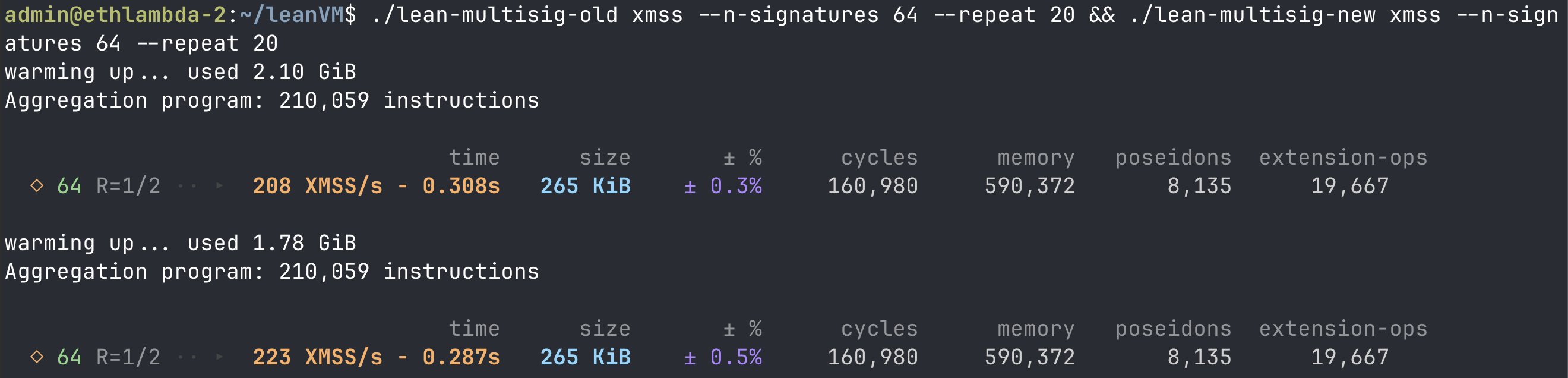
After investigating, we found the cause: a recently-created 256 MB buffer was being copied into a new memory location owned by the new allocator used by the library.
We made a fix for this, which resulted in an overall 7% improvement from the old version.
1
1
109
We saw an aggregation performance regression in a devnet, when trying out the newest leanVM changes. When running leanVM benchmarks on it, and comparing both the old and new commits, we found that the regression affected the raw XMSS aggregation only (not recursive aggregation).

1
1
8
540
We're going live tomorrow on X with our Community Call at 3:30 PM UTC. We'll be sharing what the team has been working on and what's next on our roadmap.

1
51
Post-quantum aggregation is slow, but leanVM recently introduced performance improvements that made it much faster.
On Devnet 5, worst-case proposal latency dropped from 2.5s to 1.3s, nearly a 2x improvement over the previous version.

3
4
12
830
Community Call tomorrow, live on X at 3:30 PM UTC. Fresh updates from the team, a look at recent progress, and what we're building toward. Join us.

2
91
Full-block aggregation is coming to devnet 5.
We've been running initial tests on our servers (shown on the last community call). Here's a look at the dashboard.

2
5
13
1,205
Tomorrow at 3:30 PM UTC, we're going live on for our Community Call. Expect a full rundown of recent work, this week's highlights, and what's coming next. See you there.

2
72
Here's a preview of ethlambda driving @ethrex_client over the Engine API. First demo of an all-@class_lambda Ethereum stack!
State tuned for more updates.

2
17
2,858
Wondering where ethlambda stands?
We put together a progress page with everything: completed devnets, active work, upcoming milestones, and the full roadmap ahead.
This is what building in public looks like.

3
6
23
1,571
Tomorrow at 3:30 PM UTC, we're going live on X for our Community Call. Expect a full rundown of recent work, this week's highlights, and what's coming next. See you there.

1
2
8
362
Ethlambda is now passing 100% of the Hive lean-spec-tests suites, the official conformance tests that run Lean Consensus clients against the spec.
Support for the new suites was merged yesterday, and we're looking into the few failing ones from rpc-compat and reqresp.

1
6
15
2,698
We're going live tomorrow on X with our Community Call at 3:30 PM UTC.
We'll be sharing the latest updates, what the team has been working on, and what's next on our roadmap.
Join us to get the full overview.

2
69
Watching fork choice in action.
Ethlambda's forkchoice visualization just landed a fresh round of upgrades from the hands of our contributors.
With clearer block tags, cleaner weight visualization, and scrolling fixes, forks have never looked this good.

1
3
10
647
Ethlambda documentation is now available. Everything you need to get started and go deep, all in one place.

1
2
6
616
Today, ethlambda is passing all leanConsensus hive tests! (except for nlean interop; we're working on that). You can see that at a glance in this nice view recently added by @ReamLabs.

1
2
10
743
We improved signature aggregation performance, a key component for scaling post-quantum Ethereum signatures, achieving a 3× increase in throughput after a series of optimizations and careful profiling.
In this post, we cover the key bottlenecks and the changes made.

1
3
10
2,573
Here's a peek at our internal devnet, currently finalizing with 2 ethlambda, 1 zeam and 1 gean clients 🚀

2
9
865
Join us tomorrow on X at 3:30 PM UTC for our Community Call.
This week we reached a 3x improvement in signature aggregation throughput. We’ll break down the changes, share the latest updates, and talk through what’s next.

2
75
Tomorrow we’re live on X with our Community Call at 3:30 PM UTC.
Tune in for updates on our latest progress and what lies ahead.

2
3
320
New blog post!
After covering LMD-GHOST in our previous write-up, we now move to the second half of consensus: finality.
How does the protocol decide when a block is truly permanent and cannot be reorged?
This post walks through 3SF-mini as implemented by @ethlambda_lean.

1
2
6
533
We’re going live tomorrow on X for our Community Call at 3:30 PM UTC.
Join us to hear what we’ve been building and what’s coming next.

1
2
62
Going live today on X.
Our Community Call starts at 2:30 PM UTC. Join us for updates, progress, and what’s next.

62
We are hosting the #10 Ethlambda Community Call tomorrow and will walk through recent progress, key insights, and upcoming work.
The call will be streamed live on X at 3:30 PM UTC. Join us to be part of the conversation.

1
1
71
New blog post.
Continuing our series, we dive into how we implement LMD-GHOST within Lean Consensus, and what that means for chain selection and network behavior.
Link below.

1
81

Tomorrow at 3:30 UTC we’re hosting the ethlambda community call.
Join the livestream on X and catch the latest updates.

1
5
369
We’re going live today.
Join us for the ethlambda community call at 3:30 PM (UTC) to hear the latest updates and what’s coming next.
Streaming on X.

1
1
2
288
Debugging consensus failures is difficult, especially without visualization tools. We recently added a live fork visualization for ethlambda (similar to forky).
Here's a quick demo.
1/3

1
1
4
462
See you tomorrow for the next ethlambda community call.
We’ll be live at 3:30 PM (UTC) to share updates, recent milestones, and what we’re building next.
Streaming on X.

1
3
303
Join us this Friday at 3:30 PM (UTC) for our 5th community call.
We’ll go over current progress and discuss what’s coming next.

1
3
4
806

A built-in metrics stack is coming to lean-quickstart!
We recently opened a PR adding Grafana+Prometheus+leanMetrics to lean-quickstart, making it even easier to run a local devnet with an observability stack.

3
2
7
1,269
New blog post!
Building a post-quantum Ethereum client with the help of shared tooling: what a Lean Consensus client consists of and what tooling facilitates its development.

1
2
4
319
Our next community call is happening tomorrow at 3:30 PM (UTC).
Join us for updates, insights, and a look at what’s coming next.

3
5
9
938
Our third community call is happening this Friday at 3:30 PM (UTC).
If you’re following ethlambda or want to go deeper into what we’re building, this one’s for you.

1
3
3
431
Our PR adding ethlambda to lean-quickstart was merged 🚀
You can now easily run a local devnet that includes our client.

3
4
10
2,820
We’re continuing the conversation.
Our second community call is this Friday at 3:30 PM (UTC). A space to share updates, ideas, and questions with the Ethlambda team.

2
3
8
709
