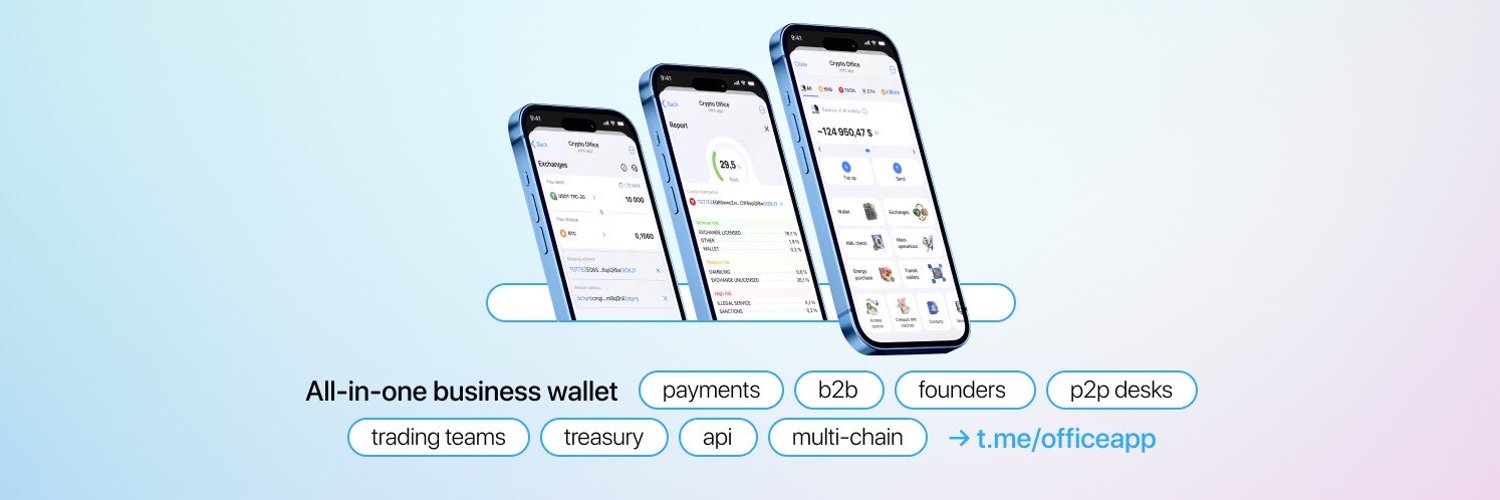

Crypto app for daily ops • Mass stablecoin payments & AML screening for founders, teams and personal use 📲 Get your wallet in-app → t.me/officeapp
Visit site ➡️
- Tweets 2,212
- Following 274
- Followers 1,028
- Likes 9,721


Pinned Tweet

Stablecoins made settlement faster, but the work around transfers can still be painfully manual
Businesses running on stablecoin rails or just getting started need an infrastructure for fast 24/7 payments, risk screening, accounting and asset movements as volume scales
So here are the tools Crypto Office provides to make crypto payment ops more scalable and easier to manage:
💼 All balances in one app
• See your full crypto balance across wallets and major chains without switching tabs. Wallets, transfers, balances, transaction statuses and fund flows are all visible in a single place
💸 Mass payouts
• Upload a file with wallet addresses and amounts then execute the full payout list at once. No manual copy-pasting required
🛡️ Single and bulk AML checks
• Screen a single address before sending or check an entire batch. Reduce the risk of funds being frozen or lost
📊 Multiple AML providers and risk reports
• Access risk data from multiple providers in one place. Generate reports to support transaction monitoring, internal controls and compliance decisions
👛 Transit wallets
• Use dedicated addresses for different clients, business lines, or use cases. Payments stay easy to trace and incoming funds are clearly attributed
🔄 Cross-chain swaps
• Swap assets across major blockchains without holding the native gas token. Our app automatically finds the best route to reduce fees and delays, runs AML checks before the transfer and provides access to CEX liquidity for every swap
🧾 Invoices, accounting, and reporting
• Generate payment checks and invoices, track incoming and outgoing payments, match them to transactions, and export structured financial data
⚡ TRON Energy
• Rent @trondao energy for $USDT payouts to cut network fee spend. In high-volume setups, savings can reach up to 50%
🔌 API and webhooks
• Address generation, payouts, balance updates, swaps, and AML events sync directly into your internal back office
🤝🏼 Referral Revenue Share
• Invite users and earn up to 15% from their activity. It is a simple and transparent way to generate additional income
——————————————————
Our DMs are open for conversations, collaborations and strategic partnerships
Get started below ⤵️

8
1
11
491
We can’t stay quiet about how founders and crypto teams scale payments without accounting for the operational risks
▫️ 10 stablecoin payments a day can look like just a spreadsheet problem
◽️ At 100 payments, the spreadsheet is already part of ops: addresses, networks, amounts, AML checks, transaction and balance statuses, reconciliation, fees. Every manual step takes time and creates another point of operational risk and potential error
◻️ At 1000, the volume changes the process itself. You need batching, automated checks, clear statuses and control over what actually happened to every payment
🚨 There’s also the AML risk. One unchecked address can turn a normal payment into a compliance issue, and manual screening doesn’t scale with volume. We talk about this a lot already, but that’s not the main point here
The main point is that scaling payment volume without scaling your ops can very quickly turn into an expensive game of losses and op risk
If this sounds familiar, we’ve got good news for you. Our DM is open ✉️
7
2
10
135
Get your business wallet in-app:
📲 t.me/officeapp
🌐 crypto-office.com
4
103
gOffice 👋🏼
Seen @Visa survey putting a hard number on the stablecoin shift?
Bank protection lifts willingness to use them from 36% to 56%. Onchain dollars are moving from primitive to production-grade rails
So curious which chain comes out on top for your everyday payments?
25%
Tron
0%
Ethereum
25%
Base
50%
Solana
0%
0%
0%
0%
4 votes • Final results
3
1
7
136
11 rules we actually use in crypto payment ops
>> Don’t mix payroll, OTC and “just this once” on one address
>> Risk score first, send second
>> Your counterparty or partner can be legit. Their wallet might not be
>> Stablecoins fixed settlement, but they didn’t fix dirty inflows. That is the part most people keep skipping.
>> Never deposit to a CEX from the same wallet that collects random inflows. Use a transit wallet in between
>> “I know the guy” ≠ clean history
>> A medium risk score is not safe. It’s already a small warning that calls for extra steps
>> Keep invoices, tx history and chats before you need them
>> If your regular stablecoin payments run on @trondao, rented Energy can cut costs by up to 50%
>> A mass payout is one file instead of dozens of clicks. Addresses, amounts, chains. Then one send
>> Save this checklist. Unless you use Crypto Office
What did we miss? 🤔
9
11
416
Make these rules part of your payment ops:
📲 t.me/officeapp
🌐 crypto-office.com
3
221
Just a friendly reminder that your wallet has a risk score. You know that, right❔
Today’s a good day to check it
👇🏼
12
16
215
You can check your AML risk in-app:
📲 t.me/officeapp
🌐 crypto-office.com
3
240
gSaturday
Btw you can create a wallet in our app without registration or KYC
👇🏼 Just open it in @telegram:
9
13
195
Stablecoins made settlement faster, but the work around transfers can still be painfully manual
Businesses running on stablecoin rails or just getting started need an infrastructure for fast 24/7 payments, risk screening, accounting and asset movements as volume scales
So here are the tools Crypto Office provides to make crypto payment ops more scalable and easier to manage:
💼 All balances in one app
• See your full crypto balance across wallets and major chains without switching tabs. Wallets, transfers, balances, transaction statuses and fund flows are all visible in a single place
💸 Mass payouts
• Upload a file with wallet addresses and amounts then execute the full payout list at once. No manual copy-pasting required
🛡️ Single and bulk AML checks
• Screen a single address before sending or check an entire batch. Reduce the risk of funds being frozen or lost
📊 Multiple AML providers and risk reports
• Access risk data from multiple providers in one place. Generate reports to support transaction monitoring, internal controls and compliance decisions
👛 Transit wallets
• Use dedicated addresses for different clients, business lines, or use cases. Payments stay easy to trace and incoming funds are clearly attributed
🔄 Cross-chain swaps
• Swap assets across major blockchains without holding the native gas token. Our app automatically finds the best route to reduce fees and delays, runs AML checks before the transfer and provides access to CEX liquidity for every swap
🧾 Invoices, accounting, and reporting
• Generate payment checks and invoices, track incoming and outgoing payments, match them to transactions, and export structured financial data
⚡ TRON Energy
• Rent @trondao energy for $USDT payouts to cut network fee spend. In high-volume setups, savings can reach up to 50%
🔌 API and webhooks
• Address generation, payouts, balance updates, swaps, and AML events sync directly into your internal back office
🤝🏼 Referral Revenue Share
• Invite users and earn up to 15% from their activity. It is a simple and transparent way to generate additional income
——————————————————
Our DMs are open for conversations, collaborations and strategic partnerships
Get started below ⤵️
8
1
11
491
Everyone saw it. The CLARITY Act vote failed. CT spent a night doomscrolling, the market moved, and everyone moved on
But the more useful question is what this means for businesses building in crypto?
🏛️ The bill got stuck on two issues: rules for public officials holding crypto assets, and yield on stablecoins
Banks have an obvious problem with yield-bearing stablecoins. They compete for deposits, and deposits are the foundation of the banking business. Banks are protecting a core source of funding
That does not mean banks have to be left out
🏦 There is already a working model. Reserves sit with a bank. The bank handles KYC, fiat on and off ramps, distribution and earns its share of the economics
⚖️ Stablecoin holders receive part of the yield. That is much closer to how the market will actually work than a full rejection of traditional financial infrastructure
The world does not need to move fully onchain for stablecoins to become a mainstream payment tool
🇺🇸 And the US is not the final chapter of this market. Crypto trading is still banned in mainland China
Major jurisdictions are still working out their long-term approach. The CLARITY Act failing matters, but it is part of a bigger issue. In two years US policy has shifted from regulation by enforcement to an openly pro-crypto SEC. When the rules depend this heavily on one administration, the next one can reverse course just as fast
——————————————
Senator Lummis says the next realistic window for a comprehensive bill may not come until 2030
——————————————
⏳ While the US waits, the UAE, Singapore, Hong Kong, the EU under MiCA, and Kazakhstan already have functioning frameworks. Companies can understand the rules, secure a license, build banking relationships, and plan beyond the next election cycle
For many crypto and fintech companies, the sensible play looks like this:
🌐 Build the operating core outside the US
▫️Get licensed where rules are already in force, not where they are still being debated. At the same time, design the product architecture to be compatible with the GENIUS Act, even if the US is not on the roadmap today
🤝🏼 Bring a bank in from day one
▫️Every durable stablecoin and payments model has a bank in it. And bank partnerships usually take longer than building the product itself. This business comes down to three things: banks, liquidity, and customers. Most other problems can be solved around them
📜 Governments should treat predictability as a product
▫️ Stable rules, clear requirements, and credible conflict-of-interest standards give a jurisdiction a real edge. That is where companies will go while Washington tells them to wait
——————————————
The US will eventually pass a major crypto bill. The winners will be the companies that arrive with licenses, banking infrastructure, liquidity, and a working product
If US regulation keeps stalling, the country will still try to extend its requirements through market access, banks, and counterparties-first to the EU, the UK and Canada, then much further
Maybe the US is no longer the default
💬 Genuinely curious which jurisdictions people are betting on now?
9
2
14
336
What a high risk score actually means and what to look at beyond the percentage
▫️A high risk score means an address or a specific transaction has links to sources flagged as high risk. That includes sanctioned or scam-related addresses, mixers, darknet markets, hacked funds or other suspicious services
▫️The score comes from onchain analysis. It looks at where the funds came from, which addresses and services they moved through, how close the connection is to a risky source and what share of the funds is affected
⛔️ But a high percentage is not a final verdict
▫️A 70% risk score can mean funds came directly from a scam address recently. Or it can reflect an indirect connection through several hops that happened years ago. The percentage might be identical, but the actual risk and the level of attention required are completely different
▫️That’s why the overall score is only part of the picture. You also need to look at the risk category, the share of exposure, whether that exposure is direct or indirect, and how recent the transactions are
▫️It also matters which provider produced the result. AML tools use different data sources, scoring methodologies, and address labels, so the same address can receive different assessments
Crypto Office brings single and bulk AML checks from multiple providers into your payment process, complete with risk breakdowns and exportable reports
So if you’re building or running payment ops, we’re always open to a conversation
📨👇🏽
7
12
320
Everything looks simple until your team has to process 30 payments in a day
▫️When you only have a few payments, you can pull the wallet address from chats, double-check the amount with a teammate and track status in a spreadsheet. But at thirty transfers a day that setup eats up half the team's time
▫️Someone updates an address or tweaks an invoice amount. The payment looks ready but your team still has to verify every detail manually before hitting send
▫️At scale your entire payment workflow needs to live in one platform instead of being put together manually every time
Crypto Office puts this whole process into a single interface so your team can handle payments without the manual mess
Visit the app to learn more or message us if you want to discuss how you manage payment processes
📨👇🏽
11
1
16
294
Before a crypto B2B payment goes out, you need to understand where the funds came from
▫️The transaction trail may lead back to hacks, mixers, sanctioned wallets or high-risk platforms
▫️So your partner’s wallet may look clean today. But the funds in it could have moved through several wallets from a risky source. Looking at the balance alone won’t show you that
▫️Tracing where those funds came from gives your team more control before sending a payment
With Crypto Office, every payment is automatically risk-checked before it goes out. You can review the recipient wallet, see the risk signals and decide whether to proceed
Questions, feedback or partnership ideas?
Feel free to DM us 📨
4
7
234
Global payments are still treated like a bank problem, even when the business has already outgrown traditional banking
Without bank hours or weekends settlement happens in minutes. That level of predictability changes how companies handle international payouts to remote teams and cross-border partners
Removing banks from the loop eliminates both extra fees and constant execution delays
This is where stablecoins win in global payments. They give businesses a single, consistent settlement layer across every market instead of adapting to local bank rules every time

Businesses and teams switch to stablecoins to fix specific operational bottlenecks. Cross-border payments usually break down at the routing layer, where extra intermediaries add costs, drag out settlement times and blind you to fund status
Stablecoins let businesses structure this settlement around their own cash flow needs rather than correspondent banking rails
3
280
Ethereum is finally taking on one of the most frustrating things in crypto
Yesterday, people in CT were talking about @ethereum wanting to let users pay fees in stablecoins without having to hold $ETH for gas by 2027
Why is this still such a big deal in crypto?
A new wave of crypto users can’t be expected to figure out which native token they need for fees and where to buy it during onboarding
Gas should be part of the process and it shouldn’t become a side quest for the user
At Crypto Office we got rid of that extra step a long time ago. For everyday transfers and cross-chain swaps there’s no need to buy and hold a native token for gas in advance. Having $USDT or $USDC on the right network is enough
Try it yourself ⤵️

6
11
239