

The prime broker for prediction markets
- Tweets 93
- Following 2
- Followers 1,162
- Likes 152


Pinned Tweet

Prediction market trading for funds and pro traders.
Book a demo → calendar.app.google/pxy9grqP…

15
2
82
35,568
In the wake of @kalshi and @polymarket taking sports volume, @draftkings, @underdog, and @fanduel have recently started to operate their own native prediction market products (DCM or FCM).
“Sportsbooks vs prediction markets” is the wrong question.
The two categories are converging.
4
1
15
1,514
A 2c improvement on 50,000 contracts is $1,000. Now multiply that by every game in the season.
For any serious trading firm, checking every exchange for the best price & fills not optional.
River Markets handles this all for you, giving you an average price improvement of 2c, letting you focus on your models and trading.
4
2
13
1,978
NFL Week 1 generated more than $1B in volume.
Demand showed across @Kalshi, @Polymarket, @Novig, Rothera, @ProphetX, etc...
Sports trading has quickly become a multi-venue market.
If you’re only trading on one venue, you’re leaving better prices and liquidity on the table.

3
1
21
2,535

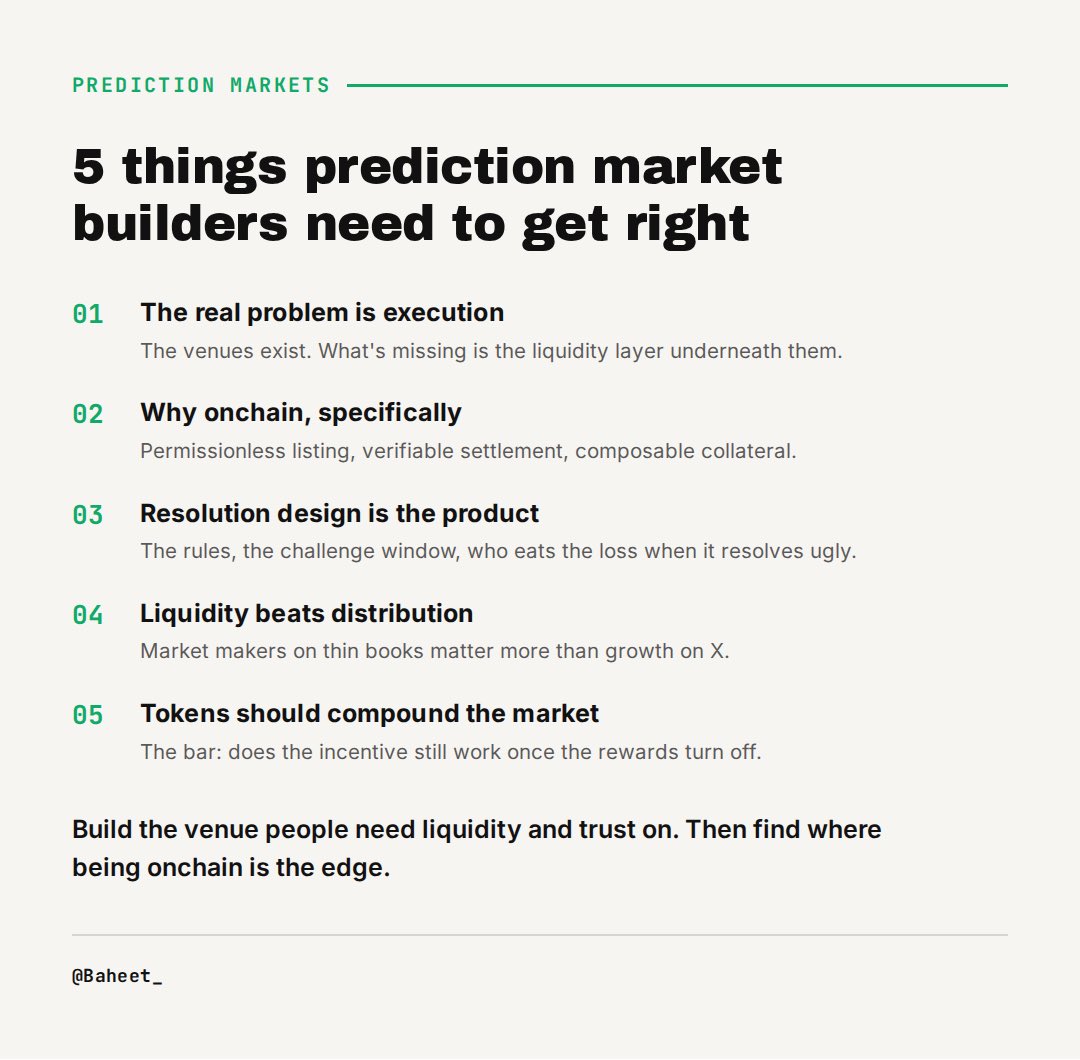
if you're building in prediction markets, here are 5 things you need to get right:
1. solve an actual execution or pricing problem-
the venues already exist. kalshi, polymarket, limitless, pred….
and a dozen smaller books already cover the popular events and a decent slice of the long tail
what's missing is the layer underneath:
liquidity that's fragmented across books pricing the same event as if they were different instruments.
build the layer that tackles this, a good example is @river_markets, @magicmarkets and @uselotusxyz
if your product is another frontend for trading markets…
be specific about which inefficiency in execution, pricing, discovery or resolution you're actually fixing before you even write a deck
the idea really to make sure, you are not competing in a saturated niche
—-
2. have a real answer for why this needs to be onchain or offchain
the truth is a prediction market app doesn't need a blockchain to let people bet on an election
what crypto rails can actually give you is permissionless listing, verifiable and trustless settlement, a more global distribution and composability with existing defi infras.
and if you are going through the offchain path to target a more defined geography or market, you need to have good reasons for it also
for example: are you an onchain sport exchange like @predofficial? or just an sportsbook
this will also help you map your core competitors
—-
3. resolution design is the most important part-
resolution and settlement is the actual product. who writes the rules, how ambiguous wording gets handled, what the challenge window looks like, who eats the loss when a market resolves ugly
for example sports has clean data feeds and results within minutes.
politics has ambiguous wording and adverse selection that shows up weeks later
a poor resolution event can send your product to zero in a single week
you need to factor all these in.
—-
4. liquidity bootstrapping is the real distribution problem here-
the usual crypto playbook (grow on x, run points, do an airdrop) gets you traders, not depth
what a market needs on day one is market makers willing to post two-sided quotes on thin books, with real answers on inventory limits, hedging,
and what happens when a news shock moves the book faster than anyone can react. a book with no depth doesn't get traded
@Outcomexyz is a good example of projects worth studying here, study how they designed their liquidity rewards program from day one
—-
5. token and fee design should compound the market, not just pay people to show up
builder codes, lp incentives, and rebates work when they make the next market easier to list and the next quote tighter
an emissions schedule that's only rewarding volume doesn't survive being turned off
most importantly, ask whether your incentive structure still holds once the rewards stop
I personally don’t see any reason why a pm should tokenize but that is just my opinion
there is a still a lot things worth checking but i believe getting these 5 right will give your product a solid foundation
6
9
42
1,316
It feels like there's a new prediction market every week. @Kalshi @Polymarket @OG_com @Novig
The same market has a different book depending on where you're trading
Anyone moving big size indirectly loses thousands due to not optimizing their venues
If this is you, we can help
1
1
20
1,396
Excited to be joining @AlpacaHQ and @tryconviction this Sunday in SF

Our Chief Brokerage Officer, Tony Lee, will kick things off with a conversation on the infrastructure behind modern investing and how Alpaca is supporting new ways to research, build, and execute trading strategies. We’ll also hear from @oscar_lvy, Founder & CEO of @river_markets, on prediction markets and the evolution of professional trading.
1
14
905
The same @NFL lines on @Kalshi and @Polymarket have different prices and liquidity depth.
We've addressed this & let you merge order books, always routing your trades for the best price and fills.

3
1
13
951
100M event contracts traded.
Four months after launch.
We’re honored to be the trusted execution partner for the top funds in prediction markets.
Thank you to all of our partners trading with River Markets.
Book a demo today
→ rivermarkets.com

5
1
28
3,671
Saturday morning, @DarioAmodei posted, saying AI labs should slow, expressing worries of AGI.
After, @elonmusk and @sama agreed.
Soon, markets on @Polymarket and @Kalshi shifted to reflect this news.
Tradfi only runs Mon-Fri, but market-moving info doesn't cease on weekends.


I agree with Dario that we need to pace the frontier. This has been a primary topic of discussions we've had at OpenAI in recent weeks.
Committing to having independent evaluators with employee-like access is a great idea, and we will do the same. We'll have more to share soon.
1
4
19
1,454
What happens when a PM settles before the event is over?
The clock hit zero, and @Kalshi paid out @WMU_Football holders
Officials reviewed the final play and restored one second
Michigan used it to complete a Hail Mary, winning 13–12...
Read article: rivermarkets.com/insights/ka…

2
18
1,043
Placing any large order on @Kalshi or @Polymarket tells your counterparty your thesis.
Use iceberg orders to get better, gradual fills which don't shock the book.

5
3
39
5,260
River Markets retweeted

This is a strong example of what prediction markets are becoming: not isolated venues, but fragmented liquidity that can be intelligently routed.
If the same outcome is priced differently across Kalshi and Polymarket, the edge isn't just choosing the right event, it's finding the best execution.
That's where River Markets gets particularly interesting: aggregating markets, improving price discovery and reducing friction for the user.
As prediction markets mature, the infrastructure connecting them could become just as important as the markets themselves.
One to watch. 👀 @river_markets

The same event can trade at entirely different prices on @Kalshi and @Polymarket
Stop overpaying on each trade.
Always get the best price on rivermarkets.com

3
4
221
The same event can trade at entirely different prices on @Kalshi and @Polymarket
Stop overpaying on each trade.
Always get the best price on rivermarkets.com
3
4
25
1,817
Stop leaking money on @Kalshi @Polymarket
Get a 4% price improvement on each trade 👇

3
4
16
842
Focus on trading, not maintaining adapters.
Every prediction market has its own API, market identifiers, order syntax, and updates. Adding another venue means another integration to build, monitor, and fix.
River gives you one API across prediction markets, so you can spend your time finding alpha, not building infra.
Read more:
rivermarkets.com/insights/un…
2
2
13
743
The hidden 2.4% tax on your prediction market trades
If you trade size in prediction markets, you already know the drill: the bigger your order, the worse your fill. We ran 50k contracts through every major venue during the July fed decision, all fees in.
Polymarket US was $3,033 more expensive than River. Polymarket , $1,425. Kalshi, $945.
Check out the full article below ⬇️
rivermarkets.com/insights/pr…

6
2
29
3,074
River Markets retweeted

Institutions trading on event contracts need deep liquidity and powerful tools that ensure they execute trades efficiently.
We’re excited to lead the seed round of @river_markets as they build the prime brokerage layer for prediction markets.
More here: haun.co/writing/the-executio…
13
4
57
8,285
Today, River Markets announced an $8.5M seed round led by @HaunVentures
We’re building the prime broker for prediction markets, giving professional trading firms unified execution and risk across venues.
Thanks to @FortuneMagazine and @c_grigera for covering what we're building
fortune.com/2026/08/11/exclu…
34
8
126
18,762
River Markets retweeted

While prediction markets continue to gain rapid adoption, its pro trading infrastructure has lagged behind... until today!
Excited to back @oscar_lvy @antonin_parrot and the @river_markets team as they build the prime brokerage for prediction markets. Congrats, team!
Today, River Markets announced an $8.5M seed round led by @HaunVentures .
We’re building the prime broker for prediction markets, giving professional trading firms unified execution and risk across venues.
Blog post : rivermarkets.com/blog/announ…

11
2
41
3,628
Today, River Markets announced an $8.5M seed round led by @HaunVentures .
We’re building the prime broker for prediction markets, giving professional trading firms unified execution and risk across venues.
Blog post : rivermarkets.com/blog/announ…
47
26
270
86,302
We launched on May 1st with trading teams that included several of the top 10 traders by volume on Kalshi and Polymarket.
Today, leading hedge funds and proprietary trading firms use River Markets to trade prediction markets at scale.
2
10
1,509
The round includes @ycombinator , @cbventures , @ufo_holdings , Qube Research and Technology (QRT), TENET, Humbition, Kima Ventures, Cherry Ventures, Stack Asset Management and Perpetual Strategies, alongside Mark Kornfilt, Jacob Fortinsky (Novig) and an exceptional group of angel investors.
Trading prediction markets professionally?
See how River Markets saves firms 2% on each trade:
calendar.app.google/RRBxj2cH…
10
1,293