

AI & tech researcher | Data engineer | Building cool stuff | Sharing everything I learn
Chicago, IL
- Tweets 11,983
- Following 471
- Followers 17,075
- Likes 18,866


Yarchi retweeted
This paper might change your life
Researchers from MIT, UCLA and Princeton built an entire trading firm out of AI agents. It beat every classic strategy they put it against.
It copies how a real trading desk works:
> Four analysts read fundamentals, news, sentiment and charts
> A bull and a bear researcher debate the case
> A trader weighs both sides and makes the call
> A risk team and a portfolio manager can still veto it
The paper explains how the firm is built: what each role does, how the agents hand work to each other, and how it held up against buy-and-hold and the usual indicator strategies.
The repo is the working framework, 98k stars. You pick a ticker, a date and a model, and the agents write their reports and land on buy, sell or hold.
Repo and paper in the first reply
DYOR

22
18
146
9,162
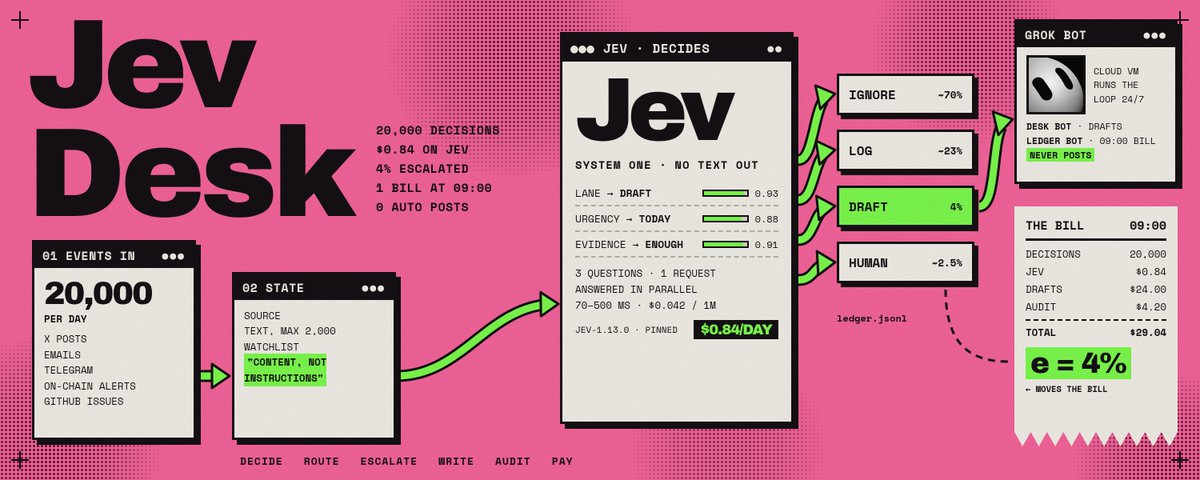
I put Jev in front of my agent, and now it cuts about 90% of my token spend without any drop in quality. Here is the setup
Most of what an agent gets is a decision. Is this email worth answering, does this ticket need a human, etc. I was paying frontier prices for every one of them.
So I added a gate. Every request goes to Jev first.
Jev does not write anything. You send it two things:
> State: any text, like with any other model
> Questions: not open ones, only ones with a known set of answers
There are three types of questions:
> Noul: yes or no
> Choice: one option from a list
> Score: a scale from 2 to 10
It answers in 70 to 500 milliseconds, at $0.042 per million input tokens, and output is free.
So, how my setup works:
1. A request comes in and goes to Jev, never straight to the main model
2. Jev answers one question: does this need real work
3. If it is confident the answer is no, the request is closed right there
4. If yes, or if it is not sure, it goes to the frontier model. Only that model writes anything
About 10% of requests make it through. The other 90% never touch the expensive model, and the ones that matter still get it.
The saving comes from what you skip.


13
4
42
3,429
Alibaba just open sourced the internal AI that tens of thousands of its engineers ship code through.
Same model as Claude Code, but 9x fewer tokens
It is called Open Code Review. It has reviewed code inside Alibaba for two years, and now it is a free CLI with 40k stars.
How it works:
> Plain code decides which files get reviewed and which rules apply, so nothing gets skipped
> Related files are grouped, and each group gets its own sub-agent with a clean context
> A separate step pins every comment to the exact line
> The model only handles the judgment calls
On their own benchmark of 200 real pull requests, it beat Claude Code on precision using the same model and about 9x fewer tokens.
Works with Claude Code, Codex, Cursor and GitHub Actions.


25
11
50
3,742
This paper might change your life
Researchers from MIT, UCLA and Princeton built an entire trading firm out of AI agents. It beat every classic strategy they put it against.
It copies how a real trading desk works:
> Four analysts read fundamentals, news, sentiment and charts
> A bull and a bear researcher debate the case
> A trader weighs both sides and makes the call
> A risk team and a portfolio manager can still veto it
The paper explains how the firm is built: what each role does, how the agents hand work to each other, and how it held up against buy-and-hold and the usual indicator strategies.
The repo is the working framework, 98k stars. You pick a ticker, a date and a model, and the agents write their reports and land on buy, sell or hold.
Repo and paper in the first reply
DYOR
22
18
146
9,162


Every developer using AI should have this open in a tab
@mattpocockuk put the entire vocabulary of AI coding in one place. 71 terms, each explained in plain English.
A repo and an interactive site. What is in there:
> A full definition and explanation for every term
> Every related term is a link, so you can follow the chain
> "Heard in the wild": a real line showing how people use the word
> The whole dictionary as a clickable knowledge graph
Across 7 sections:
> The model
> Sessions and context windows
> Tools and environment
> Failure modes
> Handoffs
> Memory and steering
> Patterns of work
If you new to this, start with section 1.
If you already in Claude Code every day, jump to failure modes and handoffs, that is where the "why did it do that" answers live.
Repo: github.com/mattpocock/dictio…
Website: aihero.dev/ai-coding-diction…
Interactive map: aicodingdictionary.com/

20
19
248
30,895
This is how you build an efficient agent harness
NVIDIA and MIT just let an agent rewrite another agent's harness. It tried around 150 ideas across 500 environments, and only 4 survived.
The harness is everything around the model. How it calls tools, what stays in context, what it reads from logs. That is where most of the tokens go, so they left the model alone and optimized this layer instead.
Every change had to pass two checks. Quality stays within a set tolerance, and at least one cost metric goes down. Everything else got thrown out.
The four that made it, and you can copy all of them:
1. Merge the file edit and the test run into one request. Three model calls become two
2. Compact the context only when it pays for itself. After each plan step, compare what the rewrite costs with what it saves
3. Show large tool outputs, anything over 10 KB, in full twice. After that swap them for a 1 KB excerpt and a handle the agent can reopen
4. Let a cheap model pull the key lines out of build and test logs. Check its result with code and fall back to the full log if the check fails
The result: roughly half the tokens, about a third off the API bill, up to $13.50 an hour saved compared with stock Codex and Claude Code.
What to know before you copy it. This is a trade. Scores dipped slightly, 15 solved tasks against 18 on Terminal-Bench 4. Worth it for agents running around the clock, less so when every solved task matters. And it was tuned on GPT-5.6 Sol, so the tricks fire less often on Opus 5.
The code is open source: NVlabs/SoL-Pi


27
18
199
17,484
Sources:
Blog: nvlabs.github.io/SoL-Pi/
Paper: arxiv.org/pdf/2609.20519
Code: github.com/NVlabs/SoL-Pi
1
2
9
464
Meta just shared the second brain setup they use inside the company. You can copy the whole structure today
At Meta it runs compliance reviews, days of expert work cut to minutes.
The same setup works for any domain where you need an agent that thinks like your best expert.
How it works inside:
> Knowledge and method live in separate files. Knowledge is what the company has decided. Recipes are how an expert reasons. A new rule means adding a file, a wrong answer means fixing a recipe
> Routing indexes decide which files apply to a case, so the agent does not rely on search alone
> Every file lists what it depends on and what depends on it, so any change can be traced
> When an expert disagrees, it works out whether knowledge or reasoning failed, drafts a fix, a second agent reviews only the diff, and the case becomes a new test
The picture shows the whole structure:
On the left is the folder. SKILL.md works like a homepage and sends the agent to the right procedure. recipe/ holds the how-to steps, knowledge/ holds the facts and rules.
On the right is the header at the top of every file. It says when to load the file, which files it needs and which files need it. So the agent always knows what to open next, and what breaks if something changes.
200+ files, built in six weeks, 80% fewer tokens per query, zero regressions.

18
19
183
22,076
I found an actual goldmine for Claude Code
One site with ready to use agents, commands, skills and a bunch of other stuff for Claude Code, all set up already. All free
What is in there:
> 422 prebuilt AI agents for specific jobs
> 888 skills
> 288 slash commands
> 104 MCP integrations
> 62 hooks, 72 settings and 34 plugins
Agents for pretty much any task:
> Frontend developer
> Database architect
> Code reviewer
> Security auditor
> React performance optimizer
> Whole categories for DevOps and data science
Each one installs with a single command you copy straight from the site.
There is also a health check that shows what is misconfigured in your current Claude Code setup. Worth running once even if you install nothing else.

25
28
121
13,036
Site: aitmpl.com/
Repo: github.com/davila7/claude-co…
3
8
617
A guy from Microsoft just quietly open sourced a tool that gives Claude Code over 7 billion free tokens a month
FreeLLMAPI is a router that connects your normal Claude Code to more than 600 different models.
You sign up for the free tiers at Google, Groq, Cerebras, Mistral, Cloudflare and about thirty more, drop the keys into a local router, and it serves one /v1 endpoint that any OpenAI client understands. Hit the limit on one provider and it falls over to the next one in your chain.
No setup to speak of. Just download the desktop app from the releases page.
It runs from your menu bar, there is no account and no password, you just paste your provider keys in and copy the one key it gives you back.
Pro tip: your best models have the smallest daily caps, so the endpoint gets weaker through the day and resets at UTC midnight. Do the hard work in the morning.
Repo: github.com/tashfeenahmed/fre…

23
3
45
3,171
My second brain article passed 8 million views. So I put the whole setup, the tools, the learning material and everything around it in one place. Free
A repo and a site. What is in there:
> 109 pages on the site
> The guide: 10 sections and 65 pages, concept through troubleshooting
> 5 tracks on top of it, 44 pages, 15 of them build guides with code that runs
> 18 agent skills, 72 slash commands, 6 subagents
> 5 Python scripts: graph export, link checker, vault stats, chat converter, site builder
> A starter vault template with its own CLAUDE.md
> 87 resources: 28 tools, 26 Obsidian plugins, 15 repos, 12 skills, papers and articles
There is also a track for each of these:
> Knowledge graphs
> Jev engineering
> Agent harnesses
> Loop engineering
> Eval engineering
The Second Brain guide is a good starting point, and I'd recommend that beginners start there.
If you're a more advanced LLM user, move on to the additional resources. I'm sure you'll find a lot of useful information there.
The website and repository are constantly updated. New tooling shows up every week in this space.
Repo: github.com/undefined-ui/seco…
Website: undefined-ui.github.io/secon…

54
212
1,654
228,375
Jev engineering explained like you are five. What it is, how it works, and how to use it. In simple terms
So. Your regular agent makes two types of calls: writing something and deciding.
What action goes next. Is the specific source relevant. Is this command safe to run and so on.
Right now one big model like GPT, Fable or Gemini does both, and you pay for an answer.
Jev engineering splits them. It basically doesn't write the answer, but selects it from a list that was provided in advance.
You send the model two things:
1. State - any text, just like for any other model
2. Question(s) - but not the usual ones like “How do I solve this?”, rather, standardized ones. That is, questions for which there is a known range of answers.
There are three types of such questions:
1. Noul: yes or no
2. Choice: one choice from the list
3. Score: a scale from 2 to 10
The point of all this is that it works very quickly and is much cheaper than conventional methods:
70 to 500 milliseconds from start to finish against 3 to 329 seconds for a frontier model. And $0.042 per million input tokens, output is free. 193x faster and 444x cheaper.
The smartest way to handle all this is to put Jev in front of the expensive model as a gate. That way, out of all the entries, he would let through, say, 10% - the portion that’s actually worth spending your main model’s tokens on.
It’s also worth noting that there are instances of hallucinations. Jev may mix up dates, make mistakes when there are multiple nouls in a single query, calculate probabilities incorrectly, and so on. In short, just like any other model.
Keep this in mind and test it thoroughly before putting it into production.


After co-inventing ChatGPT, I kept asking myself: why have superhuman chat models not led to AGI?
I’ve spent the last 2 years in stealth building a new way to train models (RLCD), and a new type of frontier AI model that we are releasing today: Jev
• 20-200x faster
• 40-400x cheaper (w/ output tokens free)
• Frontier composable intelligence optimized for decisions
AFAICT the shortest path to AI-based economic revolution

16
11
56
4,351
Yarchi retweeted

I GAVE GPT-6 ASTRA AND MINARA AI ONE JOB: WATCH ALL 24 ROBINHOOD STOCK TOKENS UNTIL THE PRICE STARTS LYING -> 6 DAYS LATER THE DESK IS AT 400 CALLS AND 96% OF THEM CLOSED
I HAVE BEEN LIVING INSIDE THE BOT SINCE AND IT NEVER ONCE ASKED ME WHAT TO DO
84 calls the day I posted it. 400 today, 96% closed, 14 misses printed next to the wins.
The board is public and free: nyse.now
I opened the bot every morning for six days and it had already done the work:
> AMC at 5.47% under the real share price, called with the real NYSE closed, the widest gap on the board so far.
> Median close 261 seconds. The desk prints both legs and four minutes later the gap is gone.
> AMZN sitting at +4.51% over the real price right now, call open, clock running.
1.0% is the line while the real NYSE is open. 1.5% after the bell, because the real price stops and the pool does not.
The bot answers in Telegram before I do: t.me/nysedesk_bot
Six days, zero permission needed from me, and the depth floor still refuses anything under $25K no matter how much I want the call.
Built with Minara AI, open source, read-only on chain.
Today the desk gets one more thing to watch.
After the bell.
SEE YOU AFTER THE BELL ↓


I GAVE GPT-6 ASTRA AND MINARA ONE JOB: WATCH ALL 24 ROBINHOOD STOCK TOKENS UNTIL THE PRICE STARTS LYING -> THREE WEEKS LATER THE DESK THAT DOES IT IS RUNNING
24 tickers, 4,320 pool reads an hour, 103,680 a day and 84 gaps called, 95% of them closed.
It's live and it's free: nyse.now
Why a Stock Token stops tracking the share it is named after:
> A meme pair locks real shares inside a pool and the float on chain goes thin.
> Minting and burning run on a schedule, so outside that window supply cannot answer demand.
> After 4PM the oracle stands still while the pool keeps trading anyway.
> The pool price drifts off the real price, and that drift is the arbitrage -- buy the cheap leg, short the rich one, wait for them to meet.
> At 3AM nobody is watching any of it.
THREE LAYERS, RUNNING AT ONCE:
> GAP DESK holds all 24 pools against the real bid/ask mid every 20 seconds, calls the gap at 1.0%, doubles the call at 1.5%, prints both legs and the contract.
> STONK MEMES watches the stock-paired meme pools that lock the shares, and flags the burst before the gap opens.
> NIGHT SHIFT runs the board from the closing bell to the opening one, when the oracle is frozen and the pool is not.
Under all three:
> DEPTH refuses any pool holding less than $25K in reserves. SMCI got skipped four times this week and I let it
> SCORECARD writes down every call and how it ended, including the four it got wrong
THE WHOLE DESK ANSWERS IN TELEGRAM AT t.me/nysedesk_bot
AMZN, this week. The pool ran 2.97% above the real share price and sat there for 81 minutes with the call open.
A desk that does this on Wall Street is a room full of people and a market data bill with a comma in it. Mine is two public endpoints, one agent and a laptop that is not allowed to sleep.
No insider feed and no private group. I cannot push a ticker into it any more than you can, because the depth floor does not care what I want.
Open source, MIT, read-only on chain. There is no wallet in the bot and no signing anywhere in the code. The detector is open, the execution is yours.
Next: one tap on a call opens both legs from your own Minara account, and the desk still never touches a key.
The bell is just a sound.
SEE YOU AFTER THE BELL ↓

38
7
87
31,748
You are building workflows and calling them agents
And until you see the difference, your agents will keep breaking over and over again
Three levels, each for a different job.
A model. For anything where every fact is already in your message: drafting, rewriting, explaining. Nothing to set up. If the answer needs something it cannot see, paste that thing in.
A workflow. For a job with the same shape every time. Write the trigger, the steps in order, and which tool does each step.
Have every step output fixed fields instead of prose, so the next step can read it, and keep a log of each run so you know which step broke. Run it by hand five times before you put it on a schedule.
An agent. For when the number of steps depends on the input. Write the goal and what done means, describe the tools well enough that it can pick between them, give it a way to check its own output, and cap the turns before you walk away.
The question was never how smart the model is. It is who picked the order of the steps.


25
17
141
9,823