

28 - please be patient I have autism
United Kingdom
- Tweets 10,824
- Following 492
- Followers 3,701
- Likes 219,861


MR B.E 🇬🇧 retweeted

"An English identity with a strong ethnic core, but which provides space for civic and cultural forms of kinship for all, could pave the way for the healthy sense of national belonging that many people in England crave."
My latest @spikedonline.
spiked-online.com/2026/10/03…
15
10
48
3,884
👀👀👀
Manchester council gave City owners ‘sweetheart’ property deal
thetimes.com/article/f70cf00…
31
How can we trust them to do this when they didn’t even remove the EU laws still on the statute books after we left?
I’d rather just go with the real deal

NEW: The Tory deputy leader has promised to reverse any step Labour takes to move Britain closer to the EU if his party regains power.
Alex Burghart says the “reset” in UK–EU relations begun under Starmer and continued by Burnham has been “disastrous” and “extraordinary”.
It means the Tories will rip up
- Agrifoods agreement
- Youth free movement deal
- UK’s return to Erasmus
- EU’s 12-year UK fishing access
- Moves to link carbon trading schemes
(All expected to be finalised and confirmed at the summit later this year)
Burnham’s reopening of the Brexit debate has raised the question of where the Tories will position themselves
Some (eg @George_Osborne) have warned the Tories not to promise to overturn Labour moves as it’ll see the party painted as anti-business at the next election.
But the Tory position is now clear: The EU-UK relationship will revert to 2024 position if they win back power.
Full interview below. ‘Tory deputy vows to reverse any step closer to EU’
thetimes.com/article/a5a12cf…
31
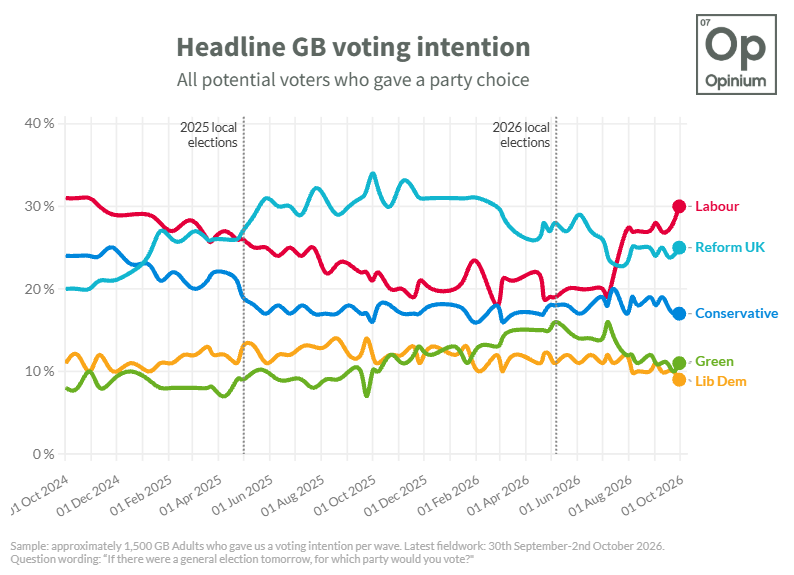
Reform are the clear contenders to Labour. Use your vote wisely.

Westminster Voting Intention:
Labour: 30% (+2)
Reform UK: 25% (+1)
Conservative: 17% (=)
Greens: 11% (+1)
Liberal Democrats: 9% (-1)
Others: 5% (-1)
SNP: 2% (-1)
Plaid Cymru: 1% (=)
Via: Opinium
MOE: ±2.2%
Field Work: 26 Sep - 2 Oct changes w/ 23-24 Sept

1
2
11
298
MR B.E 🇬🇧 retweeted

🚨Reform now 8% ahead of the Conservatives in the latest Opinium poll!
The right must coalesce around Reform, like the left is around Burnham, for us to win the next General Election 🗳️

🚨 Latest Opinium @ObserverUK poll 🚨
Labour hits 30% for the first time since November 2024, opening up a 5-point lead over Reform.
🌹 LAB 30% (+2)
➡️ REF 25% (+1)
🌳 CON 17% (n/c)
🌍 GRN 11% (+1)
🔶 LD 9% (-1)
11
15
51
1,582
MR B.E 🇬🇧 retweeted

Trump 2.0 has been a disaster on most things, but not on migration and borders

Net negative migration for the first time in HALF a CENTURY.
Americans are amassing victories NEVER seen before thanks to President Trump.
We will continue to grow our efforts to fulfill the mandate given to this administration.

5
1
20
548
MR B.E 🇬🇧 retweeted

I cannot hate them enough. It appears that it is likely if the police had done their job properly a friend might not have been brutally murdered.

NEW: Ann Widdecombe murder suspect, Joshua Kerry, 28, charged with terror offences against Nigel Farage after home ‘firebombed’
thesun.co.uk/news/40567300/a…
64
476
2,825
39,563


MR B.E 🇬🇧 retweeted

With all these debates around Englishness going on in the press thought I would mention:
Anglo Saxons have been in England longer than the Maori in New Zealand in fact double as long 1570 years compared to 650 yet one is considered native and the other is not.
124
317
4,252
120,850
MR B.E 🇬🇧 retweeted

Able to identify every ethnic minority, but somehow the ethnic majority is non existent

'If I was born in Japan I couldn't call myself Japanese.'
Suella Braverman tells Tim Shipman that the 'dogma of multiculturalism' is eroding the sense of Englishness, which in turn is having a bad effect on how Britishness is defined.
@SuellaBraverman | @ShippersUnbound

1
5
284
MR B.E 🇬🇧 retweeted

There's an English culture and an English ethnic group. People are obfuscating the difference because thanks to mass migration there are now people born here who fit into neither category, who contribute little, and who the Left feels need the cover of an inclusive identity.

Fascinating. Genetic testing can distinguish ethnic groups that don't exist. Even closely related groups within the same archipelago.

17
37
388
8,582
MR B.E 🇬🇧 retweeted

The reason that there is much more focus on English identity is a consequence of policy actions over the past four decades:
1. High levels of immigration
2. Immigrants receiving preferential treatment through DEI / selective recruitment policies.
6
7
87
1,315
MR B.E 🇬🇧 retweeted

Today, politics stops. My family home address was published deliberately by a Labour Councillor, and I am absolutely furious that this line has been crossed.
Cllr Gavin Callaghan published my home address knowing full well my family live there, including my 86-year-old heavily disabled grandmother. We are living in a country where Reform UK representatives such as Ann Widdecombe were murdered in a targeted attack, and a man has now been charged with preparing terrorist acts targeting Nigel Farage. Political security is not some abstract concern anymore. It is real.
I want to thank the Chief Executive, Monitoring Officer, Essex Police and Cllr Andy Barnes for rallying around me and my family today. Whatever political differences exist, this has gone beyond politics. My home, my family and their safety are NOT fair game.
So Gavin Callaghan should understand this very clearly… Today you crossed the line. I will pursue every lawful route available to hold you accountable, and I will not rest politically until residents have the chance to judge your conduct for themselves.
You wanted to intimidate me? You have achieved the complete opposite. You have AWAKENED the lion.
265
1,079
6,844
172,806

This is it for me. I don't even really care what the tories say. Been burned enough times that I just can't and won't ever trust them. It's not even so much individuals like Nick, I'm sure he means well. But as an institution, for me they're done.

No-one believes you.
The last Tory government started the early release scheme.
And when they had a Home Secretary (me) telling them not to do it, they ploughed ahead anyway- putting victims at risk and undermining confidence in the justice system.
Read about my attempts to stop the Tory’s early release scheme in my new book, ‘Patriot: Empire, betrayal and hope’ out on Amazon now: amzn.eu/d/05HEh2Bc
5
284
MR B.E 🇬🇧 retweeted
Your party and the Tories have loaded utility bills with everything from subsidies for green energy to covering the social costs for customers that do not pay.
You can't complain about private businesses when you specify how they have to bill and generate energy.

I want to be honest about how we’ve got to a place where British billpayers are paying some of the highest energy costs in Europe.
Over the past 40 years, we’ve given up control of our necessities, outsourced our essentials and privatised the basics. Water, transport, housing. And of course, energy.
Now the public are paying the price. We haven’t invested in the infrastructure we need. Conflict overseas has pushed up energy costs and it’s hurting our businesses and families.
That’s why we need to take back greater control of our energy system.
This week, I announced Great British Grid, which will speed up connections and push down bills.
We’re also giving mayors, local leaders and communities a stronger role. With funding for People’s Power projects, communities will be able to build solar panels on libraries and town halls, hydro schemes in rivers or publicly owned windfarms on local land.
But it’s not just energy we need stronger public control over. It’s also water, housing, transport and care.
So we’re repealing the ban on public ownership of water companies. We’re building more council homes than this country has seen since the end of World War Two.
We’re reforming the leasehold system so families aren’t squeezed for every penny. And we’re opening up home ownership for first time buyers who can’t rely on the bank of mum and dad.
This week I also announced my determination to introduce a National Care Service, to put people above profit and to give pensioners peace of mind.
Together, we’ll rewire the country from top to bottom so that it works for all people in all places.
That is the only way to put Britain back on the right path. It’s the only way to put power back in people’s hands. And it’s the only way we will bring hope again.
2
6
56
1,147
MR B.E 🇬🇧 retweeted

We used to manufacture products labelled “Made in Britain”.
Now we produce terrorists labelled “Radicalised in England”.
All of this done to us by Labour and the Conservatives. Never forget.

🚨🇴🇲 NEW: The flydubai co-pilot who tried to hijack the plane has been identified as 29-year-old Omani national Hamman al-Hammami
He studied Aviation Management at Buckinghamshire New University in the UK
1
1
2
101
Utter rot. It’s nothing to do with privatisation. It’s govt policy. Our bills are high because we don’t allow extraction of enough fossil fuels and place egregious taxes on the companies that still do it.
I want to be honest about how we’ve got to a place where British billpayers are paying some of the highest energy costs in Europe.
Over the past 40 years, we’ve given up control of our necessities, outsourced our essentials and privatised the basics. Water, transport, housing. And of course, energy.
Now the public are paying the price. We haven’t invested in the infrastructure we need. Conflict overseas has pushed up energy costs and it’s hurting our businesses and families.
That’s why we need to take back greater control of our energy system.
This week, I announced Great British Grid, which will speed up connections and push down bills.
We’re also giving mayors, local leaders and communities a stronger role. With funding for People’s Power projects, communities will be able to build solar panels on libraries and town halls, hydro schemes in rivers or publicly owned windfarms on local land.
But it’s not just energy we need stronger public control over. It’s also water, housing, transport and care.
So we’re repealing the ban on public ownership of water companies. We’re building more council homes than this country has seen since the end of World War Two.
We’re reforming the leasehold system so families aren’t squeezed for every penny. And we’re opening up home ownership for first time buyers who can’t rely on the bank of mum and dad.
This week I also announced my determination to introduce a National Care Service, to put people above profit and to give pensioners peace of mind.
Together, we’ll rewire the country from top to bottom so that it works for all people in all places.
That is the only way to put Britain back on the right path. It’s the only way to put power back in people’s hands. And it’s the only way we will bring hope again.
5
338

Whilst I absolutely respect this gentleman's right to feel the way he does, and to define his identity in whatever way he sees fit, I can't help but question the proposition he presents as fact: “If you were born here, you're indigenous.”
There is an important distinction, in my view, between belonging to a place and being indigenous to it. To say that someone born in a country belongs there is an absolute fact, it is home. But to suggest that birthplace alone renders questions of ancestry, historical continuity and indigeneity irrelevant seems to me to reduce something extremely complex to a single geographical fact. We must question what we lose when we do this.
If people who arrived in a country only a few generations ago become indigenous simply by virtue of being born there, does the history of their ancestors before that migration somehow cease to exist? Do their ancestors, cultures, traditions, faith, languages and collective memories become irrelevant? Does everything that came before the moment of migration have to be discarded in order to establish belonging in the present?
I find this argument particularly interesting when it is presented as a means of combating racism. If the objective is to create a society in which people are not judged by the colour of their skin or the circumstances of their ancestry, surely the answer cannot be to make ancestry itself something that must be forgotten.
My identity does not diminish my sense of belonging here, nor does my knowledge of where I come from. If anything, knowing who I am, where my ancestors came from, what they endured, what they created and what they believed gives me a greater sense of rootedness.
Knowledge tends to have the power to do that.
A person who knows their history can understand themselves in a way that someone deliberately severed from their history cannot.
Interestingly, this debate takes place at a time when we're taking things even further, this week we hear of a debate around the removal of words such as "mother" and "father" from our vocabulary. What is the destination of this journey?
Why are we hellbent on creating Huxley's Brave New World? People detached from the past, from history, from any sense of belonging and knowledge of who they are, simply manufactured as commodities for the needs of the present.
A person without memory may be easier to define, to sculpt into the image of this Brave New World, but a person who knows who they are, where they came from, and what they stand for is much harder to turn into a commodity.
So far the debate is being approached from the point of view of white people holding on to their ethnic identity, and being painted as racist.
But flip the argument, recall when the argument was made that we must allow more migrants into the country because white people were not willing to do the demeaning jobs migrants are doing. What would those people, in those demeaning jobs that are beneath everyone else in society, amount to once stripped of all history, all identity, all pride in ancestory? Just a convenient underbelly of society? The Epsilons of Huxley's Brave New World?
It is impossible to do that to a people who are rooted in a sense of pride in the knowledge of who they are, what their history is. And I'm very suspicious of any argument that pushes us down a path in which all that is sacred to the human experience is stripped away.
2
2
12
613
There are multiple things at play here though. Does France have birthright citizenship? Are we making a distinction between ethnicity and nationality?
Do we actually agree, but our lack of shared grammar means that we are failing to understand each other?

"If I was born in France, I'd be French."
Gary, who challenged Suella Braverman over her 'Englishness' remarks, calls in to @TomSwarbrick1's show to reinforce his argument that ‘brown people can be just as prejudice as white people’.

1
3
310