
Scientist @chroniclebioai, patient & science communicator. hEDS, POTS, ME/CFS & complex chronic illness.
- Tweets 29
- Following 51
- Followers 184
- Likes 38


I've spent years being open about being a patient in the same disease space I research. Being a patient-scientist with hEDS got a lot of attention, sometimes framed as if I was the only one doing it.
As my work has expanded into ME/CFS, one of the things I've loved most is that patient-led research isn't unusual there. It's everywhere. Patients designing studies, running advocacy organizations, pushing back on flawed trials, building research programs from scratch.
But it has me wondering...are patients stepping up because we want to, or because we have to?
ME/CFS has been neglected for decades, underfunded relative to its burden, dismissed clinically, and continues to be incredibly misunderstood. If patients hadn't stepped up, it's not clear who would have. Much of this work is being done by people with limited energy, often unpaid and from their beds.
I believe deeply in the sentiment of “nothing about us without us." Patients bring expertise that no one else has and it's a scientific asset to any research approach.
But patient-led research can be both a strength and a sign of systemic failure. Patient leadership should be how research is designed from the start, not the backup plan when no one else shows up to move the field forward.
I'm curious, does your involvement in research feel like choice, necessity, or both?
16
12
106
4,430
A normal result is useful. It rules things out. But if we don't know what to measure yet, we can't test for it yet. The lack of diagnostic tests affects whether patients are believed, how long diagnosis takes, and whether the right trials can even be designed.
1
88
Your illness isn't waiting on a test to be real. The test is waiting on science to catch up. It's why I'm proud to be a part of the work at @ChronicleBioAI and fighting to find the answers for people who've been told for far too long their experience is "normal".
1
3
113
The harder a disease is to see, the easier it is to doubt. ME/CFS, long COVID, hEDS, and MCAS don't have a single definitive test. So patients hear "everything looks normal" while feeling anything but normal. I've been there more times than I can count.
2
14
605
Cortney Gensemer, PhD retweeted

Such a meaningful experience at the @chroniclebioai lab, seeing the biobank behind the research!
Every sample in these freezers represents a person, living with these complex chronic illnesses, that needs answers.
Thank you @SummerDashe & team for the warm welcome!

4
4
47
1,962
I'll be speaking at the 4th Annual Penn State EDS & HSD Patient Engagement and Global Collaboration Research Symposium this November "Between the Stripes: Focusing on the Comorbidities."


1
1
3
101
Cortney Gensemer, PhD retweeted

There is an enormous amount of treatment discussion happening across the ME/CFS, Long COVID and related complex chronic illness communities.
Some insights have meaningful evidence behind them. Others are much earlier and still largely hypothesis-driven.
Here are eight treatment signals that surfaced this week, along with what the evidence currently tells us:
Methyldopa: A new retrospective series of five patients with hyperadrenergic POTS reported improvements in orthostatic symptoms and sleep. It’s a very small study, but an interesting signal around central sympathetic modulation that may be worth watching.
Bezisterim (NE3107): The Phase 2 ADDRESS-LC trial did not reach statistical significance on any of its 22 individual endpoints in the overall population, although 21 of 22 numerically favored treatment. Exploratory subgroup signals emerged, but we need the full peer-reviewed results to better understand effect sizes, subgroup definitions and safety. Watching carefully.
Injectable NAD+ / oxaloacetate: These are often discussed together as metabolic approaches, but the evidence is quite different. Injectable NAD+ currently lacks controlled clinical-outcomes evidence, including established efficacy data in ME/CFS. Oxaloacetate, by contrast, has been tested in an 82-person randomized, double-blind controlled ME/CFS trial at 2,000 mg/day, where it significantly reduced fatigue compared with control. The study was relatively small and had an important commercial conflict of interest, so replication would be important to strengthen the finding.
CSF leak evaluation: This may be more important as a diagnostic signal than a treatment signal. In a study of 34 patients with imaging-confirmed spontaneous intracranial hypotension (SIH), 35% met POTS criteria. Blood patching and surgery are treatments for confirmed SIH, making appropriate diagnostic evaluation important before intervention. This is one of our focus areas for CODA CCD.
Enterosgel: A double-blind randomized trial in 440 people with IBS-D found a higher responder rate with Enterosgel than placebo, 37.4% vs. 24.3%. Important caveat: this is evidence in diarrhea-predominant IBS, and shouldn’t be extrapolated to constipation-predominant disease or gastroparesis.
Bispecific T-cell engagers: Very early autoimmune data are emerging. In a Phase 1 SLE study, 12 people were treated, with encouraging disease-activity signals among the 10 evaluable participants. But there are currently no ME/CFS data and no validated ME/CFS biomarker for selecting patients for this approach. We should be digging further.
@CODA_research
6
10
50
2,079
Patients with hypermobile Ehlers-Danlos syndrome (hEDS) absolutely do need to advocate for themselves. Patients often need to bring research to appointments, ask clarifying questions, request carious referrals, and push hard for answers when their symptoms are dismissed. But…
2
2
13
2,477
Unfortunately, the content on social media telling patients *how* to get a diagnosis, reinforcing the stigma around “Dr. Google” or social media self-diagnosis.
1
5
99
Cortney Gensemer, PhD retweeted

When the team at @RenegadeRes reached out to us to collaborate on sample analysis, we didn't hesitate. In under 24 hours we had a plan in motion, kits shipped their way, and vendors prepped. The Renegade team worked just as quickly to make it happen.
Patient-led science means we all understand what's at stake with our work and why time matters. Millions of people are losing days to their symptoms. We are working rapidly to understand the biology of complex chronic conditions in an effort to find treatments that could help.
ChronicleBio is generating multi-omic data on samples collected during Renegade Research's Innovation Inn. It was a multi-day event where #MECFS patient-researchers deliberately tracked their own post-exertional malaise (PEM) to help characterize what happens in the body before, during, and after.
Across the event, the team collected 482 plasma, serum, and whole blood samples at multiple timepoints, alongside HRV, lactate, heart rate, blood pressure, and symptom data. We supplied collection kits for every timepoint, and our analyses will complement everything else being measured.
We're proud to be one of several partners contributing to this work, alongside @amaticahealth, Alden Scientific, Arden Bio, Infinity Bio, CDI Labs, Theriome, @imyoohealth, and an MIT team from @ImmunoFever’s MAESTRO project demoing nailfold capillaroscopy, WAVi EEG, and Right Eye tracking.

1
4
17
1,706
Cortney Gensemer, PhD retweeted

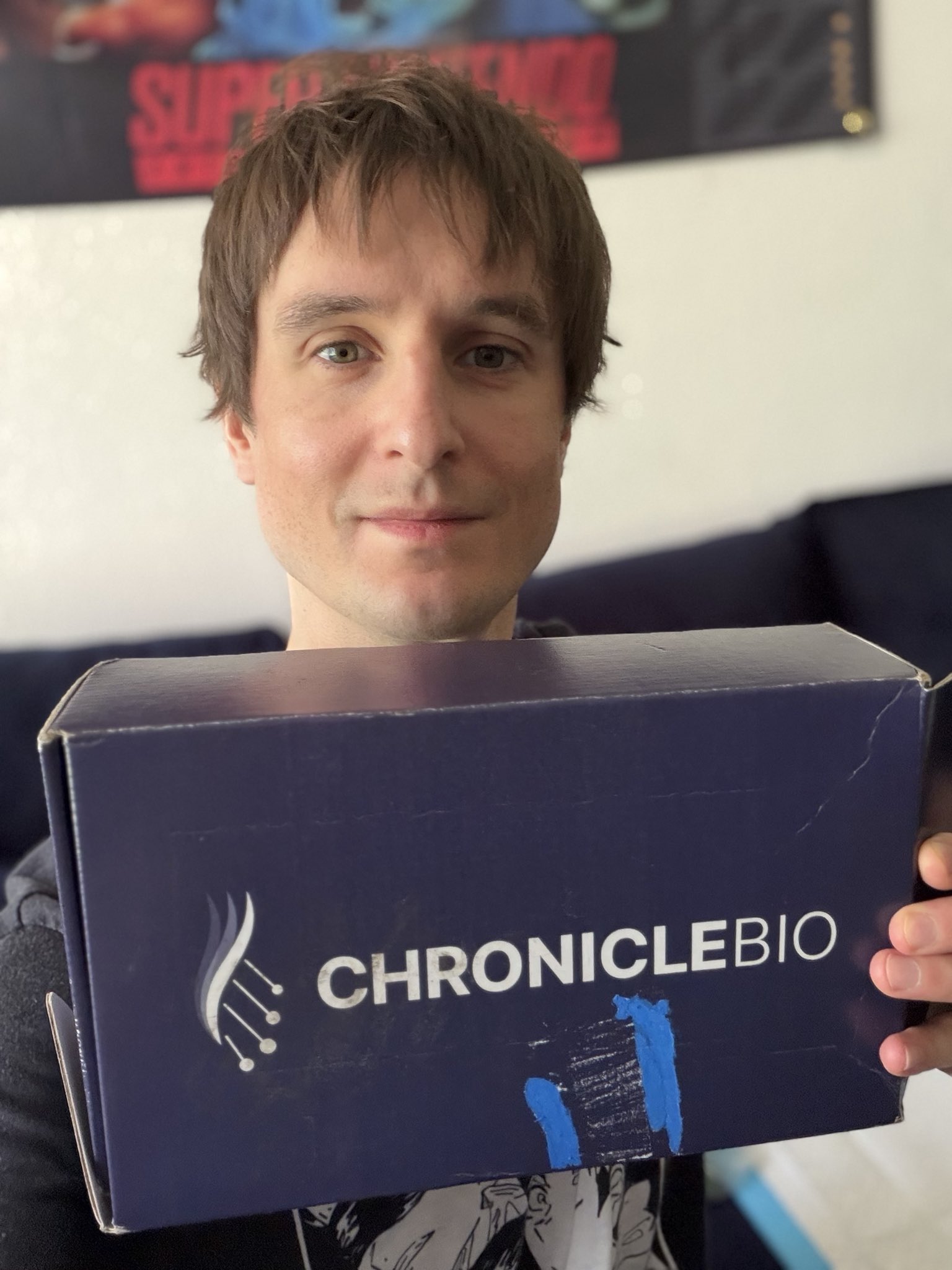
Just got my blood drawn for multiomics from @ChronicleBioAI ! This futuristic company is using long-read genome sequencing (from @nanopore ), transcriptomics, proteomics, and metabolomics to build an AI foundation model for rare and complex diseases, like #EhlersDanlosSyndrome and #POTS. I just want to thank the team and give a shoutout to @fidjissimo for putting this together. Fidji is one of the most amazing visionary leaders in the entire tech space. Motivated by her own health struggles, put together a new company doing what I have been dreaming someone would do since my hackathon in 2019. It’s cool to be working with all star research scientists like @CortDoesScience as well.
Interestingly, all of this became possible because I met @gdb / Greg Brockman, president and cofounder of OpenAI, at an EDS conference at GitHub, hosted by the nonprofit I work with, @Research2People . Greg pleasantly surprised everyone and showed up unannounced with his wife, who has EDS like me. After talking with them for a while, I was introduced to Fidji by email. Fidji introduced me to her people, who I got to know and respect, and now I am proudly working with ChronicleBio to do what I have been dreaming of ever since starting with Research to the People, where my multiomics journey began and changed my life. This now is the next level - far more ambitious than anything before.
I have to say, ChronicleBio is doing the most cutting edge data generation in the entire space, and I am so happy to be a part of this. Thank you ChronicleBio! Today is a good day!
#EDS #EhlersDanlos #MECFS #MCAS #RareDisease


3
5
35
5,340
A preprint just proposed a framework for "Neuro-EDS" preprints.org/manuscript/202…
2
1
7
182
Subtyping should eventually rely on biological mechanism, not clustered symptoms alone. But one can, and should, inform the other as we move toward precision medicine in this space.
1
19
Substack breakdown of the prprint & more on complex chronic illness: cortneygensemer.substack.com…
1
18