

The clinical-development coordination layer for AI-generated drugs | Discord: discord.gg/s3ekrgjuMR | Telegram: t.me/lifenetwork_ann
- Tweets 1,010
- Following 355
- Followers 62,323
- Likes 627


Pinned Tweet

𝗡𝗩𝗜𝗗𝗜𝗔 𝗚𝗧𝗖 𝗧𝗮𝗶𝘄𝗮𝗻 𝟮𝟬𝟮𝟲 - 𝗠𝗮𝗽𝗽𝗶𝗻𝗴 𝘁𝗵𝗲 #𝗛𝗲𝗮𝗹𝘁𝗵𝗰𝗮𝗿𝗲𝗔𝗜 𝗩𝗮𝗹𝘂𝗲 𝗖𝗵𝗮𝗶𝗻
At NVIDIA GTC Taiwan 2026, our Co-Founder & CEO Dr. Tuan Cao @tuan_lifeai presented “LifeAI Biohub: A Purpose-built AI platform for Drug Development”
One signal emerged throughout the session:
As AI capabilities continue to advance, the bottleneck is no longer intelligence itself. It is the infrastructure that enables validation, governance, and coordination across the full spectrum of healthcare stakeholders.
𝗧𝗵𝗲 𝗛𝗲𝗮𝗹𝘁𝗵𝗰𝗮𝗿𝗲 𝗔𝗜 𝗩𝗮𝗹𝘂𝗲 𝗖𝗵𝗮𝗶𝗻
Pharma → Hospitals → Doctors → Labs → Regulators → Auditors → Patients
Sustainable progress in healthcare AI demands alignment across the entire ecosystem, not isolated optimization within a single organization.
𝗟𝗶𝗳𝗲𝗔𝗜 𝗕𝗶𝗼𝗛𝘂𝗯
Shared Infrastructure → Coordination Layer → Connected Network → Application Success
This is the foundation Life AI is building: the shared infrastructure and coordination layer for the healthcare AI value chain so that every application built on top can move faster, scale further, and earn trust across the industry.
The long-term opportunity in healthcare AI will not be defined by better models alone. It will be defined by the infrastructure that makes those models deployable, accountable, and impactful at scale.
It was a privilege to share this vision alongside the researchers, healthcare leaders, and technology builders at NVIDIA GTC Taiwan shaping the next chapter of AI.


424
318
730
223,243
Today in Singapore, we took a question we have been working on at Life AI to a much bigger room.
As AI accelerates drug discovery, how do we build the operating infrastructure to move what we discover through clinical validation, evidence, and real-world execution?
Our Co-Founder & CEO Dr. Tuan Cao shared Life AI’s perspective on that question today at the NVIDIA Inception Grand Challenge Finale.
And much of the value lies in what follows: new perspectives, sharper questions, and meaningful connections across the industry.
Singapore extended the rails we’ve been laying, bringing our work into a broader conversation across AI, drug development, and healthcare.
And that is exactly where we want to be.


Life AI Named a Top 20 Finalist in the NVIDIA Inception Grand Challenge 2026
Life AI has been named one of the Top 20 Finalists in the NVIDIA Inception Grand Challenge 2026, selected from more than 500 startups across Asia Pacific.
The recognition follows Life AI’s selection in 2025 as one of six startups in the inaugural FastTrack AI Accelerator, powered by GenAI Fund and accelerated by the NVIDIA Inception Program.
On September 22, our co-founder and CEO, Dr. Tuan Cao, will present Life AI’s perspective at the Grand Challenge Finale during NVIDIA AI Day Singapore.
But the significance of this milestone extends beyond the competition.
AI capabilities are advancing at unprecedented speed. Yet in healthcare, building more capable AI is only the beginning. The harder challenge is making that intelligence usable inside systems that were never designed to work together.
Clinical records, workflows, validation processes, and decision-making remain distributed across hospitals, laboratories, pharmaceutical companies, and care teams. Moving AI from isolated pilots into real-world practice therefore requires more than a powerful model. It requires a way to connect signals, coordinate actions, and maintain accountability across those boundaries.
As AI intelligence becomes increasingly abundant, how do we turn it into accountable action across fragmented healthcare systems?
That is the question Life AI is taking to Singapore. In the weeks ahead, we will share how we are approaching it.

63
101
190
11,707
The countdown to the NVIDIA Inception Grand Challenge Finale is on.
Tomorrow, our Co-Founder & CEO Dr. Tuan Cao will take the stage as one of the Top 20 finalists, sharing Life AI’s approach to building the operating infrastructure for AI-enabled drug development from accelerating discovery to clinical validation and real-world execution.
📅 September 22, 2026 | Singapore
If you’re joining us in Singapore, we’d love to connect.
Life AI Named a Top 20 Finalist in the NVIDIA Inception Grand Challenge 2026
Life AI has been named one of the Top 20 Finalists in the NVIDIA Inception Grand Challenge 2026, selected from more than 500 startups across Asia Pacific.
The recognition follows Life AI’s selection in 2025 as one of six startups in the inaugural FastTrack AI Accelerator, powered by GenAI Fund and accelerated by the NVIDIA Inception Program.
On September 22, our co-founder and CEO, Dr. Tuan Cao, will present Life AI’s perspective at the Grand Challenge Finale during NVIDIA AI Day Singapore.
But the significance of this milestone extends beyond the competition.
AI capabilities are advancing at unprecedented speed. Yet in healthcare, building more capable AI is only the beginning. The harder challenge is making that intelligence usable inside systems that were never designed to work together.
Clinical records, workflows, validation processes, and decision-making remain distributed across hospitals, laboratories, pharmaceutical companies, and care teams. Moving AI from isolated pilots into real-world practice therefore requires more than a powerful model. It requires a way to connect signals, coordinate actions, and maintain accountability across those boundaries.
As AI intelligence becomes increasingly abundant, how do we turn it into accountable action across fragmented healthcare systems?
That is the question Life AI is taking to Singapore. In the weeks ahead, we will share how we are approaching it.
44
103
208
12,907
What kind of operational infrastructure does coordination across the healthcare value chain actually require?
Eight years of building clinical programs across Southeast Asia, working with governments, hospital networks, and pharmaceutical companies, produced one consistent finding: the challenge is not the absence of capable AI. It is the absence of operational infrastructure that makes coordination reusable across programs.
Without that infrastructure, coordination remains highly program-specific, especially in drug development, where multiple key players must work together across the development process.
The infrastructure this requires has three properties.
It has to be reusable. Clinical programs should move from bespoke projects to reusable rails, with shared coordination rails replacing bespoke integration at every site.
It has to compound. Every application should strengthen the model, the network, and the protocol, building greater capacity across the ecosystem over time.
It has to enable coordination among independent actors. Hospitals, doctors, labs, pharma sponsors, regulators, patients, and AI builders can contribute services, validation, and clinical execution without surrendering operational sovereignty.
At Life AI, we are building an operating infrastructure for drug development around these requirements, bringing together AI-driven discovery, wet-lab screening, and clinical validation.

Why is validation so difficult to accelerate?
Because unlike discovery, validation cannot be completed in isolation.
An AI-generated drug candidate still has to move through key players across the healthcare value chain, including pharma teams, clinical sites, hospitals, clinicians, patients, and regulators. Each operates with different timelines, evidence requirements, compliance constraints, and operational priorities.
A candidate can move forward on one front while remaining constrained elsewhere, whether by patient recruitment, study execution, evidence generation, or the decisions required to advance it.
This makes validation more operationally complex than discovery. Discovery can be accelerated within a model, platform, or controlled environment, while validation depends on how effectively these key players coordinate and execute across the development process.
With more candidates entering development, that operational complexity compounds, requiring more evidence generation, clinical execution, patient participation, and coordinated decision making across organizations.
As AI accelerates discovery, the need for better coordination and the infrastructure to support it becomes increasingly important downstream.

49
100
245
15,352
Why is validation so difficult to accelerate?
Because unlike discovery, validation cannot be completed in isolation.
An AI-generated drug candidate still has to move through key players across the healthcare value chain, including pharma teams, clinical sites, hospitals, clinicians, patients, and regulators. Each operates with different timelines, evidence requirements, compliance constraints, and operational priorities.
A candidate can move forward on one front while remaining constrained elsewhere, whether by patient recruitment, study execution, evidence generation, or the decisions required to advance it.
This makes validation more operationally complex than discovery. Discovery can be accelerated within a model, platform, or controlled environment, while validation depends on how effectively these key players coordinate and execute across the development process.
With more candidates entering development, that operational complexity compounds, requiring more evidence generation, clinical execution, patient participation, and coordinated decision making across organizations.
As AI accelerates discovery, the need for better coordination and the infrastructure to support it becomes increasingly important downstream.
AI is accelerating drug discovery. But the pressure is shifting downstream, toward the work required to validate what discovery produces.
Across science and life sciences, AI is moving deeper into discovery. Anthropic is expanding AI into scientific research, Isomorphic Labs is scaling AI-first drug design and development, and Discovery Loop is building systems to automate experimental loops.
As these capabilities advance, more targets can be explored, more molecules can be designed, and more potential candidates can be generated. The discovery layer is becoming faster and more expansive.
But accelerating discovery does not automatically accelerate the path to validation.
A promising candidate still has to be evaluated, tested, and supported by sufficient evidence before it can move forward. Clinical validation is where this downstream pressure becomes especially visible. The gains from faster discovery can begin to narrow if the path to validation remains slow and difficult to scale.
For Life AI, this raises a critical question: How do we make sure the path to validation can keep pace as AI accelerates discovery?

108
104
306
26,707
AI is accelerating drug discovery. But the pressure is shifting downstream, toward the work required to validate what discovery produces.
Across science and life sciences, AI is moving deeper into discovery. Anthropic is expanding AI into scientific research, Isomorphic Labs is scaling AI-first drug design and development, and Discovery Loop is building systems to automate experimental loops.
As these capabilities advance, more targets can be explored, more molecules can be designed, and more potential candidates can be generated. The discovery layer is becoming faster and more expansive.
But accelerating discovery does not automatically accelerate the path to validation.
A promising candidate still has to be evaluated, tested, and supported by sufficient evidence before it can move forward. Clinical validation is where this downstream pressure becomes especially visible. The gains from faster discovery can begin to narrow if the path to validation remains slow and difficult to scale.
For Life AI, this raises a critical question: How do we make sure the path to validation can keep pace as AI accelerates discovery?
35
107
247
30,674
LIFE AI retweeted

I used to come to the Google office mostly for the food. This time, it's special. I came here for work.
I just finished a video interview with the Google for Startups team. They asked wonderful questions, and ten minutes was nowhere near enough. Here's what I wish I'd had time to say.
Years ago, I was a Google engineer on the Gmail and Google Data Infra teams. Walking back in as a founder, selected for the first Google for Startups Accelerator: Southeast Asia, feels like a homecoming. Google taught me how to build systems billions depend on. Now I'm bringing that standard to healthcare.
At Life AI, we're building an operating infrastructure for drug development: AI models for drug discovery, a robotic wet lab for in vitro screening, and a network of hospitals for clinical validation. Several products run on it. The one we're bringing to Google is closest to my heart: Life Cloud, an AI-powered cloud for healthcare.
Here's the problem. AI has disrupted industry after industry, but not yet healthcare. Hospital data is uniquely hard: fragmented, buried deep inside departments. Connecting data within one hospital is already a serious challenge. Connecting a network of hospitals is orders of magnitude harder. Yet patients move between hospitals, test by test. The warning sign a doctor needs often already exists, scattered across systems, never connected in time.
Take thalassemia: about 13% of Vietnamese, 14 million people, carry the gene. Every year, around 8,000 affected babies are born, most of them preventable. The first clue hides in a routine blood test that costs less than a cup of coffee, stored somewhere, in some hospital.
Life Cloud is built on one principle: the data never moves. The AI does. Hospitals keep full control of their records. The AI comes to them and learns across the whole system. The AI flags and suggests. The doctor always makes the final decision.
What excites me most is the mentorship. I still remember how much I learned just by sitting close to great engineers at Google. Now my whole team gets three months of that. Honestly, it feels a bit like going back to school.
In October, I'll bring our product to Google San Francisco's bootcamp for engineers to stress-test. Thalassemia doesn't stop at borders. With health partners in Thailand and Indonesia, Southeast Asia is the map we're building for.
Closing the gap between what AI can demonstrate and what doctors can depend on. That's the whole journey. And yes, I'm coming back to Google, not only for food, but for work too.
If you're a clinician, life-science researcher, or investor who cares about trustworthy healthcare AI in Southeast Asia, my inbox is open.
#GoogleForStartups #HealthcareAI #LifeCloud
19
7
42
1,883
AI is moving faster than the systems around it. In healthcare, that gap matters.
But what makes that gap so difficult to close?
“How do we turn AI intelligence into accountable action across fragmented healthcare systems?”
It is also a question that has increasingly shaped how Life AI thinks about healthcare AI. Speaking at NVIDIA GTC Taiwan 2026, Life AI Co-Founder and CEO Dr. Tuan Cao @tuan_lifeai put it this way:
“In other industries, if you have the best model, you win. But in healthcare, what actually matters is the coordination of so many key players across the healthcare value chain.
That is why running a clinical trial in the US is so expensive. It costs about $20 million to $100 million to run a Phase III clinical trial, and for every patient, we pay about $500,000 because the man in the middle has to coordinate so many different players: the pharma, the hospital, the patient, and the doctor.
So coordination of all of those key players is actually one of the main bottlenecks.”
The challenge is not simply advancing AI, but understanding what it takes to make AI work across the complexity of healthcare.
The NVIDIA Inception Grand Challenge 2026 gives Life AI a timely platform to bring this infrastructure question into a broader AI conversation.

29
97
182
17,759
1/6
Asia is living longer. But too many of those years are spent in poor health.
That is the central tension explored in a recent Future of Asia Podcast from the McKinsey Health Institute.
So what stands between living longer and living healthier?
🧵 Here are some numbers and insights worth looking at.

25
103
185
11,358
4/6
What stands out is that the opportunity is not only about discovering new treatments.
McKinsey points to the potential of proven interventions, particularly those focused on prevention at the population and individual levels.
The challenge becomes how to move prevention earlier, broaden access, and make its impact more consistent.
This is where the conversation shifts:
from healthcare to health.
1
47
53
287
6/6
And this is the key question left open by the discussion:
When the pieces of a person’s health journey are spread across different interventions, providers, and systems, what connects them over time?
The McKinsey Health Institute’s From healthcare to health: Asia’s longevity opportunity is well worth reading for anyone thinking about what comes next for healthcare in the region.
mckinsey.com/featured-insigh…
2
2
12
207
Life AI Named a Top 20 Finalist in the NVIDIA Inception Grand Challenge 2026
Life AI has been named one of the Top 20 Finalists in the NVIDIA Inception Grand Challenge 2026, selected from more than 500 startups across Asia Pacific.
The recognition follows Life AI’s selection in 2025 as one of six startups in the inaugural FastTrack AI Accelerator, powered by GenAI Fund and accelerated by the NVIDIA Inception Program.
On September 22, our co-founder and CEO, Dr. Tuan Cao, will present Life AI’s perspective at the Grand Challenge Finale during NVIDIA AI Day Singapore.
But the significance of this milestone extends beyond the competition.
AI capabilities are advancing at unprecedented speed. Yet in healthcare, building more capable AI is only the beginning. The harder challenge is making that intelligence usable inside systems that were never designed to work together.
Clinical records, workflows, validation processes, and decision-making remain distributed across hospitals, laboratories, pharmaceutical companies, and care teams. Moving AI from isolated pilots into real-world practice therefore requires more than a powerful model. It requires a way to connect signals, coordinate actions, and maintain accountability across those boundaries.
As AI intelligence becomes increasingly abundant, how do we turn it into accountable action across fragmented healthcare systems?
That is the question Life AI is taking to Singapore. In the weeks ahead, we will share how we are approaching it.
62
118
356
38,697
The next edge in drug development will come from understanding patients at higher resolution.
For decades, clinical evidence was shaped by scheduled visits. What patients reported. What clinicians observed. Everything between visits remained largely unseen.
The FDA’s Digital Health Technologies program is expanding the use of continuous and frequent measurements beyond traditional study visits, including through wearables, sensors, and remote monitoring.
For drug development, this opens the possibility of following treatment response beyond scheduled assessments and across the patient journey.
But capturing these signals is only part of the challenge.
Biological signals, interventions, and outcomes remain fragmented across the patient journey. Without coordination, the longitudinal picture remains incomplete.
The next infrastructure layer will need to connect these signals with interventions and outcomes across time, institutions, and real-world conditions.
As the FDA advances the regulatory pathway for digitally derived endpoints, that coordination layer becomes increasingly important to drug development.
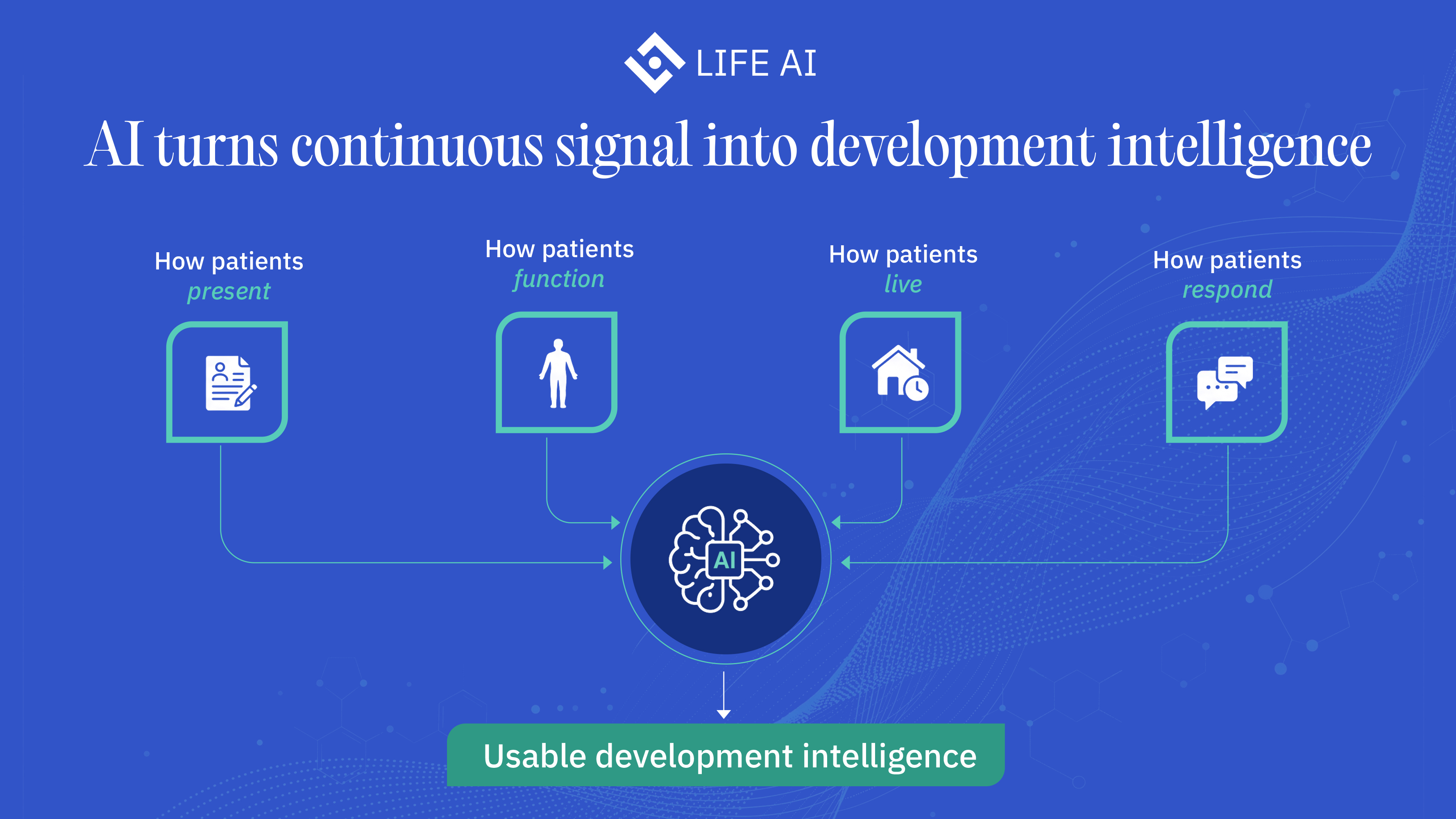
30
91
188
9,641
Source: FDA, Digital Health Technologies for Drug Development fda.gov/science-research/sci…
78
86
609
AI can now generate more drug and treatment candidates than the healthcare industry can ever validate.
That gap between what AI can discover and what actually reaches patients is the problem Life AI was built to close.
What we're most excited about in the @GoogleStartups Accelerator: Southeast Asia program is the chance to work directly with Google's engineering teams on scaling that infrastructure, the rails that help hospitals and pharma partners move healthcare AI programs from pilot to real, deployed care.
We've already seen what's possible when this works: programs that used to take years now take months, at a fraction of the cost, while still meeting regulatory standards.
Over the next three months, we'll be pressure testing our technology alongside some of the best AI minds in the industry, building toward a technical residency in San Francisco.
More soon.
#AcceleratedWithGoogle
We're pleased to announce that Life AI has been selected for the @GoogleStartups Accelerator: Southeast Asia program.
We look forward to the opportunities ahead and to sharing our journey.
[goo.gle/4wIlbsP] #AcceleratedWithGoogle
28
93
186
11,543
AI in drug development is entering a more demanding phase.
As candidates move through the development pipeline, they face increasingly complex challenges across biological validation, translational risk, patient heterogeneity, and the timing of evidence.
Many candidates enter the pipeline. Far fewer progress toward clinical validation.
The next frontier is not simply increasing the number of candidates.
It is generating robust, validated, decision ready evidence earlier in the development process, enabling more informed decisions at critical stages.

28
92
207
10,068
The list is yours to fill.
What’s the one self-care habit you’re committing to this weekend?
Drop it below. You might inspire someone to finally do it too. 💚

43
108
208
8,868
We're pleased to announce that Life AI has been selected for the @GoogleStartups Accelerator: Southeast Asia program.
We look forward to the opportunities ahead and to sharing our journey.
[goo.gle/4wIlbsP] #AcceleratedWithGoogle

Welcome to the startups joining the Google for Startups Accelerator: SEA 2026!
Over the next three months, they'll build and scale AI models before heading to SFO for their first-ever US technical residency. 🌉
Meet the cohort ➡️ goo.gle/4wIlbsP
146
193
317
20,509
AI in drug development is moving beyond isolated use cases and becoming a portfolio of decision support capabilities across the full development lifecycle.
In discovery, AI supports target identification, molecule design, screening, and lead optimization.
In nonclinical development, AI supports toxicity assessment, pharmacology modeling, and translational risk analysis.
In clinical development, AI supports patient stratification, trial feasibility, endpoint selection, dose optimization, and safety monitoring.
In postmarketing, AI supports real world data analytics, signal detection, subgroup analysis, and long term treatment performance.
In manufacturing, AI supports process monitoring, quality control, and production consistency.
The strategic opportunity is not to apply AI more broadly for its own sake. It is to apply AI where uncertainty is highest and decisions are most consequential, where better evidence earlier can improve validation, reduce development risk, and strengthen the basis for advancing the right therapies toward patients.
That is the standard by which AI in drug development will increasingly be measured.

28
93
140
16,265