

The clinical-development coordination layer for AI-generated drugs | Discord: discord.gg/s3ekrgjuMR | Telegram: t.me/lifenetwork_ann
- Tweets 1,011
- Following 355
- Followers 62,300
- Likes 628


LIFE AI retweeted

@AnthropicAI , a company whose entire product is intelligence, just confirmed it runs a wet lab. Within a day, several of our investors had pinged me with the same two questions.
Is this a trend? Will every frontier AI lab end up running its own wet lab?
And if so, is Life AI losing its competitive advantage?
Short answers: yes, and no. Here are the longer ones.
I understand why Anthropic did it. I have a fair idea how that internal debate went, because we had the same one eight years ago.
Back then it looked like an odd move for a company that started on the software side of genomics: we built a physical sequencing center, the largest in Southeast Asia, designed for 500,000 genomes a year, with all the freezers and sample logistics that come with it.
We did it for the reason Anthropic gives now: in biology, the final test still happens at the bench. A model can propose. Biology doesn't have to agree.
So to the first question: yes, expect more of this, and the reason is arithmetic. The marginal cost of a hypothesis is heading toward zero. The cost of a failed trial is not. Roughly nine in ten candidates that reach the clinic still fail, and ten times more candidates does not fix that ratio; better evidence before the trial does. A company that sells intelligence has just concluded that intelligence is not the bottleneck. That is the real news, and every model company will reach the same conclusion once its predictions meet a petri dish.
Anthropic seems to know this. It says the lab is focused on fundamental biology, not drug discovery, and it doesn't want to be seen competing with pharma. That is structure, not modesty: pharma pays its bills, and a model company that starts producing evidence for approval competes with its own customers. So the lab exists to make a model better at biology. Its product is a smarter Claude.
Our lab was built for a different job. Its product is evidence a regulator will accept.
A research-grade experiment tells you whether a hypothesis is interesting. A regulatory-grade one tells you whether a patient can be treated on the strength of it. Evidence at that grade cannot be rented by the token. It takes a robotic wetlab, validated processes, and a loop that runs from study design through validation to deployment, and we started building ours before models were producing candidates at today's volume.
Which brings me to the second question. No, I don't lose sleep over Anthropic, DeepMind, or whoever builds the next wet lab. A better model is the best supplier we could ask for. Every jump in capability sends more candidates toward the narrow door where proof happens. We spent eight years building the infrastructure for this moment.
Welcome to the bench, Anthropic. There's plenty of room.
To the investors who asked, and to any who want to join the conversation: the question I'd put back is not which model will win drug discovery, but the next step. Who can prove what the models find will be the final winner.
9
3
70
1,835

Today in Singapore, we took a question we have been working on at Life AI to a much bigger room.
As AI accelerates drug discovery, how do we build the operating infrastructure to move what we discover through clinical validation, evidence, and real-world execution?
Our Co-Founder & CEO Dr. Tuan Cao shared Life AI’s perspective on that question today at the NVIDIA Inception Grand Challenge Finale.
And much of the value lies in what follows: new perspectives, sharper questions, and meaningful connections across the industry.
Singapore extended the rails we’ve been laying, bringing our work into a broader conversation across AI, drug development, and healthcare.
And that is exactly where we want to be.


Life AI Named a Top 20 Finalist in the NVIDIA Inception Grand Challenge 2026
Life AI has been named one of the Top 20 Finalists in the NVIDIA Inception Grand Challenge 2026, selected from more than 500 startups across Asia Pacific.
The recognition follows Life AI’s selection in 2025 as one of six startups in the inaugural FastTrack AI Accelerator, powered by GenAI Fund and accelerated by the NVIDIA Inception Program.
On September 22, our co-founder and CEO, Dr. Tuan Cao, will present Life AI’s perspective at the Grand Challenge Finale during NVIDIA AI Day Singapore.
But the significance of this milestone extends beyond the competition.
AI capabilities are advancing at unprecedented speed. Yet in healthcare, building more capable AI is only the beginning. The harder challenge is making that intelligence usable inside systems that were never designed to work together.
Clinical records, workflows, validation processes, and decision-making remain distributed across hospitals, laboratories, pharmaceutical companies, and care teams. Moving AI from isolated pilots into real-world practice therefore requires more than a powerful model. It requires a way to connect signals, coordinate actions, and maintain accountability across those boundaries.
As AI intelligence becomes increasingly abundant, how do we turn it into accountable action across fragmented healthcare systems?
That is the question Life AI is taking to Singapore. In the weeks ahead, we will share how we are approaching it.

63
102
196
12,119
The countdown to the NVIDIA Inception Grand Challenge Finale is on.
Tomorrow, our Co-Founder & CEO Dr. Tuan Cao will take the stage as one of the Top 20 finalists, sharing Life AI’s approach to building the operating infrastructure for AI-enabled drug development from accelerating discovery to clinical validation and real-world execution.
📅 September 22, 2026 | Singapore
If you’re joining us in Singapore, we’d love to connect.
Life AI Named a Top 20 Finalist in the NVIDIA Inception Grand Challenge 2026
Life AI has been named one of the Top 20 Finalists in the NVIDIA Inception Grand Challenge 2026, selected from more than 500 startups across Asia Pacific.
The recognition follows Life AI’s selection in 2025 as one of six startups in the inaugural FastTrack AI Accelerator, powered by GenAI Fund and accelerated by the NVIDIA Inception Program.
On September 22, our co-founder and CEO, Dr. Tuan Cao, will present Life AI’s perspective at the Grand Challenge Finale during NVIDIA AI Day Singapore.
But the significance of this milestone extends beyond the competition.
AI capabilities are advancing at unprecedented speed. Yet in healthcare, building more capable AI is only the beginning. The harder challenge is making that intelligence usable inside systems that were never designed to work together.
Clinical records, workflows, validation processes, and decision-making remain distributed across hospitals, laboratories, pharmaceutical companies, and care teams. Moving AI from isolated pilots into real-world practice therefore requires more than a powerful model. It requires a way to connect signals, coordinate actions, and maintain accountability across those boundaries.
As AI intelligence becomes increasingly abundant, how do we turn it into accountable action across fragmented healthcare systems?
That is the question Life AI is taking to Singapore. In the weeks ahead, we will share how we are approaching it.
44
104
213
13,033
What kind of operational infrastructure does coordination across the healthcare value chain actually require?
Eight years of building clinical programs across Southeast Asia, working with governments, hospital networks, and pharmaceutical companies, produced one consistent finding: the challenge is not the absence of capable AI. It is the absence of operational infrastructure that makes coordination reusable across programs.
Without that infrastructure, coordination remains highly program-specific, especially in drug development, where multiple key players must work together across the development process.
The infrastructure this requires has three properties.
It has to be reusable. Clinical programs should move from bespoke projects to reusable rails, with shared coordination rails replacing bespoke integration at every site.
It has to compound. Every application should strengthen the model, the network, and the protocol, building greater capacity across the ecosystem over time.
It has to enable coordination among independent actors. Hospitals, doctors, labs, pharma sponsors, regulators, patients, and AI builders can contribute services, validation, and clinical execution without surrendering operational sovereignty.
At Life AI, we are building an operating infrastructure for drug development around these requirements, bringing together AI-driven discovery, wet-lab screening, and clinical validation.

Why is validation so difficult to accelerate?
Because unlike discovery, validation cannot be completed in isolation.
An AI-generated drug candidate still has to move through key players across the healthcare value chain, including pharma teams, clinical sites, hospitals, clinicians, patients, and regulators. Each operates with different timelines, evidence requirements, compliance constraints, and operational priorities.
A candidate can move forward on one front while remaining constrained elsewhere, whether by patient recruitment, study execution, evidence generation, or the decisions required to advance it.
This makes validation more operationally complex than discovery. Discovery can be accelerated within a model, platform, or controlled environment, while validation depends on how effectively these key players coordinate and execute across the development process.
With more candidates entering development, that operational complexity compounds, requiring more evidence generation, clinical execution, patient participation, and coordinated decision making across organizations.
As AI accelerates discovery, the need for better coordination and the infrastructure to support it becomes increasingly important downstream.

49
100
247
15,477
Why is validation so difficult to accelerate?
Because unlike discovery, validation cannot be completed in isolation.
An AI-generated drug candidate still has to move through key players across the healthcare value chain, including pharma teams, clinical sites, hospitals, clinicians, patients, and regulators. Each operates with different timelines, evidence requirements, compliance constraints, and operational priorities.
A candidate can move forward on one front while remaining constrained elsewhere, whether by patient recruitment, study execution, evidence generation, or the decisions required to advance it.
This makes validation more operationally complex than discovery. Discovery can be accelerated within a model, platform, or controlled environment, while validation depends on how effectively these key players coordinate and execute across the development process.
With more candidates entering development, that operational complexity compounds, requiring more evidence generation, clinical execution, patient participation, and coordinated decision making across organizations.
As AI accelerates discovery, the need for better coordination and the infrastructure to support it becomes increasingly important downstream.
AI is accelerating drug discovery. But the pressure is shifting downstream, toward the work required to validate what discovery produces.
Across science and life sciences, AI is moving deeper into discovery. Anthropic is expanding AI into scientific research, Isomorphic Labs is scaling AI-first drug design and development, and Discovery Loop is building systems to automate experimental loops.
As these capabilities advance, more targets can be explored, more molecules can be designed, and more potential candidates can be generated. The discovery layer is becoming faster and more expansive.
But accelerating discovery does not automatically accelerate the path to validation.
A promising candidate still has to be evaluated, tested, and supported by sufficient evidence before it can move forward. Clinical validation is where this downstream pressure becomes especially visible. The gains from faster discovery can begin to narrow if the path to validation remains slow and difficult to scale.
For Life AI, this raises a critical question: How do we make sure the path to validation can keep pace as AI accelerates discovery?

108
104
307
26,918
AI is accelerating drug discovery. But the pressure is shifting downstream, toward the work required to validate what discovery produces.
Across science and life sciences, AI is moving deeper into discovery. Anthropic is expanding AI into scientific research, Isomorphic Labs is scaling AI-first drug design and development, and Discovery Loop is building systems to automate experimental loops.
As these capabilities advance, more targets can be explored, more molecules can be designed, and more potential candidates can be generated. The discovery layer is becoming faster and more expansive.
But accelerating discovery does not automatically accelerate the path to validation.
A promising candidate still has to be evaluated, tested, and supported by sufficient evidence before it can move forward. Clinical validation is where this downstream pressure becomes especially visible. The gains from faster discovery can begin to narrow if the path to validation remains slow and difficult to scale.
For Life AI, this raises a critical question: How do we make sure the path to validation can keep pace as AI accelerates discovery?
35
107
247
30,809
AI is moving faster than the systems around it. In healthcare, that gap matters.
But what makes that gap so difficult to close?
“How do we turn AI intelligence into accountable action across fragmented healthcare systems?”
It is also a question that has increasingly shaped how Life AI thinks about healthcare AI. Speaking at NVIDIA GTC Taiwan 2026, Life AI Co-Founder and CEO Dr. Tuan Cao @tuan_lifeai put it this way:
“In other industries, if you have the best model, you win. But in healthcare, what actually matters is the coordination of so many key players across the healthcare value chain.
That is why running a clinical trial in the US is so expensive. It costs about $20 million to $100 million to run a Phase III clinical trial, and for every patient, we pay about $500,000 because the man in the middle has to coordinate so many different players: the pharma, the hospital, the patient, and the doctor.
So coordination of all of those key players is actually one of the main bottlenecks.”
The challenge is not simply advancing AI, but understanding what it takes to make AI work across the complexity of healthcare.
The NVIDIA Inception Grand Challenge 2026 gives Life AI a timely platform to bring this infrastructure question into a broader AI conversation.

29
97
182
17,786
6/6
And this is the key question left open by the discussion:
When the pieces of a person’s health journey are spread across different interventions, providers, and systems, what connects them over time?
The McKinsey Health Institute’s From healthcare to health: Asia’s longevity opportunity is well worth reading for anyone thinking about what comes next for healthcare in the region.
mckinsey.com/featured-insigh…
2
2
12
209
4/6
What stands out is that the opportunity is not only about discovering new treatments.
McKinsey points to the potential of proven interventions, particularly those focused on prevention at the population and individual levels.
The challenge becomes how to move prevention earlier, broaden access, and make its impact more consistent.
This is where the conversation shifts:
from healthcare to health.
1
47
53
288
3/6
That makes the healthspan gap an economic issue too.
Poor health affects productivity, employment, household income, and economic growth.
McKinsey estimates that expanding proven interventions across Asia could by 2050:
• Reduce disease burden by 37%
• Prevent approximately 22M premature deaths
• Add 285M years lived healthfully each year
• Add approximately $6.2T to Asia’s annual GDP
1
78
84
377
2/6
Over the past 25 years, life expectancy across Asia has risen from about 68 to 75 years.
Yet people now spend roughly 9.8 years in poor health, compared with 8.5 years in 2000.
And the burden is not concentrated only among older people.
Around 65% of years lost to poor health occur within the active population.
3
83
97
1,013
1/6
Asia is living longer. But too many of those years are spent in poor health.
That is the central tension explored in a recent Future of Asia Podcast from the McKinsey Health Institute.
So what stands between living longer and living healthier?
🧵 Here are some numbers and insights worth looking at.

25
103
185
11,371
Life AI Named a Top 20 Finalist in the NVIDIA Inception Grand Challenge 2026
Life AI has been named one of the Top 20 Finalists in the NVIDIA Inception Grand Challenge 2026, selected from more than 500 startups across Asia Pacific.
The recognition follows Life AI’s selection in 2025 as one of six startups in the inaugural FastTrack AI Accelerator, powered by GenAI Fund and accelerated by the NVIDIA Inception Program.
On September 22, our co-founder and CEO, Dr. Tuan Cao, will present Life AI’s perspective at the Grand Challenge Finale during NVIDIA AI Day Singapore.
But the significance of this milestone extends beyond the competition.
AI capabilities are advancing at unprecedented speed. Yet in healthcare, building more capable AI is only the beginning. The harder challenge is making that intelligence usable inside systems that were never designed to work together.
Clinical records, workflows, validation processes, and decision-making remain distributed across hospitals, laboratories, pharmaceutical companies, and care teams. Moving AI from isolated pilots into real-world practice therefore requires more than a powerful model. It requires a way to connect signals, coordinate actions, and maintain accountability across those boundaries.
As AI intelligence becomes increasingly abundant, how do we turn it into accountable action across fragmented healthcare systems?
That is the question Life AI is taking to Singapore. In the weeks ahead, we will share how we are approaching it.
62
118
356
39,162
Source: FDA, Digital Health Technologies for Drug Development fda.gov/science-research/sci…
78
86
618
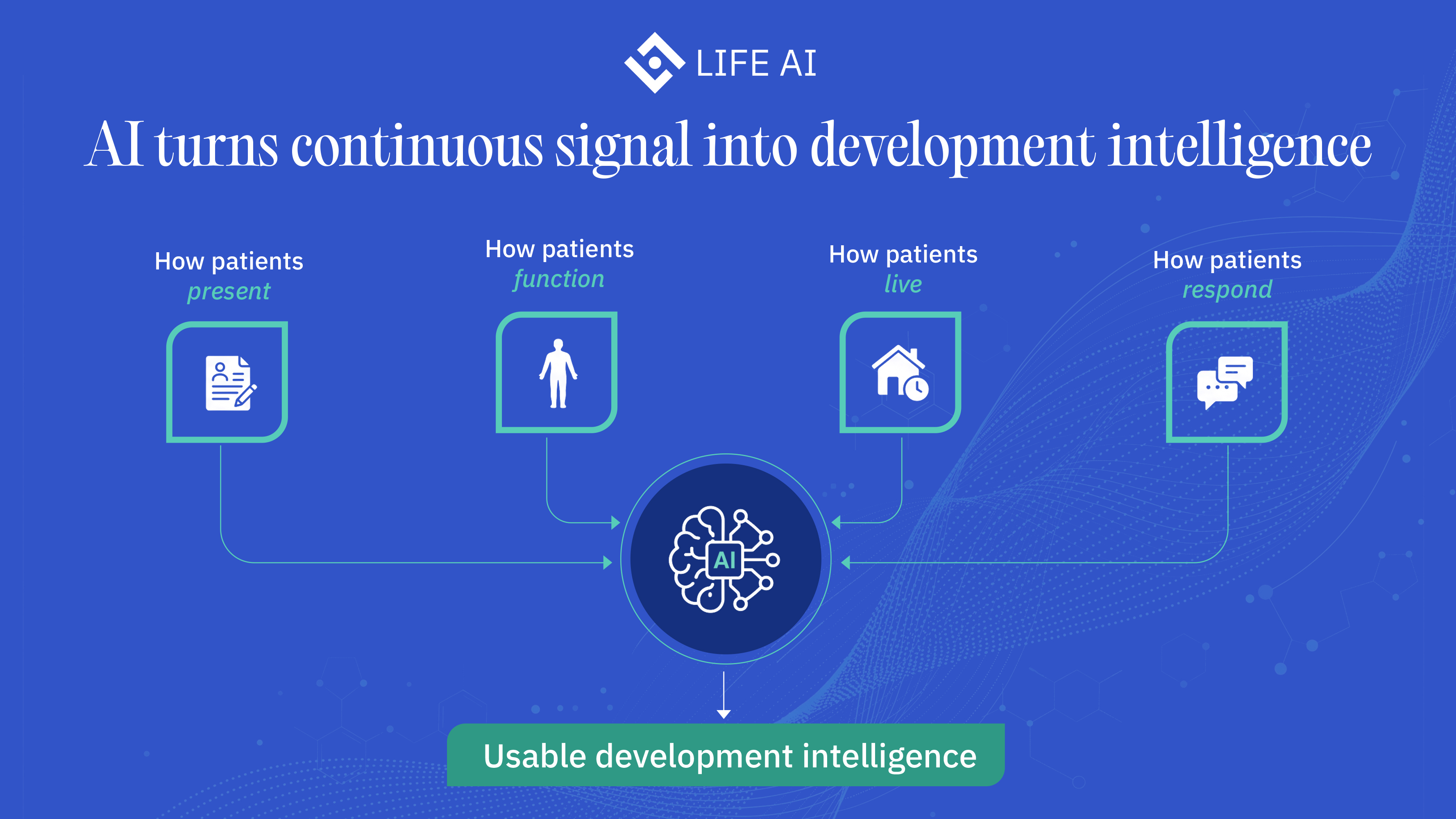
The next edge in drug development will come from understanding patients at higher resolution.
For decades, clinical evidence was shaped by scheduled visits. What patients reported. What clinicians observed. Everything between visits remained largely unseen.
The FDA’s Digital Health Technologies program is expanding the use of continuous and frequent measurements beyond traditional study visits, including through wearables, sensors, and remote monitoring.
For drug development, this opens the possibility of following treatment response beyond scheduled assessments and across the patient journey.
But capturing these signals is only part of the challenge.
Biological signals, interventions, and outcomes remain fragmented across the patient journey. Without coordination, the longitudinal picture remains incomplete.
The next infrastructure layer will need to connect these signals with interventions and outcomes across time, institutions, and real-world conditions.
As the FDA advances the regulatory pathway for digitally derived endpoints, that coordination layer becomes increasingly important to drug development.
30
91
188
9,650
Faster discovery only matters if regulatory review can keep pace with the evidence AI helps generate.
2
67
Exactly. More candidates only matter if we can validate the right ones and move them into real-world treatment faster.
3
63
That’s exactly the shift. AI can help accelerate discovery, but the real value comes from helping move promising candidates through validation and development faster, without compromising safety.
1
4
104
AI can now generate more drug and treatment candidates than the healthcare industry can ever validate.
That gap between what AI can discover and what actually reaches patients is the problem Life AI was built to close.
What we're most excited about in the @GoogleStartups Accelerator: Southeast Asia program is the chance to work directly with Google's engineering teams on scaling that infrastructure, the rails that help hospitals and pharma partners move healthcare AI programs from pilot to real, deployed care.
We've already seen what's possible when this works: programs that used to take years now take months, at a fraction of the cost, while still meeting regulatory standards.
Over the next three months, we'll be pressure testing our technology alongside some of the best AI minds in the industry, building toward a technical residency in San Francisco.
More soon.
#AcceleratedWithGoogle
We're pleased to announce that Life AI has been selected for the @GoogleStartups Accelerator: Southeast Asia program.
We look forward to the opportunities ahead and to sharing our journey.
[goo.gle/4wIlbsP] #AcceleratedWithGoogle
28
93
186
11,560