

AI & Marketing Technology Executive | 4x Founder, 3 Exits | Services Transformation | PE, Bootstrap & VC
Saint Louis, Missouri
- Tweets 17,721
- Following 740
- Followers 128,628
- Likes 29,752


Pinned Tweet

LinkedIn had become too much noise, not enough signal. So I made LinkedIn Desk...a Grok @bot that learns your networking preferences, reviews invites daily, filters pitches and spam, recommends Accept/Ignore, and only clicks what you approve.
Clone it: x.ai/bot/tQuoQ94ErUfXNJu4xPq…
Included:
• First-Run Setup Skill: builds your personal network policy
• Review Skill: recommends Accept, Ignore, or Ask Me without changing anything
• Approval Skill: clicks only the exact actions you approve
• Daily Routine: reviews new invitations on your schedule


2
3
12
3,312
AJ Ghergich retweeted

SEO News: Google Search Console just added a new "Multimodal" filter to the Performance report.
Opening the Search type filter now splits the "Web" option into two: Text-based and Multimodal.
Google's definition: "Web-multimodal tracks search results triggered by a query that uses an image, photo, or screenshot. Text-only queries are tracked as Web text-based."
In practice, that means you can finally isolate discovery coming from:
• Google Lens
• Circle to Search on Android
• Image uploads to Google Search
• The Chrome right-click "Search this image" option
One important caveat before you get excited: there's no query data for multimodal traffic. Google's own docs say the queries dimension isn't available for this search type (even though there is oddly a column for it), because these searches use images rather than text. So you'll see impressions, clicks and positions – but not the actual search queries.
Why it matters: visual search has been unclear in GSC until now. If your business lives on products, packaging, screenshots, plants, parts, artwork, or anything people point a camera at, this new report gives you a better idea of the size of this channel.
Check whether the filter has reached your property – it's rolling out gradually, and I'm now seeing it for several accounts.
Is multimodal traffic already showing in your Search Console?
h/t @rustybrick


18
30
123
11,071
AJ Ghergich retweeted

Google September 2026 spam update 👾 is rolling out and it will take 2 weeks to roll out - we saw this coming, I think...
seroundtable.com/google-sept…
12
8
80
15,807


AJ Ghergich retweeted

The Perfectly Optimized Page For AEO:
- Optimized Title / H1
- Key Takeaways
- Structured Content Formats
- Freshness Updates
- FAQs

20
40
337
48,305

AJ Ghergich retweeted

We are the first generation with the tools to end scarcity.
149
204
2,061
48,236
AJ Ghergich retweeted
What actually matters for ranking on Google in 2026?
Thrilled to share my insights alongside 130 other SEOs in the latest expert survey from @CyrusShepard.
Read the full breakdown: signal.zyppy.com/p/google-ra…


13
37
168
12,314
AJ Ghergich retweeted
Google tests paying publishers for using its content in AI Overviews, AI Mode and Gemini through Search Console AI contribution pilot (something we actually spotted last April) seroundtable.com/google-al-c…


16
43
176
44,312
AJ Ghergich retweeted

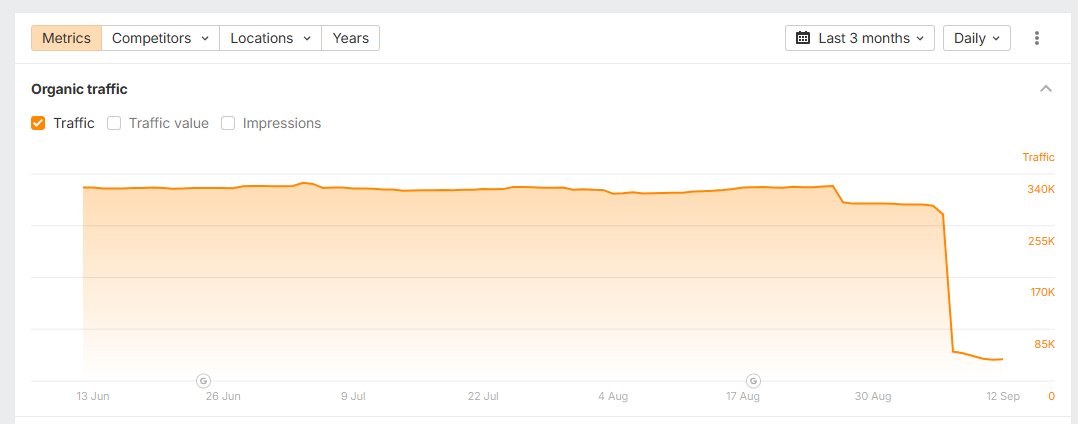
A huge heads-up: I held off on sharing about this yesterday, but now there is overwhelming evidence. There was some unconfirmed update that Google pushed out in early September (around 9/3 into 9/4) that hammered some websites. I've had a number of companies reach out to me about this and some have completely tanked. I mean, almost dropping completely (no visibility at all now). Some aren't even ranking for their brand names. I've been receiving emails every morning for the past week about this and had several calls with site owners who have shared their GSC screenshots.
Some are in ultra-YMYL categories, so I'm not sure if Google meant for this to happen, or something is off with the unconfirmed update. It could also have been a reviews system update, which Google runs behind the scenes and doesn't confirm anymore. The reviews system is now updated on a 'regular and ongoing pace'.
But I wanted to share this in case there are other site owners out there have seen heavy impact around 9/3 into 9/4. These are *confirmed drops* btw (GSC shows the massive decline starting then.) I have shared a few visibility screenshots below to show the drops. Note, Semrush took a bit of time to reflect the change, but you can see the massive drop there now... Almost 100% drop for that site.


16
17
97
31,886
AJ Ghergich retweeted

New: 2026 Google Ranking Factors Expert Survey
We surveyed 131 top SEO practitioners to score which factors most affect Google's organic search rankings.
The experts contributed over 13,000 data points across 9 MAJOR AREAS:
1. Relevance
2. Backlinks
3. Content Quality
4. Brand & Reputation
5. User Signals
6. Technical SEO
7. Internal Linking / Site Architecture
8. UX Signals
9. Google AI Ranking Factors 🆕
Big thanks to all of our contributors!

27
74
355
41,491
AJ Ghergich retweeted

ChatGPT retrieval system LEAK alert 💥
I found "something huge" in ChatGPT's server-sent events over the weekend.
Inside the stream is a detailed debug view of ChatGPT's web retrieval system. Which queries it wrote, which engines it called, what came back, scoring objects,what it fetched, how it split each page, and what finally made it into the answer.
I have been pulling this data for a few days. On Saturday I started getting rate limits, so I was probably the most active user of that stream this weekend :)
A few things I can share today:
One question is never one search. Yes, we know there are fanouts. But actually more fanouts behind the scenes!
For a single "best AI visibility tools" prompt, ChatGPT ran 5 search rounds, wrote 18 different queries(hidden queries), made 50 engine calls, pulled 228 results, fetched 223 URLs with selected chunks, and cited 16. You see 16 links.
✍ Let's start today with renderer. How actually ChatGPT uses your page for retrieval.
Your meta tags travel with every result.
There is a separate og_data object in the payload and it is empty on every single result. The raw meta_tags list is what is actually kept.
The page body is not HTML. It is a markdown-like text render. I compared its fingerprints against the common HTML to text parsers. Two-space "* bullet", "* * " for horizontal rules, "# heading" and "--- | ---" table separators with no outer pipes all match the Python html2text library. Turndown, markdownify and Trafilatura each match only one or two of those. So html2text is the strongest candidate, but it is not a stock build.
That render is what gets cut into blocks of roughly 170 words and scored. The model does not see your full page. It sees one to three of those blocks per source.
The images below is not a mockup. Every code block is copied from the stream as is, including our own Peec AI product page.
What I showed above is a small slice. One prompt produces a 150,000-line JSON dump, and the two fields in the image are maybe 2 percent of it.
The same stream also carries:
Every rewritten query, and which of roughly ten internal engines each one was sent to (web, news, Wikipedia, Reddit, arXiv, YouTube, PDF and more)
📍 A per-result score, plus a score object that breaks that score into its components
📍 A per-chunk score for every block of every fetched page, and which blocks were kept for the prompt
📍 A should_fetch decision on each result, with crawl date and publication date
📍 A second ranking pass done in the model's reasoning, where domains are re-ordered before the answer is written
📍 The exact prompt the model receives, with the word budget it is given per source
📍Separate result types for shopping and local queries, with their own fields
If you work on GEO or AI visibility, this is the closest look at ChatGPT's retrieval pipeline I have seen. MORE TO COME.
Follow @DavidKonitzny, @TomekRudzki, @MalteLandwehr, there is a lot more coming THIS WEEK.

10
35
219
58,495
OpenAI posted this and then took it down...looks like a star-coordinate acrostic 🌌?
Each pair is the location of a star: right ascension and declination...
- Antares
- Sirius
- Tarazed
- Rigel
- Aldebaran
Initials: ASTRA....Latin for “stars” clever

3
1,771
AJ Ghergich retweeted

A lot of people are asking how I pulled off these super long-horizon builds with Astra.
Astra is extremely powerful, but by default it struggled with a task this difficult. I tested a bunch of approaches to get past this, and the one I landed on is something I'm calling the Manager Loop.
It's basically a couple of tricks we used to use with much less capable models a couple of years ago, with a few new ideas layered on top. Turns out that when you put those together and apply them to Astra, its ability to do extremely difficult long-horizon tasks goes up dramatically.
Here's how it works:
1. Launch an agent (I'm calling this one the "manager"). Chat with it about what you want to get done, and have it build a massive checklist of to-dos, then break that checklist into phases.
2. The manager then spawns a second Codex agent in a separate thread (the "implementer"). The two agents can message each other.
3. Put the manager in /goal mode, and tell it to run each phase on the implementer in /goal mode.
4. The manager messages the implementer: "/goal Complete phase one completely, extremely well." The implementer doesn't stop until that phase is done, then messages the manager back. The manager tells it to start phase two. They repeat until every phase is finished, completely autonomously.
Why I think this works: over a long-horizon task, Astra tends to asymptote. It gets way further than previous models, but at a certain point it kind of just stops improving against the goal as quickly as it did before. It gets stuck in the minutiae, focusing way too much on small details, and overall progress stalls. The Manager Loop forces it to work piecemeal, one phase at a time. It's essentially how a human would steer a model, except the model is doing the steering for me.
That's actually how this started. I was having the model write the checklist and break it into phases, and then I was doing the manager's job by hand. At some point I thought, "Wait, why can't I just get a separate AI to do this?" That's what unlocked full autonomy, which is super useful.
A wording detail that seemed to matter: I ask for each phase to be done "extremely well," not "perfectly." Maybe I'm reading too much into it, but asking for "perfect" sent the model right back into the minutiae. "Extremely well" implies it's allowed to move on once it's good enough, and that worked better in my testing.
One more trick that I think helps (this one is more of a hunch, but it was useful for me): have the implementer build a simple HTML page with the full checklist on it. The implementer checks boxes off as it goes and updates a counter, and the page has a chart of # of boxes ticked over time.
Obviously the boxes aren't all equal, but it forces the model to notice things like "I haven't made progress in a while, time to move on." You can even put this in the prompt directly, like: "if you haven't ticked a box in X amount of time, move on". That helps a lot.
I also ran 96 sub-agents at a time. You can change this in your Codex config (or just ask Codex to change it).
This got me far better long-horizon performance than anything else I tried. I'll be sharing more in the coming days!

GPT-6 Astra built this Manhattan world in Unreal Engine over the course of a week.
It was literally able to go street by street to make each one perfect.

182
271
4,285
581,195
AJ Ghergich retweeted
SEOs, this is pretty freaking epic. WildChat is a public dataset that contains 300K+ real user prompts.
If you want to analyze how users actually search ChatGPT, this is an amazing resource.
12
13
137
10,449
GPT-6 Astra's SRE-Bench result from the system. 🤯
Hand it a compiled binary, no source code. It reverse-engineers 99.2% of them. GPT-5.6 Sol got 68.7%.
And it did that on a quarter of the tokens. Better answer, and fewer tokens.

1
1
3
1,443
