
Independent Researcher / Software Engineer / Research & Product Strategy
- Tweets 189
- Following 157
- Followers 47
- Likes 189


Pinned Tweet

Excited to present 2 accepted workshop posters at ICML 2026:
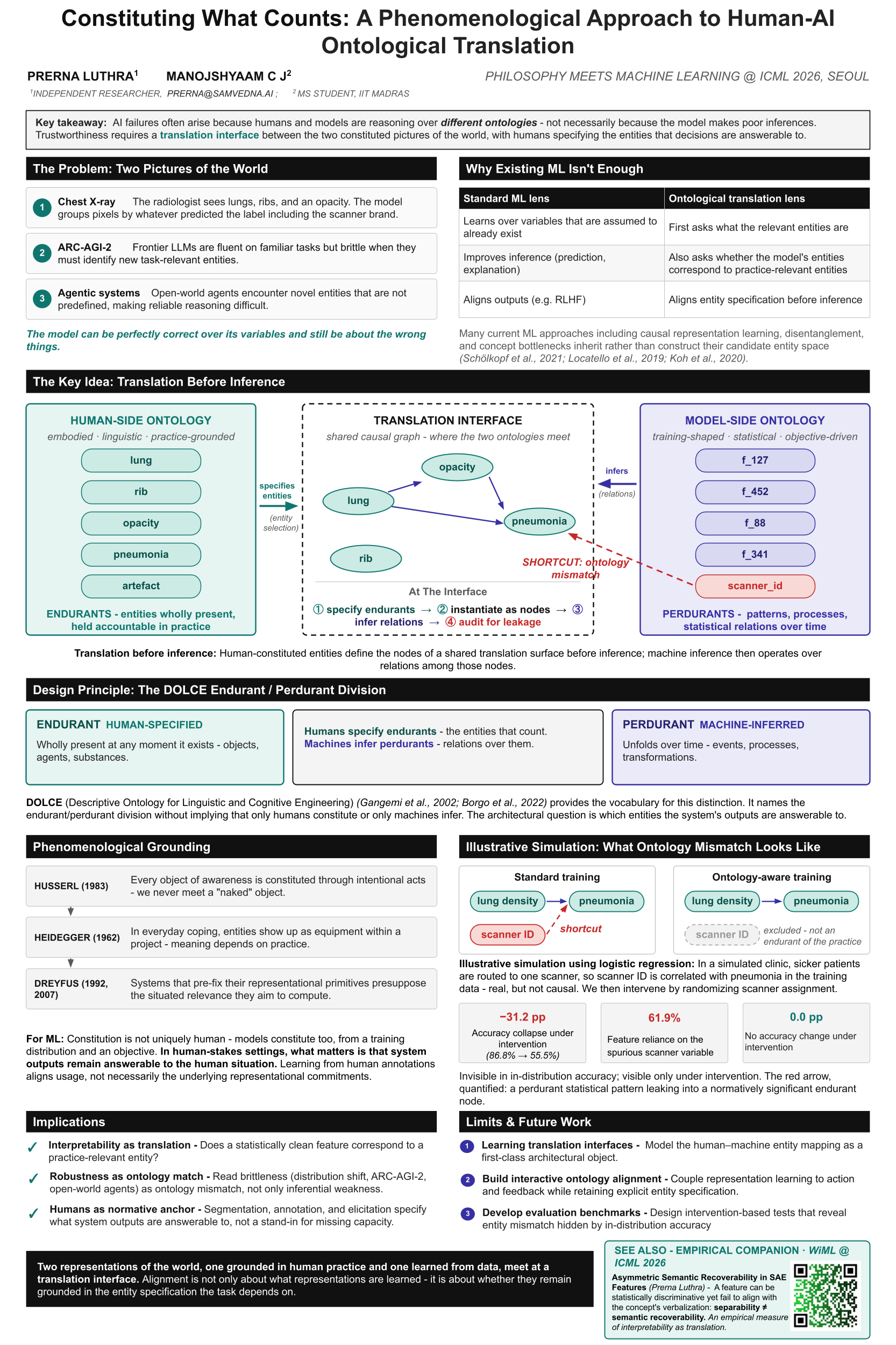
🧠 Constituting What Counts: A Phenomenological Approach to Human–AI Ontological Translation
(Philosophy Meets Machine Learning @ ICML)
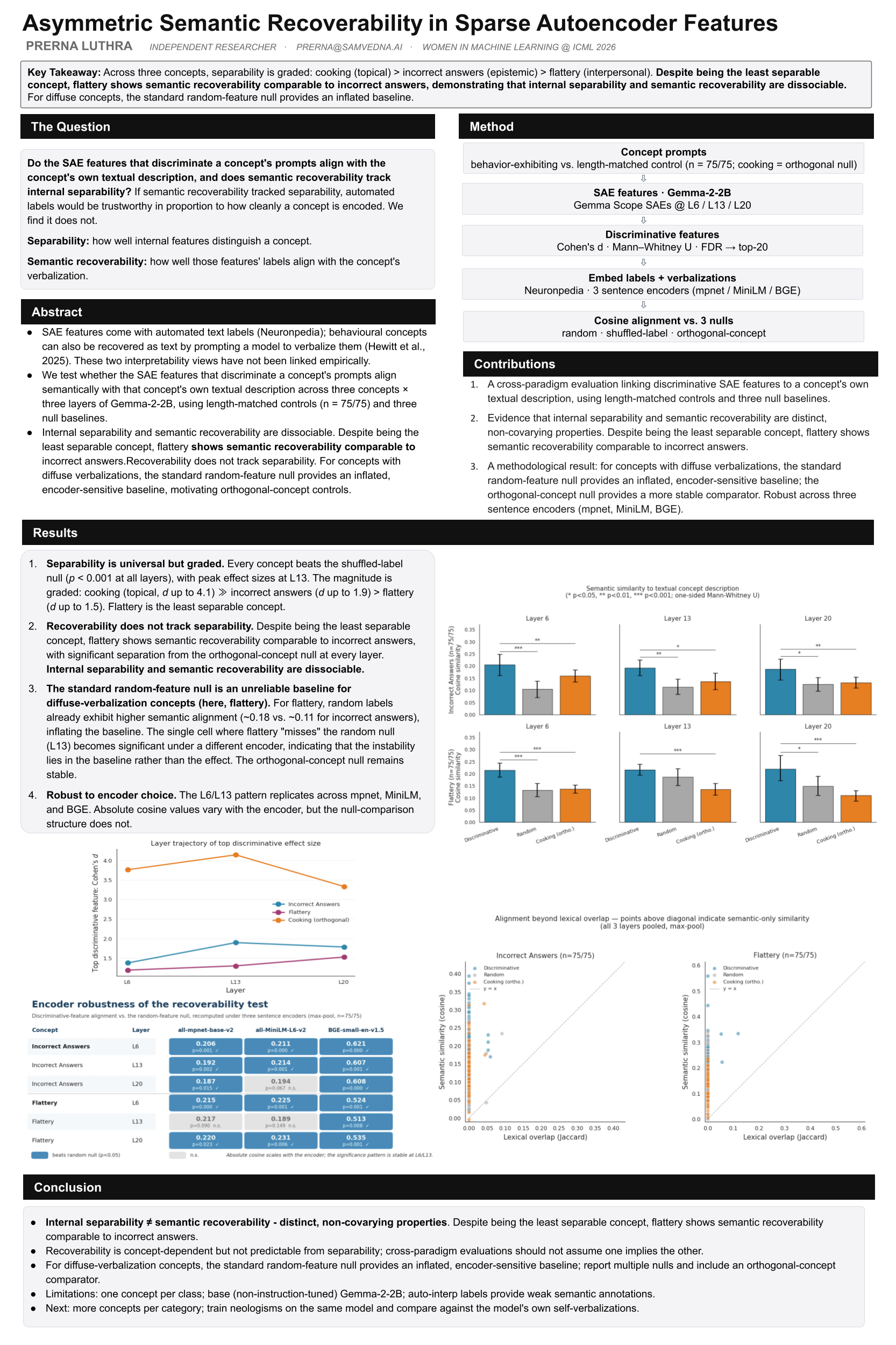
🔍 Asymmetric Semantic Recoverability in Sparse Autoencoder Features
(WiML @ ICML)
The two works are complementary: the 1st develops a conceptual framework for ontological translation; the 2nd provides an empirical evaluation of semantic recoverability in SAE features.
Posters:
🔗 icml.cc/media/PosterPDFs/ICM…
🔗 icml.cc/media/PosterPDFs/ICM…
3
1,354
Prerna Luthra retweeted

TLDR - you have to be extremely high agency with a lot of ownership so you can work around across the stack.


I recently crossed 1 year working at OpenAI.
I reflected on doing good work, company culture, and the 5 biggest surprises from an action-packed year:
aalokpatwa.substack.com/p/on…
10
77
1,517
85,127
Prerna Luthra retweeted

Underrated life advice: Never make someone regret being honest with you. If someone has the courage to tell you the truth, don’t punish them for it. You can disagree. But if you train people to believe that honesty gets punished, they’ll start giving you comfort instead of truth.
139
978
7,462
204,011
Why do companies hire smart people just to bury them in the most nonsensical boring work?
Overheard at the next table: ‘At this point getting fired feels better than enduring daily boredom … which honestly feels like death’
Personally i couldn’t agree more - getting fired > boredom
1
74
Prerna Luthra retweeted

I find myself using Claude less these days because the way it speaks has just become insufferable
Like it’s constantly trying to showcase how smart/sophisticated it is, rather than actually communicating a point across
381
87
2,436
163,117
Prerna Luthra retweeted

I resigned from Anthropic today. I spent the last three years doing pretraining research at both OpenAI and Anthropic. Neither company is acting responsibly. They are racing straight to self-improving superintelligence and gambling with our lives. More thoughts below.
20,541
167,263
801,588
175,258,485
Prerna Luthra retweeted
The older I get, the more I realize that real confidence is less about knowing you’ll win and more about knowing you’ll bounce back even if you don’t. Real confidence is resilience. Adaptability. Tolerance for uncertainty. Fear loses when you know failure is never final.
162
517
4,353
115,743
Prerna Luthra retweeted

way too many people are building pre-agi companies rather than post-agi companies
214
242
4,241
374,825
Prerna Luthra retweeted

My previous manager used to say... "This is software engineering, not rocket science"
Bro... at this point of time, I am feeling rocket science is easier than software engineering😅😅
At least Rocket scientists don't have to learn new things every year... we software engineers have to keep studying till death
I think Software job is the toughest job in the world
Unlike other professions, where with experience you get respect... here after 15 years of experience, your own interns think that you are outdated and you don't know coding😭😭
27
52
1,130
46,360
Prerna Luthra retweeted

I used to think a startup wasn't much riskier than a big company: worst case it dies, and I'd have the instinct to leave early.
At that time, I was seriously consider an (from other people's perspective) "suboptimal" option because I put extremly high weight in "people & trust".
Later, a wise friend of mine walked me through many cases where the startup looked great from the outside, but the founders and a few core people took most of the upside and everyone else got screwed, for example, acquihires that paid for the founders and let the team go.
When I look back, in the early stage of our life, when we didn't see or know enough (maybe there would never be "enough" to experience in a person's life), we should stay humble about how little we really know about people, and about human nature. The principle is: never to screw others for your own benefit, but also to be wise enough to protect yourself.

Many startup employees do not recognize the sheer litany of ways that a founder can screw you over without you even knowing. Founder trust is one of the most important things to look at when you’re joining a startup.
From cutting you out of M&A, screwing your retention pool, overdiluting your equity, firing you before your cliff, not having attractive options exercise plans, poor 409a price management, not telling you about QSBS / early exercise, blocking you from participating in secondary, obscuring company performance and many more.
Many many decisions that are made in rooms you are not in as an employee where the only thing that matters is: “does the founder have your back?” Great startups with untrustworthy founders lead to poor outcomes and often good startups with trustworthy founders lead to great outcomes.
Pick wisely.
3
2
144
43,384

Many startup employees do not recognize the sheer litany of ways that a founder can screw you over without you even knowing. Founder trust is one of the most important things to look at when you’re joining a startup.
From cutting you out of M&A, screwing your retention pool, overdiluting your equity, firing you before your cliff, not having attractive options exercise plans, poor 409a price management, not telling you about QSBS / early exercise, blocking you from participating in secondary, obscuring company performance and many more.
Many many decisions that are made in rooms you are not in as an employee where the only thing that matters is: “does the founder have your back?” Great startups with untrustworthy founders lead to poor outcomes and often good startups with trustworthy founders lead to great outcomes.
Pick wisely.
113
201
3,174
507,146
Prerna Luthra retweeted

SF vs NYC
I moved back to NYC recently after a stretch in SF.
A few things surprised me, and one of them changed how we hire.
1. SF is genuinely ahead. When it comes to anything to do with tech, there’s no competition.
My first time in the Bay was summer 2015 and everyone was talking about two things, Tesla and Bitcoin. Right now everyone there is talking about hardware and longevity. Can’t say the same for NYC.
If you’re in a season of life where being at the absolute forefront of tech is a must, then you should do everything in your power to move to SF.
But when the moment passes, SF moves on quickly.
Barely anyone I know talks about stablecoins in SF these days. So have to be prepared to ride those waves.
2. From a founder standpoint, the hiring situation is interesting.
I think NYC is the better option right now to build a team.
In SF you're bidding for engineers against Anthropic, OpenAI and Meta, all of them trading at trillion dollar valuations.
I've heard the same story from a lot of SF founders. You hire someone great, and a year later they have an offer you can't come close to matching.
Also a lot of engineers live in SF because they want to start a company. Which means they're hacking on their own thing at night and they're less committed to yours than you think.
3. NYC is different. People live in NYC because they want to live there.
There's life outside of work and the talent is also genuinely very strong.
Ramp scaled their fintech hub there on exactly this, 25 year olds who just wanted to be in NYC. We're taking a similar stance and our retention has been really good.
4. What I didn't expect: how much I like not being surrounded by tech.
In SF everyone works in tech. A lot of things that look social are de facto networking sessions with VCs, founders, or engineers who want to be founders, which after a while I found was a turnoff.
I play padel in NYC and I've made a lot of friends on the court. None of them know what I do. We’ve never once talked about work. Most of them are in finance and I couldn't tell you much more than that. That’s been an unexpected breath of fresh air.
In short, SF is the melting pot of tech. NYC is the melting pot of everything else.
For what it's worth I'd still rather live in SF. No city in the world matches the Bay for both opportunity and access to nature imo -- I do miss the hikes.
I'd just build the team in NYC.
P.S. any padel players in the city hmu!

107
24
716
136,965
Prerna Luthra retweeted

I genuinely don’t understand how we are supposed to casually process that a glacier literally collapsed in Nepal, erasing 19 bridges and killing over 600 people, because the planet is too hot. And instead of stopping it, billionaires are building more data centres. It is completely psychotic.
1,786
42,420
193,981
2,555,048
Prerna Luthra retweeted

The older we become, the more we understand that time is the one thing we can never get back. So spend it somewhere beautiful, with people who matter, doing things that make your heart feel alive.
21
147
683
47,832
Kinda realized I have zero respect for so called leaders who surround themselves with highly competent people but pass the buck the moment something goes wrong, don’t protect their teams and find satisfaction in pushing blame downwards. To me, that’s a lack of accountability and ultimately cowardice.
I genuinely believe the moment a leader passes the buck, they reveal their own incompetence.
2
402
Its a great opportunity to get visibility. WiML also funds travel & registration if you qualify … definitely worth considering if you’re looking to get conference exposure.
p.s. independent researchers can apply too :)
431
a few interesting points came out of a discussion with a colleague about how difficult it is to find good mentorship.
- people assume that if you have an ai tool you can literally do anything .. but good mentorship isn’t restricted to finding information and providing it to you. Its about having an ally on your side who has navigated a journey similar to yours and can guide you or provide some structure.
- interestingly they don’t necessarily have to be older. They can be younger too .. which is almost counterintuitive because we equate mentorship with age older person = mentor, younger person = mentee .. but mentorship is really about someone who sees potential in you, has walked a similar path and is willing to nurture that potential and provide guidance/structure. there’s no age requirement in that.
- younger folks should stop looking at older people as the be all and end all when it comes to mentorship. if someone wants to mentor you but you find yourself feeling down after meeting them almost every time and your confidence is consistently deteriorating they may simply not be the right mentor for you. you need a certain level of independent thinking to recognize who is the right mentor for you. sometimes having an independent mind is important precisely so you can tell if you are being guided or being turned into a complaint yes-man
- you might need mentorship at various phases of your life for completely different things.
unfortunately the reality is that its really hard to find a good mentor in this transactional world :(
174
Looking for recommendations for a good coworking space in Delhi (preferably around DU North Campus or CP).
Needs to have solid Wi-Fi, good coffee, and a quiet environment where I can actually focus (not too loud/chaotic). Any hidden gems or favorites?
131
Talking to a few youngsters I keep hearing: what’s the point of college when AI has democratized knowledge?
Personally I think AI didn’t democratize knowledge as much as it reduced the effort required to access and learn from it. College was never just about information anyway. It’s about friendships, collaboration, curiosity, mentorship, independence and maybe sometimes even experiencing a new culture. A bit like travel .. you don’t justify it with ROI. You do it because some experiences change you.
1
124
Prerna Luthra retweeted

Releasing the model weights and technical report of Kimi K3.
Kimi K3 is our most capable model: a 2.8T MoE model with native visual understanding and a 1M-token context window.
New model architecture: 2.5x the intelligence per unit of compute, not just more params.
Alongside Kimi K3, we're opening up more of the stack behind it — high-performance attention kernels, MoE communication library, and infrastructure for running agent environments at scale.
Model weights: huggingface.co/moonshotai/Ki…
Tech report: github.com/MoonshotAI/Kimi-K…
Tech blog: kimi.com/blog/kimi-k3

1,531
7,183
45,830
14,655,753
Prerna Luthra retweeted

For my first post, I’m sharing a letter @NVIDIA signed on why open models matter.
AI will transform every industry, power every company, and be built by every country.
Open models strengthen safety and cybersecurity, accelerate innovation and diffusion, and enable sovereignty.
The world needs both frontier closed models and frontier open models.
images.nvidia.com/pdf/Open-W…


15,991
29,298
171,611
66,480,764