

Building full-stack abundance: @inclsvabundance @abundancepac @abundancedems;#HistoryOfScience;❤️🏃🏻♂️🚴🏻♂️🥾;@baa 26.2 in 2:59:29;3 boys w/@leorahorwitzmd
Greenwich, CT
- Tweets 24,495
- Following 2,025
- Followers 3,263
- Likes 108,232


Pinned Tweet

"Kaufman doesn’t mind going against the grain. He likens working on legislation to buying long-dated options contracts: The odds of success are uncertain, and a payoff is years away, but a policy win can result in tens of billions of dollars in economic and social impact." #PolicyPhilanthropy

Derek Kaufman once oversaw fixed income trading at the hedge fund Citadel. Now he’s betting on something else: a movement to get America building again bloomberg.com/news/articles/…
2
1
21
2,293
Derek Kaufman retweeted

One of the fastest ways to lower utility bills is getting more out of the power lines we already have. @ENERGY’s new SPARK awards upgrade existing lines to carry more electricity, adding 23+ GW of capacity for about 100 million Americans. Read more here: energy.gov/articles/energy-d…
1
4
132
Permitting tush-push time! piped.video/watch?v=iKjxL7-a…

NEW: Permitting goes past the 11th hour. Senators are hopeful that Trump’s signal that he would ease his blockade on wind projects will help unlock a deal. ENR ranking member Martin Heinrich told me last night talks are “on the five-yard line, but those five yards are hard”


2
14
2,576
And from @SenWhitehouse

Latest Sen. Whitehouse, a key Dem on permitting:
“As with any big bill, there's quite a lot of work to be done, but none of it is work that suggests there’s going to be any problem with getting the bill passed.”
1
157
Timeline:

The Senate should finalize a deal this month to give stakeholders time to review it and build a coalition of support. The House, the Senate and the White House all want this to happen—this moment doesn't come often. The time to act is now.
Read my full statement. ⬇️
scottpeters.house.gov/press-…
111
Derek Kaufman retweeted

The Senate should finalize a deal this month to give stakeholders time to review it and build a coalition of support. The House, the Senate and the White House all want this to happen—this moment doesn't come often. The time to act is now.
Read my full statement. ⬇️
scottpeters.house.gov/press-…
1
8
33
6,462


And simultaneously understand security implications

I am calling for the National Security Council to hold regular meetings on the emerging national security threats posed by advanced AI systems.
America must continue to lead the world in AI while staying ahead of the security challenges posed by this rapidly advancing technology.


166
Derek Kaufman retweeted

Bipartisan negotiators @SenCapito, @SenWhitehouse, @SenMikeLee and @SenatorHeinrich have made tremendous progress on permitting reform. Now is the time to continue the work to deliver meaningful, lasting reform that gives manufacturers the certainty we need to invest, build and grow.
Manufacturers cannot wait. We need durable policy that gets shovels in the ground faster, projects moving and America building again. Let’s get it done.
1
6
16
988
Derek Kaufman retweeted

My session for the IFP short course on the economics of innovation is now online!

The short version: the returns to R&D are very high.
But @mattsclancy's full lecture on how we measure the returns to R&D - what we know and what we're still learning - is fascinating.
I thought this chart was particularly helpful in understanding WHEN we get returns from different types of research.
Check out Matt's Economics of Ideas, Science, and Innovation lecture here: macroscience.org/p/matt-clan…

2
10
34
5,768


Derek Kaufman retweeted
The American Leadership in Fusion Act, introduced today, would invest $10 billion to accelerate commercial fusion. Abundant and affordable power is worth building for. Proud to support this, and grateful to @RepZoeLofgren, Rep. @JayObernolte, @RepDonBeyer, @RepGallagherCA1, & @RepLoriTrahan.
2
3
179
Derek Kaufman retweeted

New: Energy Sec Chris Wright tells @kelseytam at event in Pa. that the Trump admin is still committed to passing permitting in lame duck: "If if it gets passed in November instead of September, it's still a big win for the American people. We want to get permitting reform done."
2
18
82
14,835
Derek Kaufman retweeted
Yesterday, we joined @ThirdWayTweet to discuss permitting reform at NYC Climate Week. Thanks to our panelists, moderators, and all who packed the room!
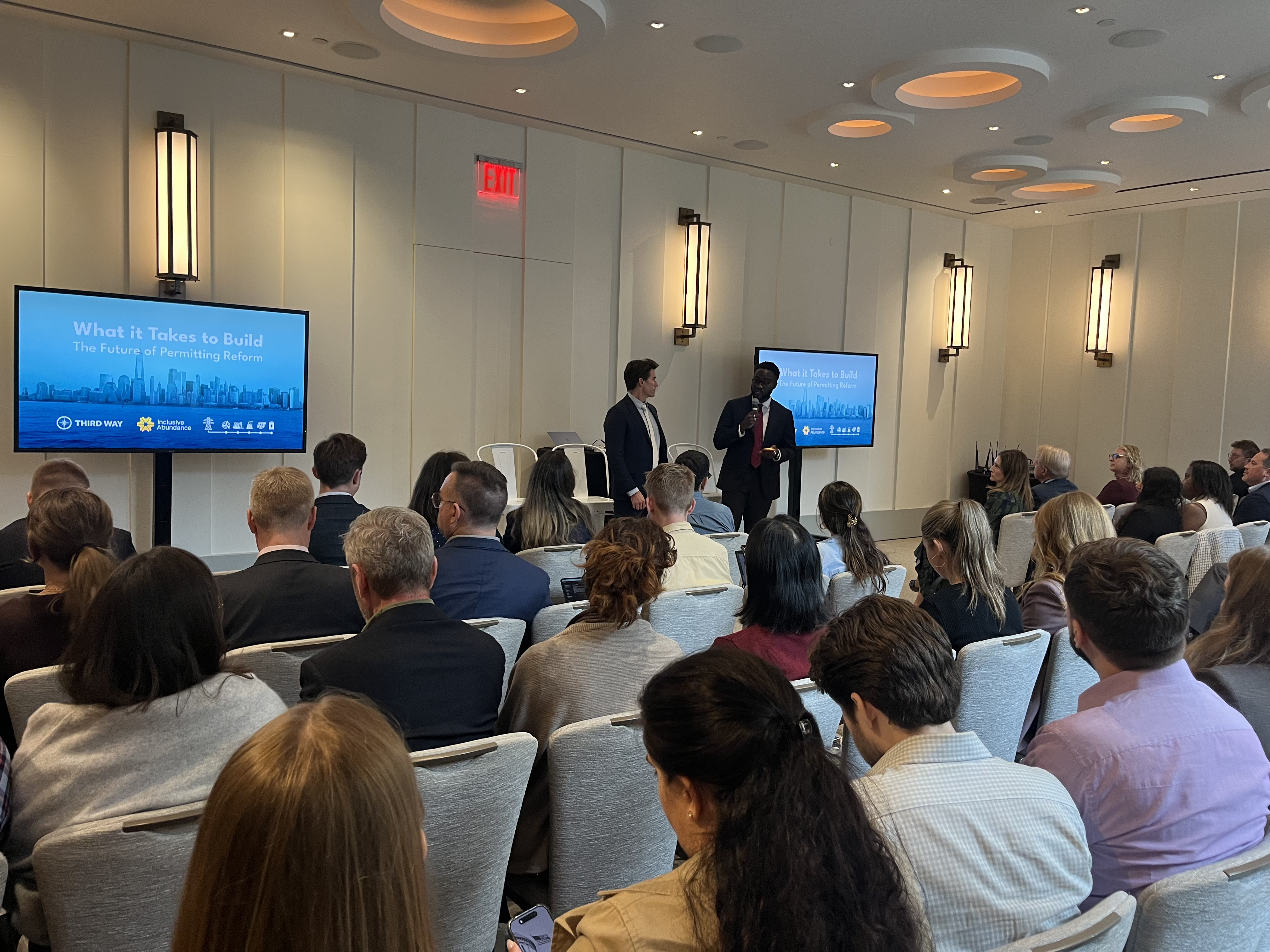
2
4
230
Derek Kaufman retweeted

When Roland Fryer sought to improve 20 struggling Houston schools, he implemented five practices: more instructional time, high-dosage tutoring, frequent teacher feedback, data-driven instruction and a culture of high expectations.
The results were extraordinary.
In math, elementary students gained four additional months of learning each year; secondary students gained nearly eight months in a nine-month school year. Every graduating senior in the high schools was admitted to a two- or four-year college.
Roland Fryer writes about Nikole Hannah-Jones, school choice, and the real way to turn struggling schools around in @WSJ: wsj.com/opinion/the-educatio…
39
312
1,323
83,254
Derek Kaufman retweeted

Thank you Sens. @SenCapito, @SenWhitehouse, @SenMikeLee and @SenatorHeinrich for the bipartisan leadership and hard work to bring a permitting reform deal this close.
Let’s get it done—so we can lower energy costs, get shovels in the ground and build the future in America.
3
6
24
1,801
Derek Kaufman retweeted

If your feed is anything like mine, you might have been hearing more about effective altruism this week. I think the key underlying reason for the surge is that concern about the risks from advanced AI have been getting more airtime recently, and EA was early to those concerns.
What’s driving the surge in attention on AI risks?
-OpenAI's Hugging Face attack (openai.com/index/hugging-fac…)
-METR/Redwood’s investigation of the hack came out, and (correctly IMO) freaked a lot of people out. (e.g. nitter.net/binarybits/status/2092…, nitter.net/SenJohnKennedy/status/…, nitter.net/BarackObama/status/210…, nitter.net/HawleyMO/status/209813…)
-Jacob Coxon’s resignation went mega viral as the first time a lot of people heard the (crazy, true) fact that lots of people building the most advanced AI systems think there’s a >10% chance they will kill everyone.
-That’s moving public opinion in a big way (nitter.net/davidshor/status/21003…, semafor.com/article/09/16/20…)
What does any of this have to do with effective altruism?
Well, effective altruism is a community that developed mostly online starting in the early 2010s around using evidence and reason to do the most good (especially with your donations and career choice). Three very different focuses have all been popular in the EA community since the beginning: effective giving in global health and development (e.g., donating to the kinds of organizations @givewell recommends, which do things like distribute bednets to prevent the spread of malaria), trying to reduce suffering for farm animals (which are orders of magnitude more numerous, treated vastly worse, and receive way less philanthropic attention than animals in shelters), and reducing risks to the future of humanity, especially from advanced AI. I personally came into this work from the global health angle - I had started working at GiveWell before the term “effective altruism” was coined - but Coefficient Giving, the funder I cofounded and now lead, over time came to fund work across all three of these streams of work (in addition to many other areas that aren’t typically associated with EA, such as the YIMBY movement to build more housing, work on science policy to accelerate discovery and economic growth, and research on new treatments for neglected diseases).
OK, so the EA community was early to work on AI safety, and CG has been funding a lot of the key players working on AI safety for a long time. As AI risk concerns have popped over the past couple of months, that’s led to more scrutiny on the EA community for IMO a mix of good and bad reasons.
I think the good reason is genuine curiosity (and maybe some healthy skepticism!) about these connections - where did the ideas of the people who are now leading giant AI companies come from? Why is everything in this world so interconnected? (My answer: it used to be a really small world - very few people were thinking about this stuff or taking it seriously until just a few years ago, so of course the ones who were found each other and started collaborating. It’s kind of wild IMO looking back how prescient some of the early writing from this world was (e.g. lesswrong.com/posts/6Xgy6CAf…). At the time, I was skeptical - I mostly just worked on global health and I was like “I dunno about this SV crowd freaking out about AI, how much can we really predict this stuff” but holy shit they were way more right than me, and I’ve moved in their direction a lot.)
But I think the bad reasons are unfortunately mostly self-interested. A bunch of powerful actors stand to benefit from unchecked AI progress, and they’re doing everything in their power to demonize or dismiss anyone with concerns. This leads to disproportionate discussion of EA because EA is interested in neglected and underappreciated ways of doing good. That makes it open to weird ideas. And people, very disproportionately with a financial stake in the AI fight, are trying to make it about EA instead, because EA being weird is much safer territory for them than the rather uncomfortable fact that many of the people making the most advanced AIs think that they might kill everyone.
(FWIW, my personal estimation of the risks is a lot lower than many of the folks who worry about this stuff. In debates like this one (asteriskmag.com/issues/03/th…), I often feel more sympathetic to the perspective of folks like my colleague @mattsclancy than the people on the other side, and I have a lot of time for @binarybits critiques (understandingai.org/p/the-ca…). I think a big part of the difference with more worried folks is that I expect society to react more vs sleepwalk into a crisis. But it is not lost on me that folks like @ajeya_cotra and @RyanGreenblatt who are more worried have had outstanding and falsifiable recent forecasting track records (theaidigest.org/2025-ai-fore…), making way better predictions than I would have. So I think their perspectives need to be taken seriously. And of course a single digit percent chance of everyone dying is way too high!)
Where should this leave you?
I think the main thing is not to get distracted. You absolutely do not have to be an EA, care about EA, or like EA, at all, to care about risks from AI and to be engaged on this issue. Everyone from Josh Hawley to the Pope to Obama are weighing in now, and that is great. This conversation was always too big and too important for any one community to drive. It’s unfortunate that we need to play catch up as society because until this year it was too weird for most people to want to engage with, and I think that should generate some grace for people who were earlier to these topics than most of us (certainly than I was). But it’s great the conversation is broadening now and it’s good to focus on the merits of where we are now and the appropriate policy response rather than getting caught up in the (in some sense unsurprising) fact that the people who were willing to think weird thoughts about the future of AI ten years ago were also interested in other weird ideas. If you’re not into weird ideas, that’s fine, you can just do you, you shouldn’t let this history stop you from engaging.

Just to update this chart:
1) AI salience has increased dramatically in the past week - increasing as much in the last week as the previous year combined
2) 80% of voters think it's either very or somewhat likely that AI will cause widespread job loss in the five to ten years
3) 64% of voters think it's either very or somewhat likely that AI could pose a threat to humanity's survival
4) Large bipartisan majorities back immediate government action on AI even when primed about risk from China


7
47
352
102,165