

100 countries, 1 humanitarian mission: to promote respect for the laws of war #IHL and help people caught up in armed conflicts and violence.
- Tweets 29,299
- Following 1,279
- Followers 2,101,501
- Likes 10,071
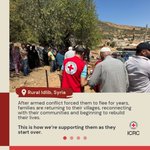


ALT After armed conflict forced them to flee for years, families are returning to their villages, reconnecting with their communities and beginning to rebuild their lives. This is how we\u2019re supporting them as they start over.

ALT Over 250 families who returned to the villages of Sheikh Sandian and Ghaniya in southern rural Idlib were able to cover their immediate basic needs with the food and essential household items we\u2019ve distributed alongside the Syrian Arab Red Crescent.

ALT The house is destroyed, but the olive trees are still there, and they are helping us continue this life.\u201D Abu Fares, 80 years old, returned to his village after ten years of displacement.

ALT I waited more than 14 years to return. But home was no longer as I remembered it. The fear of explosive remnants of war still affects our sense of safety.\u201D Umm al-Nour She and her family are finding ways to rebuild their lives, despite difficult living conditions.

ALT Every road a humanitarian cannot safely travel is a road help cannot take.


ALT I lost everything I had. My children and I were hungry; there was no clean water. There was nothing to sleep on. Mosquitoes feasted on us. Seeing these mosquito nets today, the food, the oil, blankets, and the repaired boreholes, I am filled with joy that my children will have meals that they missed and drink clean water.\u201D Charity Nyoka Displaced person in Kajo-Keji, Central Equatoria State


ALT International humanitarian law (IHL) and peace processes are often treated separately, but they are deeply connected. IHL aims to reduce human suffering during armed conflicts by setting limits to the means and methods of warfare. Peace processes are designed to put an end to armed conflicts. Understanding their intersection is essential to facilitating the path to peace. - IHL helps lay the groundwork by: Protecting civilians and civilian objects, including civilian infrastructure Protecting humanitarian activities Providing a basis for accountability. Helps preserve pathways towards sustainable peace. - Preparing for peace can start before conflict begins.. Strong national frameworks, institutions and preparedness measures can help preserve the capacity to respect IHL when crisis comes and support pathways back to peace afterwards.

ALT International humanitarian law (IHL) and peace processes are often treated separately, but they are deeply connected. IHL aims to reduce human suffering during armed conflicts by setting limits to the means and methods of warfare. Peace processes are designed to put an end to armed conflicts. Understanding their intersection is essential to facilitating the path to peace. - IHL helps lay the groundwork by: Protecting civilians and civilian objects, including civilian infrastructure Protecting humanitarian activities Providing a basis for accountability. Helps preserve pathways towards sustainable peace. - Preparing for peace can start before conflict begins.. Strong national frameworks, institutions and preparedness measures can help preserve the capacity to respect IHL when crisis comes and support pathways back to peace afterwards.

ALT International humanitarian law (IHL) and peace processes are often treated separately, but they are deeply connected. IHL aims to reduce human suffering during armed conflicts by setting limits to the means and methods of warfare. Peace processes are designed to put an end to armed conflicts. Understanding their intersection is essential to facilitating the path to peace. - IHL helps lay the groundwork by: Protecting civilians and civilian objects, including civilian infrastructure Protecting humanitarian activities Providing a basis for accountability. Helps preserve pathways towards sustainable peace. - Preparing for peace can start before conflict begins.. Strong national frameworks, institutions and preparedness measures can help preserve the capacity to respect IHL when crisis comes and support pathways back to peace afterwards.

ALT International humanitarian law (IHL) and peace processes are often treated separately, but they are deeply connected. IHL aims to reduce human suffering during armed conflicts by setting limits to the means and methods of warfare. Peace processes are designed to put an end to armed conflicts. Understanding their intersection is essential to facilitating the path to peace. - IHL helps lay the groundwork by: Protecting civilians and civilian objects, including civilian infrastructure Protecting humanitarian activities Providing a basis for accountability. Helps preserve pathways towards sustainable peace. - Preparing for peace can start before conflict begins.. Strong national frameworks, institutions and preparedness measures can help preserve the capacity to respect IHL when crisis comes and support pathways back to peace afterwards.

ALT For many families, the impact of the floods that struck Nepal on 26 August continues long after the waters recede. Damaged roads and bridges are making some communities difficult to reach, while families continue to search for loved ones and cope with loss. We continue to work with the Nepal Red Cross Society to reach affected communities, support families searching for missing relatives, and help ensure the safe and dignified management of the deceased.

ALT For many families, the impact of the floods that struck Nepal on 26 August continues long after the waters recede. Damaged roads and bridges are making some communities difficult to reach, while families continue to search for loved ones and cope with loss. We continue to work with the Nepal Red Cross Society to reach affected communities, support families searching for missing relatives, and help ensure the safe and dignified management of the deceased.

ALT For many families, the impact of the floods that struck Nepal on 26 August continues long after the waters recede. Damaged roads and bridges are making some communities difficult to reach, while families continue to search for loved ones and cope with loss. We continue to work with the Nepal Red Cross Society to reach affected communities, support families searching for missing relatives, and help ensure the safe and dignified management of the deceased.

ALT For many families, the impact of the floods that struck Nepal on 26 August continues long after the waters recede. Damaged roads and bridges are making some communities difficult to reach, while families continue to search for loved ones and cope with loss. We continue to work with the Nepal Red Cross Society to reach affected communities, support families searching for missing relatives, and help ensure the safe and dignified management of the deceased.

ALT The rules of are not meant to exist only on paper; they must be enforced to save lives.


ALT Today, we delivered 22 tonnes of life-saving medical supplies to Sana\u2019a to replenish dwindling stocks and support hospitals responding to a growing number of war-wounded patients in Yemen. The delivery is part of a wider emergency response to intensifying fighting that has placed health-care facilities across Yemen under immense strain, including in Marib governorate, where an ICRC mobile surgical team has been deployed since late August. \u201CThe recent escalation in hostilities has overwhelmed hospitals, which are grappling with critical shortages of medical supplies and an influx of war-wounded patients,\u201D said Christine Cipolla, ICRC\u2019s head of delegation in Yemen. \u201CThis urgent support will help front-line hospitals continue life-saving care to those in desperate need.\u201D


ALT Civilian homes shouldn\u2019t look like this. They are not a target

ALT For families waiting to know what happened to a missing loved one, the return of their remains can bring painful but important answers.\u2028\u2028Today, we supported the repatriation of the remains of fallen soldiers between Russia and Ukraine, following an agreement between the parties.\u2028\u2028Since 2022, we supported and observed 68 such repatriations. Each one is a solemn reminder of the human cost of conflict and an important step towards identifying the dead.\u2028\u2028Confirmation that a loved one has died is devastating. But after a long period of uncertainty, it can also allow families to mourn and lay their loved one to rest with dignity.\u2028Families have the right to know the fate of their missing loved ones. We remain committed to supporting efforts to ensure that the dead are treated with dignity.