

The Journal of International Economics is intended to serve as the primary outlet for theoretical and empirical research in all areas of international economics
- Tweets 1,809
- Following 47
- Followers 9,085
- Likes 242


New at JIE: "Global production networks and imperfect competition" by Hanwei Huang (@HanweiHuangEcon), Kalina Manova (@EconUCL), Oscar Perelló (@oiperello) and Frank Pisch (@FrankPisch)
doi.org/10.1016/j.jinteco.20…

1
13
36
3,303

New at JIE: "The impact of AI and cross-border data regulation on international trade in digital services" by Ruiqi Sun, Daniel Trefler
doi.org/10.1016/j.jinteco.20…

7
23
1,443
New at JIE: "Expert inflation preferences and the evaluation of monetary policy" by Timo Wochner (@TimoWochner), Lukas Hack (@LukasHack_) and Niklas Potrafke (@ifo_Institut)
doi.org/10.1016/j.jinteco.20…

1
4
10
872

New at JIE: "Climate policies as a catalyst for green FDI" by Samuel Pienknagura (@spienk80)
doi.org/10.1016/j.jinteco.20…

1
6
36
1,861

New at JIE: "Trust, business group verticality, and firm productivity" by Christian Fons-Rosen, Miriam Manchin, Katalin Szemeredi
doi.org/10.1016/j.jinteco.20…

2
10
823
📢 The International Seminar on Trade (ISoT) returns for its 3rd edition!
📍 ifo Institute, Munich 🗓️ 20–21 May 2027 📅 Deadline: 10 Jan 2027
Co-organised by @JIntlEcon, @LMU_Muenchen, @CESifoNetwork, @ifo_Institut, @WorldBankGroup & @cepr_org
🔗 sciencedirect.com/journal/jo…

10
51
3,514
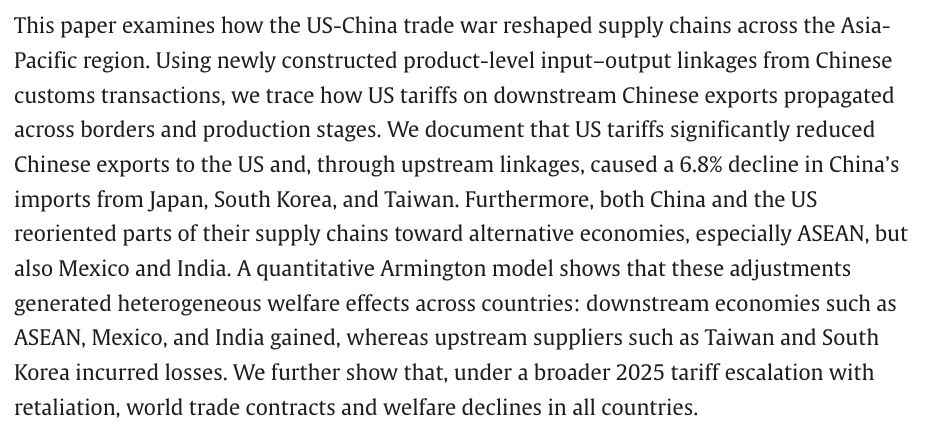
New at JIE: "Reshaping factory Asia: How did the US-China trade war affect the Asian-Pacific supply chain?" by Hong Ma (@HongMa_Tsinghua), Jingxin Ning, Yuan Xu
doi.org/10.1016/j.jinteco.20…
2
8
18
2,263

New at JIE: "The extensive margin of restructuring: Adoption of new work in a global economy" by Gueyon Kim (@Gueyon_Kim)
doi.org/10.1016/j.jinteco.20…


2
6
16
10,298
New at JIE: "Exporter survival with uncertainty and experimentation" by Sebastián Fanelli (@Seb_Fanelli), Juan Carlos Hallak (@juancahallak), Yongkun Yin
doi.org/10.1016/j.jinteco.20…

1
6
34
9,335
New at JIE: "Transportation networks, technology adoption, and structural transformation" by T. Terry Cheung, Han Yang (@Han_Yang_Econ)
doi.org/10.1016/j.jinteco.20…

1
10
37
2,497

New at JIE: "Industrial composition of syndicated loans and banks’ climate commitments" by Galina Hale (@galinahale_ucsc), Brigid Meisenbacher, Rami Najjar, Fernanda Nechio (@fernandanechio)
doi.org/10.1016/j.jinteco.20…

1
4
700

New at JIE: "Offshore dollar funding shocks and the dollar exchange rate" by Philippe Bacchetta, J. Scott Davis, Eric van Wincoop
doi.org/10.1016/j.jinteco.20…

8
26
1,574
New at JIE: "Different no more: Country spreads in advanced and emerging economies". by Benjamin Born (@bornecon), Gernot J. Müller (@uni_tue), Johannes Pfeifer (@PfeiferEcon), Susanne Wellmann
doi.org/10.1016/j.jinteco.20…

1
9
23
1,404
