

Proud 🇭🇺, 🇷🇴 Jew. Distressed Residential RE investor since the GFC.
Washington, DC
- Tweets 18,851
- Following 1,178
- Followers 1,613
- Likes 36,370


Greenwald retweeted

Tony Soprano could handle a lot of things, but Carmine Lupertazzi had a way of making him realize that not every problem could be solved by intimidation.
That’s what made their disputes so interesting.
Tony wanted respect, recognition, and sometimes an immediate answer. Carmine looked at everything like a business decision. No matter how heated Tony became, Carmine rarely gave him the emotional reaction he was looking for.
And that was probably the most frustrating part for Tony.
You could threaten people, raise your voice, slam your fist on a table — but none of that changes the numbers when the other side is thinking about money and leverage.
Their relationship was basically a constant reminder that in this world, being powerful doesn't mean you always get your way.

37
432
38,600


High school and college golf were so fucking awesome. Always repped the glove in the back left shorts pocket.

Saw a random high school golf team rip chipotle together post match. Fuck I miss that shit. Enjoy it gents #imwashed

2
9
1,007
Greenwald retweeted

New Haven, Connecticut, has more elite pizza spots than most states have in total.

112
73
896
145,625
Wilt chamberlain would like a word

“Best rebounder in the history of basketball!”
@POTUS x @dennisrodman 🇺🇸

2
6
1,089


Greenwald retweeted

I spoke with Lauren Holder, a Huntington's patient and advocate, about this week's $QURE AMT-130 gene therapy clinical update.
“I’m not surprised by the four-year results because this isn’t a cure,” Holder told me. “This is a slowing-of-disease-progression treatment, and so I would expect there’s still decline going on, and we’re going to see that on testing, and that doesn’t mean it’s not working.”
Holder is a lot less pleased with the proposed design of UniQure's confirmatory study, which will require some patients to be randomized to a standard treatment arm.
"It’s not ethical,” she said. “You’re requiring patients to not receive any treatments for three years or longer, and to not be able to participate in other research. To me, it’s not ethical. To the community, it’s not ethical, and I really feel we need to have a better option.”
Read more:
statnews.com/2026/10/01/hunt…
16
23
172
28,016

Tiger next time he sees Phil…

🚨ℹ️⛳️ JUST IN — Phil Mickelson recently checked into rehab voluntarily to deal with ‘family trauma & addiction’, TMZ reports. Mickelson reportedly already completed the stint. The 56-year old has been absent from the public eye this year as he has navigated personal matters.

9
77
2,409
602,270
Greenwald retweeted

🚨ℹ️⛳️ JUST IN — Phil Mickelson recently checked into rehab voluntarily to deal with ‘family trauma & addiction’, TMZ reports. Mickelson reportedly already completed the stint. The 56-year old has been absent from the public eye this year as he has navigated personal matters.
114
44
1,293
924,324
Greenwald retweeted

Yasser Arafat, the founder of the Palestinian national, said in 1971 that they invented the Palestinian identity.
This video is dedicated to all the antisemites who support something that was made up 😂😂🤡

313
5,109
9,881
184,525
Greenwald retweeted

First Fauda, now this.
Starting tomorrow, more than 80 MILLION Americans will have the opportunity to watch The Road Between Us: The Ultimate Rescue on Paramount Plus.
The film tells the extraordinary story of retired Israeli General Noam Tibon, who on October 7, 2023, took his gun, got in a car, and went to rescue his son, my dear friend and brother @amirtibon, his daughter-in-law and two young granddaughters as Gaza's terr0rists invaded Kibbutz Nahal Oz.
In all the pain and loss of October 7th, there are also many heroes who did everything to save others, let us help share their stories.

160
1,959
9,075
241,121
Greenwald retweeted

THIS. 👏 The 44% number does not erase the rest of the data.
61% slowing on TFC at FOUR years.
80% slowing on cUHDRS at 36 months.
67% slowing on TFC at 36 months.
And a continued dose-response pattern.
In a relentlessly progressive disease with no approved disease-modifying treatment, those numbers matter enormously.
Thank you for explaining why the 44% cannot be viewed in isolation. Context matters. The totality of the data matters. And for the HD community, TIME matters.
💙💜
#HuntingtonsDisease

🚨 AMT-130 FOUR-YEAR DATA: Before you panic over “75% → 44%,” we need to talk about SURVIVOR BIAS.
uniQure released its four-year AMT-130 data today.
You're probably going to see headlines focusing on one number:
At 48 months, high-dose AMT-130 showed 44% slowing of disease progression on cUHDRS compared with the updated ENROLL-HD natural-history control.
That result was not statistically significant.
But that is NOT the entire story.
One of the most important numbers in today's release may actually be this:
53%.
By four years, 53% of the matched ENROLL-HD control data were missing.
And uniQure reports that the patients who stopped providing follow-up data were progressing materially faster than the patients who remained.
Why does that matter?
Imagine following 100 people with HD.
Over time, the people progressing fastest become less likely to remain in an observational study — traveling gets harder, disability increases, participation becomes more burdensome, etc.
Eventually, the people remaining in your dataset disproportionately represent those progressing more slowly.
If you only look at who's left, it can make untreated HD appear to progress more slowly than it actually does.
That's survivor bias — or, more specifically here, bias caused by non-random loss to follow-up.
And when that group is your comparison for AMT-130, it matters enormously.
Simple example:
Treated patients decline 1 point.
Untreated patients decline 4 points.
➡️ 75% slowing
But imagine survivor bias makes the untreated group appear to decline only 2 points.
The treated patients STILL decline exactly 1 point.
Now the calculation says:
➡️ 50% slowing
The treated patients didn't change. The comparison did.
That's why saying simply, “AMT-130 dropped from 75% slowing to 44% slowing” leaves out an enormous part of the story.
A few other important findings from today:
🔹 48 months — high dose
cUHDRS: 44% slowing (p=0.144; not statistically significant)
TFC: 61% slowing (nominal p=0.008)
🔹 When the SAME 48-month patients were compared with the previous ENROLL-HD control:
cUHDRS: 53.5% slowing (nominal p=0.041)
TFC: 68.3% slowing (nominal p=0.001)
🔹 Updated 36-month data — now 15 high-dose patients
cUHDRS: 80% slowing
TFC: 67% slowing
And importantly, the four-year data continue to show a dose-response pattern, with the high-dose group declining less than the low-dose group.
None of this means survivor bias automatically explains everything we're seeing at year four. We need to be careful about making that claim.
But it DOES mean the 44% number cannot be interpreted in isolation.
The percentage of “slowing” depends on BOTH sides of the equation:
How the treated patients are doing AND how the comparison group is doing.
If the faster-progressing people disappear from your natural-history dataset, your comparison group starts looking healthier — and the apparent treatment effect gets smaller.
So please don't let a headline tell you that AMT-130 suddenly “stopped working.”
The four-year data are more complicated than that.
And for a progressive disease like Huntington's, understanding who is missing from the data can be just as important as understanding who is still there.
#HuntingtonsDisease #AMT130 #TimeMatters

1
15
72
4,862
Greenwald retweeted

🚨 AMT-130 FOUR-YEAR DATA: Before you panic over “75% → 44%,” we need to talk about SURVIVOR BIAS.
uniQure released its four-year AMT-130 data today.
You're probably going to see headlines focusing on one number:
At 48 months, high-dose AMT-130 showed 44% slowing of disease progression on cUHDRS compared with the updated ENROLL-HD natural-history control.
That result was not statistically significant.
But that is NOT the entire story.
One of the most important numbers in today's release may actually be this:
53%.
By four years, 53% of the matched ENROLL-HD control data were missing.
And uniQure reports that the patients who stopped providing follow-up data were progressing materially faster than the patients who remained.
Why does that matter?
Imagine following 100 people with HD.
Over time, the people progressing fastest become less likely to remain in an observational study — traveling gets harder, disability increases, participation becomes more burdensome, etc.
Eventually, the people remaining in your dataset disproportionately represent those progressing more slowly.
If you only look at who's left, it can make untreated HD appear to progress more slowly than it actually does.
That's survivor bias — or, more specifically here, bias caused by non-random loss to follow-up.
And when that group is your comparison for AMT-130, it matters enormously.
Simple example:
Treated patients decline 1 point.
Untreated patients decline 4 points.
➡️ 75% slowing
But imagine survivor bias makes the untreated group appear to decline only 2 points.
The treated patients STILL decline exactly 1 point.
Now the calculation says:
➡️ 50% slowing
The treated patients didn't change. The comparison did.
That's why saying simply, “AMT-130 dropped from 75% slowing to 44% slowing” leaves out an enormous part of the story.
A few other important findings from today:
🔹 48 months — high dose
cUHDRS: 44% slowing (p=0.144; not statistically significant)
TFC: 61% slowing (nominal p=0.008)
🔹 When the SAME 48-month patients were compared with the previous ENROLL-HD control:
cUHDRS: 53.5% slowing (nominal p=0.041)
TFC: 68.3% slowing (nominal p=0.001)
🔹 Updated 36-month data — now 15 high-dose patients
cUHDRS: 80% slowing
TFC: 67% slowing
And importantly, the four-year data continue to show a dose-response pattern, with the high-dose group declining less than the low-dose group.
None of this means survivor bias automatically explains everything we're seeing at year four. We need to be careful about making that claim.
But it DOES mean the 44% number cannot be interpreted in isolation.
The percentage of “slowing” depends on BOTH sides of the equation:
How the treated patients are doing AND how the comparison group is doing.
If the faster-progressing people disappear from your natural-history dataset, your comparison group starts looking healthier — and the apparent treatment effect gets smaller.
So please don't let a headline tell you that AMT-130 suddenly “stopped working.”
The four-year data are more complicated than that.
And for a progressive disease like Huntington's, understanding who is missing from the data can be just as important as understanding who is still there.
#HuntingtonsDisease #AMT130 #TimeMatters
9
34
217
30,758
Greenwald retweeted

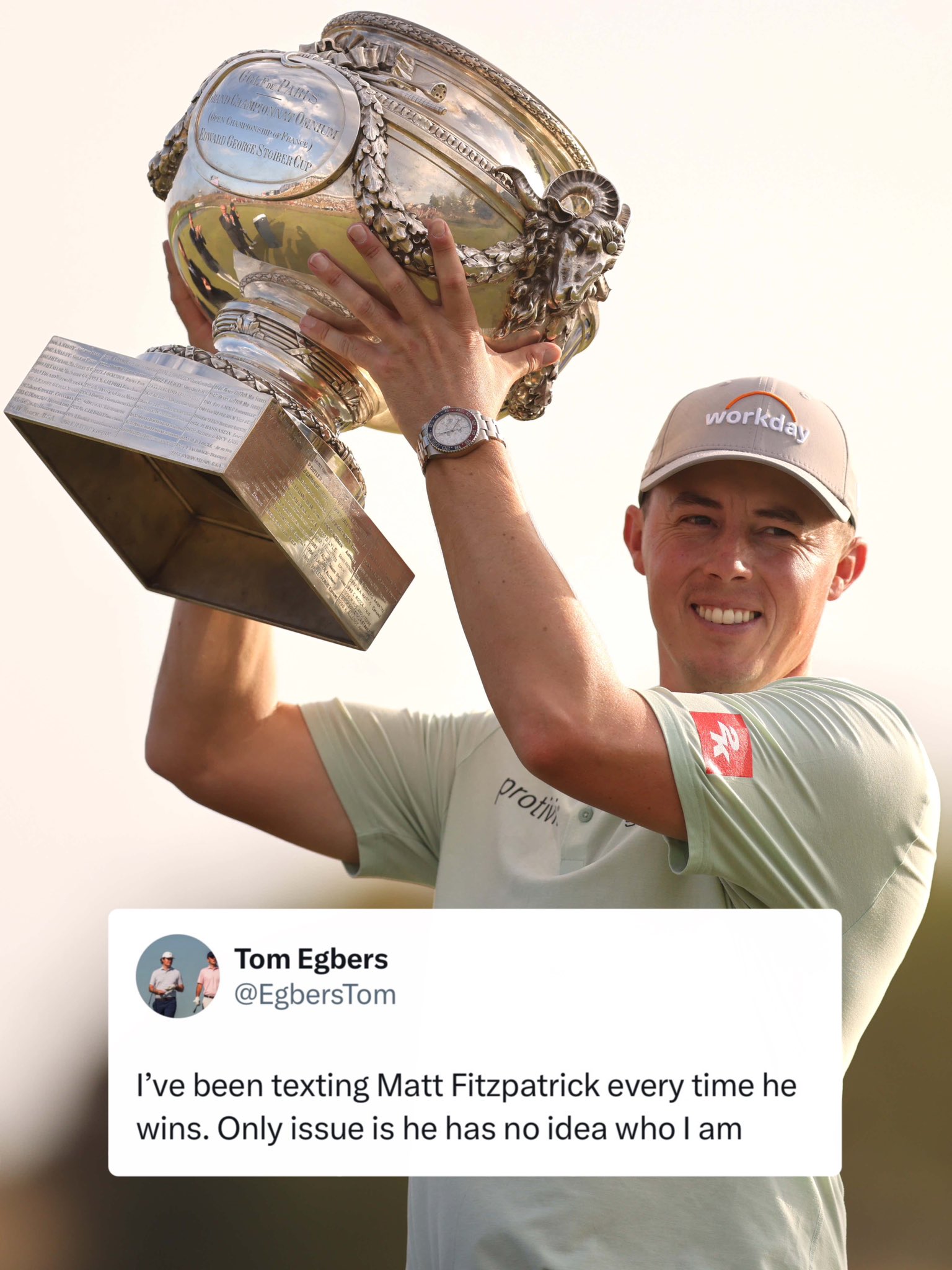
I’ve been texting Matt Fitzpatrick every time he wins. Only issue is he has no idea who I am

245
838
91,705
6,366,333
Greenwald retweeted

US team members who will drink the most beers tonight:
1. Gotterup
2. JT (already has an 8ball)
3. Wyndham (^)
4. Cam Young (patriot)
5. Koivun (will be force-fed all night)
6. Burns (patriot)
7. Cantlay
8. Xander
9. Scottie (father of two)
10. Bridgeman
11. Henley
12. Morikawa
31
24
3,142
280,622
