

Memecoin + TAO subnet charts and analysis Setups, invalidations & honest post-mortems Trading is about probabilities, not prophecies Informational purposes only
- Tweets 350
- Following 373
- Followers 7,309
- Likes 278


Pinned Tweet

Prometheus stole fire from the gods to give to mortals.
My aspirations are not quite so high.
I will use this page to share memecoin + TAO subnet charts: the reasoning, the risks and what would change my view.
Trading is about probabilities, not prophecies.
Attached is an example of a standout trade, in which luck played a significant part. Examples of more typical trades to follow.
Please see my FOMO profile to view my trading activity:
fomo.family/r/PromUnchained
Please note that this is a referral link - signing up through this link will save you 10% on your fees for trades taken on the platform, and will also earn me a share of the fees.
I will not be analysing any brand new / micro assets as sufficient trading history and liquidity are required to support meaningful analysis.
I will hold positions in some of the assets that I discuss, and will disclose this when posting (though please note positions can and do change quickly in this game, and this account will not provide live updates on every transaction - for live updates please look at my FOMO profile directly).
This page is to be used for informational and educational purposes rather than for copytrading.

49
43
182
18,203
Prometheus Unchained retweeted

AI inference onchain plays:
robinhood:0xa92768863a55d8a0591709f7f5e594a249d36ea3 strength is undeniable here. Every sell off just paints a higher low and this looks primed to breakout and create a new floor
robinhood:0xeb24a2663af4ee979dcbfe39cb95b5f12d369c4b hit 2x up from the bottom called earlier today. GENUINELY one of the BEST AI plays onchain rn cooking non stop, shipped launchpad, AI agents, Merry Men Beta (AI privacy routed swaps). Deserves to be at $10M+ minimum
$AF ( @tryaiflow ) hit ATH today, cooling off now expect next leg to $6-7M range. Crazy run up and smashed $3.6M after RT from Jeremy Allaire (Circle CEO), looks like Arc ecosystem want an AI runner and this is tek wise one of the BEST AI plays ONCHAIN. 3x more daily capacity than the ENTIRE ORBIO orderbook. Repricing soon
4
5
13
2,457
Amazing explainer for anyone wondering why I have the majority of my net worth in the Bittensor ecosystem

Ok, I just put together a proper effort post here, so hopefully you read it, but the TL;DR is that TAO hits all the notes you mentioned above. You want a coin that's essential to an AI business, where that business generates real-world value and that value drives back to the coin itself. That's Bittensor.
I am going to assume you don't know much about Bittensor beyond the "AI Bitcoin" moniker and start with a brief origin story, since I think it's important and helps illuminate where "AI Bitcoin" came from. The interesting thing about Bitcoin for the Bittensor story is that it figured out how to use a token to bootstrap a decentralized compute network, owned by nobody and accessible to everyone, that to this day is the largest computing network on Earth. Bittensor's founders are AI researchers. They knew how important compute was going to be for building AI, and they set out to build the same thing for intelligence: a decentralized intelligence network, owned by nobody and accessible to everyone. Just as Bitcoin could coordinate a disparate group of people to fight centralized control of money, perhaps a new primitive, Bittensor, could be designed to fight the coming centralized control of intelligence.
So they abstracted the Bitcoin incentive system (i.e., spend energy securing the network by solving SHA-256 hashes, get paid in BTC) so it could be applied to a whole new set of problems, all aimed at one goal: mining for intelligence. Mining SHA-256 today on Bitcoin is incredibly difficult, but as a system it's simple and objective. Mining for intelligence is orders of magnitude more complex. It's subjective, so it has to be scored on a gradient (study: Yuma Consensus), and there are multiple components that all need to be mined (compute, data, algorithms, etc.). That's where subnets come in. Each one tackles a piece of the problem.
(1) Outside revenue + value to the tokens:
It took years and a lot of iteration, but Bittensor is now doing exactly what it set out to do. It's mining intelligence.
Compute/inference: ~5 subnets are coordinating GPUs around the world to serve raw compute and inference into the open market. Customers range from retail to enterprise, with the crypto abstracted away entirely. Estimates vary, but I put this group at ~$40-50MM aggregate ARR and scaling fast (for context, think ~200% QoQ and ~50% MoM growth).
Training: two subnets are doing SOTA decentralized pre-training right now (SN3 and SN9). SN9 just wrapped up a 100B-parameter run with the highest MFU reported for a distributed pipeline-parallel run. SN3's current run is a 110B-parameter model, the largest decentralized pre-train ever attempted. These teams are past proof of concept and working on scale. And SN120 Affine is post-training Chinese OSS models at SOTA levels.
Applied AI: a whole set of subnets incentivize miners to build verticalized models that power real products. Score for computer vision. RedTeam and Bitsec for cybersecurity. Minos for genomics. Yanez for identity and fraud. Trishool for alignment. Vidaio for video compression. I'm missing plenty more. These are real products being used in the wild by enterprises. I'd put this category at $10-20MM ARR, also scaling quickly.
For context, 12 months ago I'd have said ARR across the entire network was under $5MM. The TAMs here are massive, and the blue-chip subnets are exiting the pre-revenue stage and entering the scaling-revenue stage right now.
Critically, these teams are taking that revenue and buying/burning their tokens. Not because they're altruistic. Because the network makes it the only rational move. Two reasons for this:
(1) A subnet pays its miners in its own token, a fixed number of tokens per block. So the only way to grow the supply side (more GPUs, better models, more output) is for the token to go up. If you're a compute subnet and want more capacity, you take your revenue, cover miner COGS plus some margin, and buy your token. Buy pressure on your token becomes a derivative of your compute bill. The token is the production budget.
(2) And the chain runs the same game one level up. Subnets compete against one another in a fight for daily $TAO emissions, and the scoreboard is the price of each subnet's alpha token (a clever way to let the broader market instruct the protocol on how to allocate its resources). The winners get a bigger share, and for mature subnets that TAO goes straight into buying their own token off the pool. Fall too far in the ranks and you not only lose out on emissions, you risk being deregistered.
So you might astutely point out that revenues < emissions today. That is true, but the trend is our friend. Bittensor is essentially running the Uber playbook, which I would argue a cryptocurrency is tailor-made to do. Use the token, rather than VC funding, to bootstrap supply before the demand exists. Once supply is there, demand scales and the flywheel kicks in: demand up → revenue up → buy+burns → alpha price up → miner rewards up → more/better supply → repeat. The early alpha buyers were the pre-revenue seed/Series A investors. Now we're entering the revenue/scaling era.
Although revenue isn't yet covering emissions, as discussed above, it is growing. Meanwhile, the supply side is in its first halving cycle. TAO had its first halving last December, alpha halvings are coming in 2027/28, and the subsidy shrinks on schedule as revenue takes over. I am not speculating here either - a couple of subnets already bring in more from customers than they pay out to miners.
Important to mention: to buy and burn its alpha token, a team has to buy TAO first and stake it into the pool that pairs TAO against its token. Every alpha burned leaves TAO behind in the pool. ~2M TAO already sits in those pools, and every subnet token can only trade against TAO. So subnet revenue = TAO buy pressure, mechanically. Speculative investing in subnets = TAO buy pressure. Subnet/miner/validator registrations = TAO buy pressure. Taken to its logical end... TAO is literally an index of all 128 subnets, or in other words, an index of 128 AI startups building on crypto rails.
(2) It's cypherpunk:
TAO also represents the right ethos for crypto x AI. It leverages a novel crypto primitive to bootstrap networks that coalesce edge compute and edge talent from around the world, coordinate them to produce the real inputs to intelligence (compute, data, algos, etc.), and serve them to anyone, anywhere. A network that serves open, permissionless, decentralized, uncensored intelligence. A true alternative to centralized labs and governments. And because it harnesses the world's edge compute and talent, it can scale in ways the fiat companies just can't.
(3) You're still early:
The top 3 compute subnets are ~$100MM market caps. The next two are $30-60MM. Promising subnets in other categories are sitting at $10-20MM. There are 128 subnets today and there'll be 256+ down the road. Maybe many more in the future. Bad teams get deregistered and new ones take their place. As the ecosystem grows, so do miner and owner rewards, which pulls in more teams and better talent. There will be fantastic teams launching subnets a year from now that you can buy at $5-10MM or less.
CT isn't woke to this. 99% have not bridged over to the native Bittensor chain to participate in this ecosystem. Cross-chain bridges are only just going live. In my mind, this screams opportunity.
And that's before you get to TAO itself, the L1/index/launchpad under all of it, sitting at ~$3B. That's comically low. Its 1:1 comp is ETH at ~$327B. 100x with size is viable here.
Will follow up with some longer-form sources to check out.
1
7
769
robinhood:0xeb24a2663af4ee979dcbfe39cb95b5f12d369c4b
CA: 0xeb24a2663af4ee979dcbfe39cb95b5f12d369c4b
Disclosure: I hold a position.
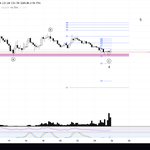
It looks as though we are coming towards the end of a period of consolidation on Cerebro.
We can note the following significant factors:
- We are finding support at the Daily S1 + Point of Control confluence area.
- We have had several wicks into the 4H Demand Wick highlighted red, finding good demand there, and we now look to have successfully held the area as support.
- We had a large spike of volume and a long lower wick at the low, showing significant demand coming in.
- On the 4H timeframe, RSI is neutral whilst Stoch RSI has bottomed out in oversold and is now crossing bullishly. A bullish divergence printed on the 1H timeframe.
As always, price needs to get above Wave b ($5.7m) to significantly increase the odds that the low is in.
If the current count is correct, Wave 5 should target around $12.4m.
(I should note that typically you are not allowed to have the price action of Wave 4 overlapping with the price action of Wave 1, but I am comfortable loosening these rules a little when trading lower liquidity environments. The price action has the hallmarks of a Wave 4, including being a longer, more drawn out correction vs. the sharper Wave 2 correction. In any case, if this is somehow a Wave 2 rather than a Wave 4, all this does it make our upside targets much higher - will review this again in due course if price action gives us a reason to).

7
3
22
2,297
Prometheus Unchained retweeted

Me watching bittensor:native showing a lot of strength this evening.
4
34
624
Prometheus Unchained retweeted

RocketSwap V3.1 is released with a new Portfolio Mode
Connect your wallet and see what's available on your wallet to trade for 🚀


4
6
25
1,448
Prometheus Unchained retweeted

We at @RocketRHC have implemented a buyback and burn since inception with our execution layer
One of the first to have TWAP via RHC
Optimized routing that meets or beats even larger scale projects
Our upcoming projects also have burn mechanics already built in

Love the progress. My only wish is consideration of some burn activity using a percentage of creator fees while MC is lower and prior to RVN revenue. The best projects and runners with the highest market caps in current market have a strong burn mechanism. This helps encourage holders. The obvious ones: Pons, Hype, Stonk.
I realize there is a balance between platform costs and other burn activity, but I think this is important in the early stages to show trading activity coming back to holders and to accelerate burns at the beginning with lower MC. Burning/buyback lock now before the next 10x move will make the ceilings way higher later.
2
5
718
Prometheus Unchained retweeted
Bid more robinhood:0xeb24a2663af4ee979dcbfe39cb95b5f12d369c4b here is FREE money at $1M mcap
if it goes below $1M mcap I will bid the fuck out it myself
They literally launched a beta of Merry Men with AI privacy routed swaps
Closest competitor with this built is ZAMA at $200M/$1B FDV
NO BRAINER
11
10
62
8,361
Prometheus Unchained retweeted

Called 120k the top and 60k next
At 60k I said 40-50k is coming
I revised and said bottom is in
Started buying big at 60-64k
Called the start of the bull at 60k
Gave the target of $88,000
Few weeks later $88,000 got hit
Now I’m expecting $79,000 next
206
142
3,791
192,243
Prometheus Unchained retweeted

gn $all ✱
end of day 4. no update from dev yet.
he's missed a few days on x, owned it, apologized, and kept showing up for holders. quiet usually means heads down.
we give him the room. we hold.
@allonsolanaa
ca: ASoQZA3Dee2HU34Vwx3b5SAtTaczJtZcyx1T413nDALL

5
10
13
68
Prometheus Unchained retweeted

7X hackathon winner building on @Arc
Guess the project?
@bagfifun
The first lending/borrowing protocol on Arc chain
Raise your targets for $BAGFI
0x1f9f98b2D7B4dDCd93654a1E20221340CF1F241e

I triumphed in Mexico I won the ETH May 5th hackathon. Even though I initially thought I wouldn't hack because nothing appealed to me, a project came along that was the perfect match; the rest is history, and we ended up winning.
I also won a @draper_u "fast track" to interview directly with the founder for a four-week trip to Silicon Valley.
6 hackathons: I'm going for more.
9
6
38
3,831
Prometheus Unchained retweeted

Gm
Especially to enjoyers of the @arc blockchain technology
Gud tek
21
4
56
15,226


Wave 1 (from 2022 lows) did a 6x in a non-expansionary macro environment. In previous cycles it never saw much upside during this time. That is showcasing pure strength to me.
Wave 3 is basically always stronger by a margin. But just to be on a safer side and say that it's gonna be the same as wave 1, it's still at 350k and a 3-4x from here.
So it's not unreasonable to expect high prices on $BTC and especially alts with wave 3 and macro both alligning together.


11
8
111
8,896
robinhood:0xc4f730335fb9e439ca5552f7b52b8e638c4245b0
CA: 0xc4f730335fb9e439ca5552f7b52b8e638c4245b0
Disclosure: I hold a position.
Wave 1 peaked at $11.7m, and I believe we have finished Wave 2 at $5.0m.
We found support around the 50% retracement level of Wave 1, which was also the 12H Demand Wick highlighted red. We dipped into this area several times, finding good demand here, and we look to have gotten clear of the range.
We have broken through and successfully retested a descending resistance line, and we are currently finding some resistance at the Weekly Pivot.
Breaking through the Weekly Pivot should have us targeting the Weekly R1 up at $12.1m, which would take us above the Wave b high of $9.2m and also above the Wave 1 high of $11.7m, significantly increasing our confidence in the count.
If the current count is correct, Wave 3 should target a minimum of $23.7m, before a Wave 4 pullback to around $16.5m and then a Wave 5 push up to around $28.1m.

45
20
84
12,425


Prometheus Unchained retweeted

We are seeing wave 2 on @arc when everyone wrote it off (happens every time on every new chain)
Tech projects like $faze @fazedotfun & $af @tryaiflow going on new rallies & upsidedowncat-3:native looks ready for new highs.
Wave 2 always trumps wave 1. The max extractors gave up, now we gas it.

Every single new hyped chain does this btw.
Overhyped pump, natural dump, then people figure out what's quality & has staying power.
It's how I bought $cashcat at 3m and it's how I'm gonna play @arc
Fwiw I do not think it's the next @RobinhoodApp, but 20% of it would be a win.

38
23
123
18,105

The Purserfi flywheel isn’t magic.
It’s market activity feeding infrastructure:
trading → fees → vault → strategy capital → liquidity → more trading
When the pair is built around tokenized stocks, the underlying stock asset becomes part of that loop.
That’s where things get interesting.

15
23
73
4,216


Prometheus Unchained retweeted

gm.
day 4. still no reveal.
the silence is loud. $all holders are already positioned for whatever drops.
who's still here? 🫡
@allonsolanaa
ca: ASoQZA3Dee2HU34Vwx3b5SAtTaczJtZcyx1T413nDALL

7
9
17
185