

Freelance Conservative dropping logical truths| Obsessed with mechanical wonders, furry friends, real human moments, classic tunes, nostalgia & random topics!
Who cares, right?
- Tweets 559,411
- Following 20,873
- Followers 89,733
- Likes 530,943


Pinned Tweet

Does anyone frequent shopping malls anymore?
Is there a specific reason why?
The New York Post has a feature on a 1.2 million sq/ft shopping mall in NY, which has become all but abandoned. It once had an Imax theater, and was sold as an entertainment draw for families and shoppers. Sold as "A place to hang out".
How it failed, well that's for debate. Was it Covid? Was it changes in shopping patterns? Or was it something else? Did the very premise of it being a place "to hang out", create its own demise? It's not just this mall that has caught my attention, but stories of other malls and shopping districts that have all but become hang outs for miscreants, petty and not so petty criminals. Stores lose business and eventually shutter, and what's left is a large empty building where criminals can come in out of the rain and create a gallery where they can attempt their criminal misdeeds in an unpoliced, nonsecure playground.
I mean, would you want your mother, wandering in some of these all but abandoned buildings? Talk about easy prey for purse snatchers or worse. I think we have to look right back at the beginning of what it is that makes people feel unsafe in a space and the very political decisions that precipitated to the free for all that many groups of roving trouble makers have capitalized upon.
Did the lack of crack down on the simple things such as trouble making youngsters, and groups of teens determined to try to polish their thug skills snowball into costing shopping malls, down town shopping districts and business their ability to thrive? Did that then progress into larger more determined criminals joining in? I think it clearly did.
I think that Giuliani understood with his "Broken Window Policy" that when people see instances of visible disorder and lack of control, it naturally implies that there's an unmanaged lawlessness. People begin to feel unsafe. When no one in a capacity to arrest, or deter criminal behavior intervenes, it invites the opportunity for criminals and others to take over. The end result becomes inevitable. The places that they take over become all but "no go" zones.
My two cents. What's yours?


Monstrous NY shopping mall that aimed to spark troubled downtown devolves into bane of Dem-run city trib.al/24Rk3x1

9
10
14
3,058
The woman in the vid, regardless of her demeanor had to use the bathroom. I think on one level we can all sympathize, but here's a little story from personal experience on why I'm with the business owner and their choice to either prohibit or limit the use of their facilities.
I owned a restaurant. One that happened to be close to an agricultural center that hosted a 4 day out door festival once a year. It drew great crowds for business, and we were grateful to enjoy the extra patronage. At other times of the year, there were horse shows and other things that went on, and those were never the problem. The festival on the other hand drew teenagers from outside of the small community where we were located.
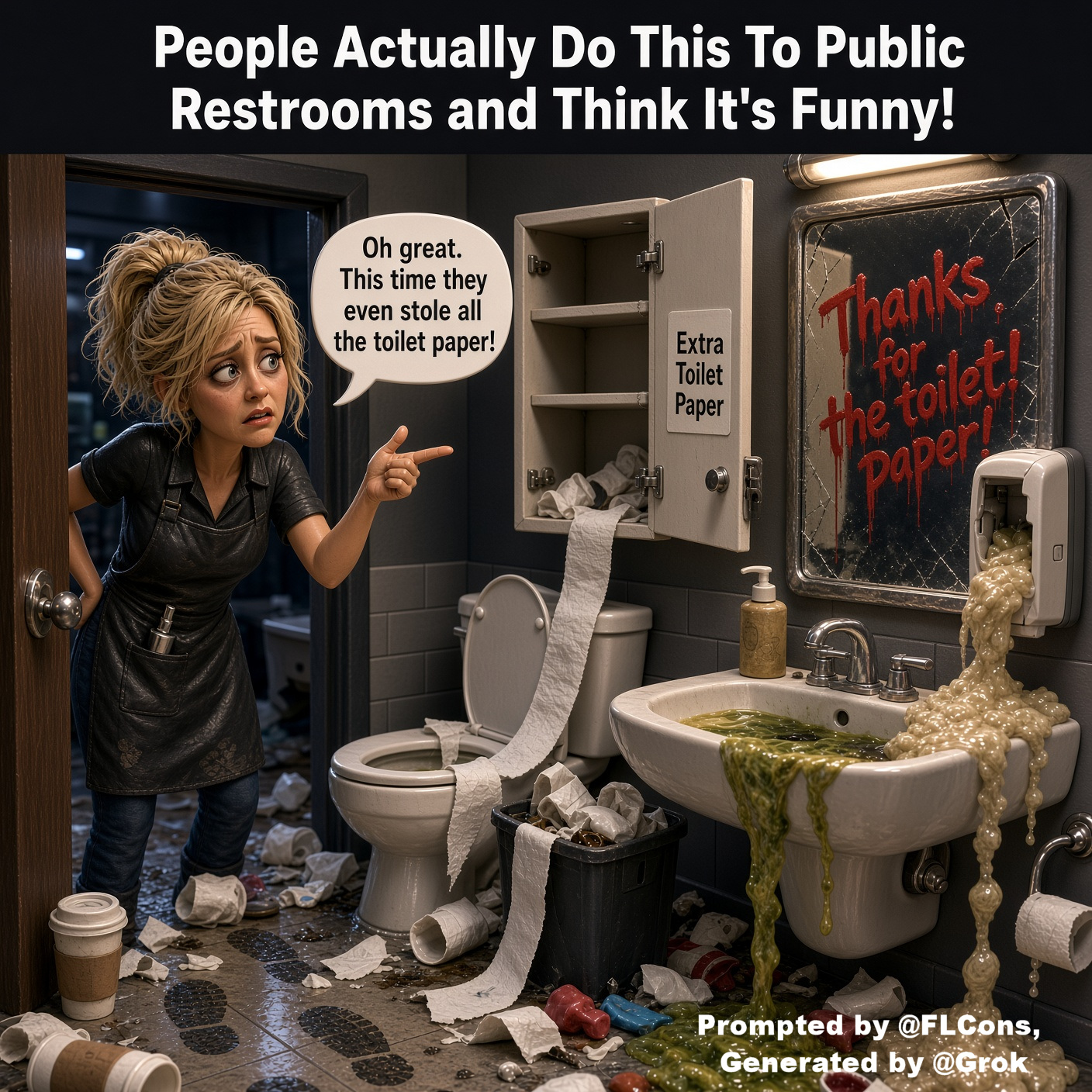
The first night of the festival I felt sorry for some of the people who would come looking to use the bathroom. It only took a few hours before my sympathy ended. And quickly. The cartoon depicts what happened. A group of 3 older teenaged girls who should know better, went into the single woman's washroom and just trashed it. Just destructively threw trash everywhere, wrote on the walls and mirror with makeup, stole all the hand creams that I had place as a courtesy for patrons, busted the soap dispenser and decor attached to the wall, and stole the entire cabinet worth of toilet paper. Why they did it? Because they thought it was funny? Because nobody knew who they were and it wouldn't blow back on them? That's my guess.
After seeing the mess, and having to attempt to clean it up, plus costing me a couple of hundred bucks to replace everything.... not one non paying customer from that point forward got in to the bathroom. Because I had a liquor license, I could also limit anyone under age being required to be accompanied by an adult to even be in the establishment for the duration of the festival.
The stuff you see some people do, would leave you shaking your head.

“I NEED IT RIGHT NOW.”
This grow woman walks into a gas station after 10pm and needs to use the bathroom. One problem: the bathroom is closed for safety.
The clerk offers another option down the street, and she still melts down like the store exists to serve her bladder on demand.
This isn’t complicated. A late-night gas station or convenience store is not your personal restroom. Policies exist because people abuse them. Yelling doesn’t make you the exception.
If your emergency is that urgent, go to the bar they pointed you to. Don’t stand there performing.

Made with AI
2
2
2
194
Croxxed Out retweeted
The woman in the vid, regardless of her demeanor had to use the bathroom. I think on one level we can all sympathize, but here's a little story from personal experience on why I'm with the business owner and their choice to either prohibit or limit the use of their facilities.
I owned a restaurant. One that happened to be close to an agricultural center that hosted a 4 day out door festival once a year. It drew great crowds for business, and we were grateful to enjoy the extra patronage. At other times of the year, there were horse shows and other things that went on, and those were never the problem. The festival on the other hand drew teenagers from outside of the small community where we were located.
The first night of the festival I felt sorry for some of the people who would come looking to use the bathroom. It only took a few hours before my sympathy ended. And quickly. The cartoon depicts what happened. A group of 3 older teenaged girls who should know better, went into the single woman's washroom and just trashed it. Just destructively threw trash everywhere, wrote on the walls and mirror with makeup, stole all the hand creams that I had place as a courtesy for patrons, busted the soap dispenser and decor attached to the wall, and stole the entire cabinet worth of toilet paper. Why they did it? Because they thought it was funny? Because nobody knew who they were and it wouldn't blow back on them? That's my guess.
After seeing the mess, and having to attempt to clean it up, plus costing me a couple of hundred bucks to replace everything.... not one non paying customer from that point forward got in to the bathroom. Because I had a liquor license, I could also limit anyone under age being required to be accompanied by an adult to even be in the establishment for the duration of the festival.
The stuff you see some people do, would leave you shaking your head.
“I NEED IT RIGHT NOW.”
This grow woman walks into a gas station after 10pm and needs to use the bathroom. One problem: the bathroom is closed for safety.
The clerk offers another option down the street, and she still melts down like the store exists to serve her bladder on demand.
This isn’t complicated. A late-night gas station or convenience store is not your personal restroom. Policies exist because people abuse them. Yelling doesn’t make you the exception.
If your emergency is that urgent, go to the bar they pointed you to. Don’t stand there performing.
Made with AI
2
2
2
194

Who would've thought this guy would look like a common sense Trump supporter!
The 2008 Barry was pro jobs, pro growth, do you think he is in support of the USA's biggest new steel plant ever. Announced yesterday?
 Medium Buying

1
4
3
130
Croxxed Out retweeted

“I NEED IT RIGHT NOW.”
This grow woman walks into a gas station after 10pm and needs to use the bathroom. One problem: the bathroom is closed for safety.
The clerk offers another option down the street, and she still melts down like the store exists to serve her bladder on demand.
This isn’t complicated. A late-night gas station or convenience store is not your personal restroom. Policies exist because people abuse them. Yelling doesn’t make you the exception.
If your emergency is that urgent, go to the bar they pointed you to. Don’t stand there performing.
71
177
320
27,445


Croxxed Out retweeted

I was inspired by Rahul's @RahulAiArt use of simple movement and the vivid contrast that was used with the water color style.
This is the tale of a simple prompt, and mixing a few pieces of various other projects. It shows how by adding a few minor changes it can create different images. I call them a "series" and save them (with the text copies of the prompts) into my hard drive. For me at the moment, I find that way the easiest so that I can re-reference them if I want to revisit the idea.
I have a few "wish lists" for @grok when it comes to how it saves, or doesn't save prompts when it comes to outputs of the project it's working on. There's probably a better way, but hey, it's still learning, and so am I, so there ya go!
I call this Series - Historical Romance Cover.
And as always, I'll put the prompts in the comments.
As always - Get Grok'in!


Made with AI
4
3
5
835
Croxxed Out retweeted

It’s a beautiful day to be alive. Take a deep breath, be thankful for the little things, and don’t let yesterday steal today’s sunshine.
Choose a positive outlook, find something useful to do, and make room for the people and moments that matter most. You don’t have to have everything figured out to move forward, just keep putting one good foot in front of the other.

2
4
20
1,400
Croxxed Out retweeted

Meet the hoatzin, a truly unusual bird found in the swamps of the Amazon and Orinoco. Often called the "stink bird," it feeds mainly on leaves and digests them through bacterial fermentation, much like a cow. That unusual digestive system gives it a strong, barn like smell.
But the chicks are what make the hoatzin especially fascinating. After hatching from their eggs high above the water, they have two small claws on each wing. If danger approaches, they can drop into the water and use those claws to climb back up through the branches and return to the nest.
With her blue face and rusty crest, the mother hoatzin watches closely over her two chicks as they begin life in the rainforest. They may look a little awkward at first, but these strange little birds are perfectly adapted to their world.
Nature is full of surprises and the hoatzin may be one of the most unusual birds of all.

1
4
13
1,462
Croxxed Out retweeted

Maybe this is why OCR payouts stayed similar despite fewer creators in the new program.
X could be allocating a % of the payout pool to the Grok Bot Template Rewards program:

28
5
81
5,887
Croxxed Out retweeted
Good morning everyone! Hope you all have a great day ahead!
It’s going to hit 90 degrees again! It would be a perfect beach 🏖️ day too bad I have other things on my schedule!
Happy Taco 🌮 Tuesday everyone!
Stay well and safe out there! 🍁🥰🌅☕️📸😉

80
15
198
3,400
The continuous improvement model practiced by SpaceXAi clearly sets them apart from the competition.
These are some of the learnings from flight 13 that were quickly implemented and pit into practice on fight 14 Today:
•Extra tile clips in high-risk spots + first-ever reuse of two Flight 13 tiles
•Sealed plasma leak paths behind tiles (building on crunch wrap)
•Curved tiles added to cut gap heating
•Better booster filters + relight software after Flight 13 ice-clog
•3 Starlink V3 sats flew cameras to image the new heat shield in orbit
We could all benefit from being as open to correction and change as SpaceXai
 SpaceX

3
11
33
1,188
Croxxed Out retweeted

In 1996, a 26 year old artist named Maria Farmer walked into a federal building and told the FBI what she had seen and what had happened to her. She told them about Jeffrey Epstein, the abuse, and the young girls she had seen coming and going from his properties. She told them everything she could remember. According to Farmer, the FBI agent she spoke to eventually hung up on her.
For nearly three decades, Maria Farmer lived with what it meant to tell the truth and have no one believe her. She had spoken up at enormous personal cost, only to be dismissed, ignored, and made to feel invisible. While the world moved on, while Epstein expanded his network and his crimes continued, Farmer carried what she knew largely on her own.
Maria had grown up in Paducah, Kentucky, and had worked hard to build a life as a serious artist. In 1995, she earned a master's degree from the New York Academy of Art. She was talented, ambitious, and beginning to build the career she had worked for when Epstein entered her life through an introduction at her own graduate exhibition. What followed would change everything.
She was hired to work for Epstein, first as an art advisor and later at the front desk of his New York mansion. While working there, she watched and saw things she could not simply forget. Then, in the summer of 1996, while living and working as an artist in residence at the Ohio estate of businessman Les Wexner, Farmer says she was sexually assaulted by Epstein and his associate Ghislaine Maxwell. She barricaded herself inside her room and called for help. When she finally managed to escape, she went directly to the FBI.
They did not act.
What Farmer did not know at the time was that her complaint, stamped September 3, 1996, would remain in a file for nearly three decades. It was not until December 2025, when the Department of Justice released a partial collection of Epstein documents, that the existence of the FBI record was finally confirmed. Her lawyer publicly confirmed that the complaint belonged to Maria. The records showed that allegations concerning Epstein's crimes had reached federal law enforcement nearly a decade before authorities in Palm Beach began their own investigation, the investigation that eventually led to his first prosecution.
The FBI had the information. They had her name. They had her account of what happened.
And they did nothing.
In 2002, Farmer described her experiences to a journalist at *Vanity Fair*. The publication ultimately decided not to include her account, citing legal concerns. She tried again, and then again. Still, she was not heard.
The years of silence took a toll that went far beyond the legal and political questions surrounding her case. They affected her body as well. In early 2019, shortly before she finally came forward publicly, Farmer was diagnosed with a rare brain tumor. A second form of cancer followed. She underwent surgeries and radiation while continuing to speak, paint, and fight for accountability. Farmer has said she believes the years of trauma and stress played a role in her illness. Whatever the cause, there is no question that she continued showing up for herself, for other survivors, and for the truth while carrying something most people would struggle to endure alone.
And somewhere along the way, she returned to painting.
She created satirical works depicting Epstein's associates, vivid and biting images that put names and faces to the network surrounding years of abuse. But she also began creating something quieter and much more personal. Farmer started painting pastel portraits of fellow survivors.
Each woman is placed against a bright background of turquoise, pink, purple, yellow, blue, green, or orange. Farmer says each color represents the individual woman in the portrait.
“I want these women to be honored individually,” she said. “I wanted it to portray how beautiful these women are and how strong they are.”

26
472
952
32,544
Croxxed Out retweeted

Marco is the Best Secretary of State! He is Smart and Witty, nothing slow about him or his approach, he understands how to achieve Success and Would Make A Great President someday! Do you agree??

"The two most important days of a person's life are the on which they were born and the day on which they discover why"
Which is to say, the day that they discover their purpose
Marco Rubio has been the all purpose man since entering the second Trump adminstration
It has been a joy to watch

5
13
99
11,406
Croxxed Out retweeted
Goodnight everyone! Sleep well and sweet dreams. Early to bed tonight. See you all tomorrow morning! Rest easy! 🤗🥰❤️🫶🏻

43
15
177
3,918
Croxxed Out retweeted
The scariest part about sinkholes is that they can form underground for years, and you may not even know they’re there.
Basically, rainwater slowly dissolves the rock underneath the ground, creating hidden caves and empty spaces. Then, when the surface can’t support itself anymore, the ground collapses.
Sometimes it happens slowly over time. Other times, a bedroom, pool, driveway, or even an entire house can disappear almost instantly.
Florida gets a lot of sinkholes because it sits on a huge layer of limestone. The Yucatán has them too, except many of those fill with water and are called cenotes. They’re also common in places like Kentucky, Missouri, Pennsylvania, and southern China, where the really massive ones are called tiankengs, or “heavenly pits.”
From the air, the land can look covered in holes. But from the ground, everything might seem completely normal, until the street, cars, or even a house suddenly drops into the earth.
And sometimes, all it takes is a drought, heavy rain, or too much groundwater being pumped out to trigger it. The ground can look completely solid and stable right up until it isn’t.
Would you feel safe living in an area known for sinkholes?

Made with AI
12
32
39
4,156

