

Head of Research @Bitwise
- Tweets 6,695
- Following 1,684
- Followers 25,884
- Likes 32,102


Pinned Tweet

In 2026… Bitcoin will break the four-year cycle, Polymarket open interest will set an all-time high, more than 100 crypto ETFs will launch, and more…
Here are 10 Crypto Predictions for 2026 by the team at @bitwise
🧵👇
100
101
903
157,959


Is this bullish ethereum:0x514910771af9ca656af840dff83e8264ecf986ca?

"If AI kills us all they will use crypto rails & Chainlink's CCIP to do it"
- @RasterlyRock
7
9
115
7,544
This. And the SEC and CFTC had outright said they were prepared to slice the Clarity Act into individual rules and regulations when it failed.
Certainty > Uncertainty = Risk Cleared

What happened here was a proper realization and subsequent absorption of a legislative risk that had already been widely anticipated.
Weeks and even days before failure, the probability of enactment was already low. Market participants had therefore discounted the adverse outcome, which limited the subsequent decline in index prices.
On the other hand, SEC and CFTC further involvement supplied a partial substitute for statutory market structure regulation, though with narrower scope and weaker impetus than passage of the Clarity Act would have conferred.
Good graphics: @RasterlyRock

2
6
30
2,545
Lessons in here

The market punishes uncertainty over risks.
It’s often better to fully realize a risk than to have it pending.
When risks are uncertain, modeling their impact on an asset is theoretically open-ended, which means an asset can potentially be worth nothing and can’t be properly hedged either.
Realizing a risk brings clarity, leading to more accurate and truthful modeling. It also allows for a shift in the narrative.
In essence, the best bottoms are formed against the prevailing consensus, often in times of deep fear or anxiety, following a significant positive price reaction to the worst news.
Times simply can’t get worse, thus they can often only get better, especially in prevalent market trends and themes seeing underlying growth.
In this case we saw a week packed with the worst news possible, we failed to pass the clarity act and looked down at a break of support. Instead of failing, it held, and a day later the CFTC and SEC stepped in to support the growth of blockchain technology.
All of this appreciation happened in the worst seasonality period, despite breadth crashing down to levels we haven’t seen since the start of the war.
Sometimes the opportunities need to be seen out of an optimistic view, when the crowd is so bearish, yet the markets shrug it off and a narrative of growth appears.
Ride the growth trend, with contrarian entries or adds on confirmation.
1
6
1,636
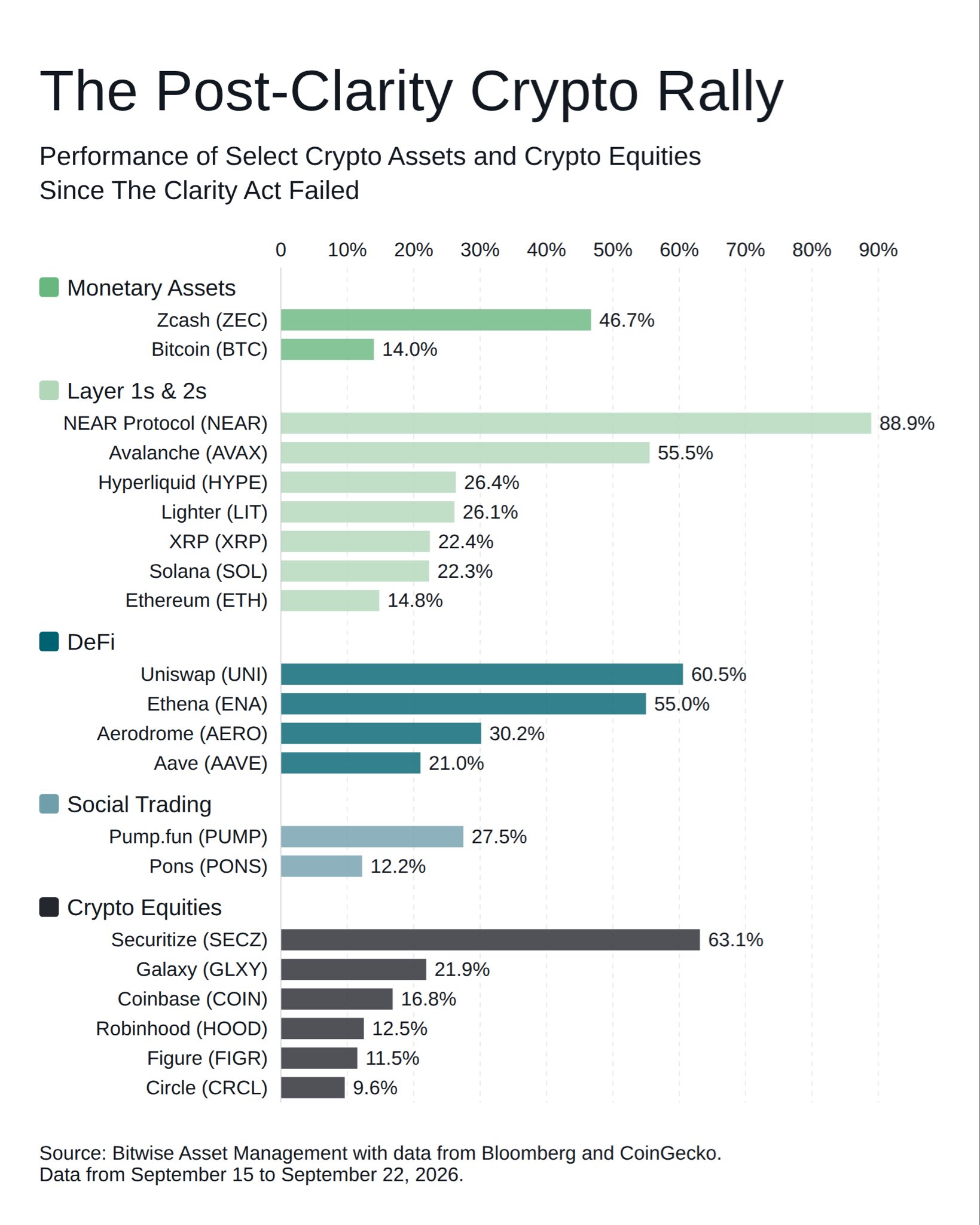
We’re one week out from the Clarity Act failing.
- SEC publishes Innovation Exemption
- CFTC ships crypto rules to the White House
- CFTC updates FAQ on crypto activities
Crypto assets and equities tell the story.

Pleased to see staff update these frequently asked questions consistent with the agency’s ongoing efforts to provide regulatory clarity for the crypto industry.
More 👇
22
71
296
74,202
Ryan Rasmussen retweeted

Among @Bitwise's 2026 crypto predictions (from @Matt_Hougan and @RasterlyRock), one in particular stood out: stablecoins will be blamed for destabilizing an emerging market currency.
"Blamed" is the key word. Dollarization and capital flight during periods of high inflation and currency instability aren't new. What's new is the vehicle. Bitwise's view is that the blame will be misplaced; the flight is symptomatic of a currency that has already lost confidence. Stablecoins are simply deemed the most rational destination for that money, not the reason it leaves. That's largely true, but stablecoins do change the speed and scale of the flight itself, and that's the part that deserves more attention.👇
Stablecoins' biggest strengths, instant and global access to dollars, are also what can amplify instability at scale. These dynamics are already unfolding, and they raise questions that existing capital flow frameworks were not designed to handle.
It isn't only an emerging market story. For many countries, it's a question of monetary sovereignty. In the US, it's what happens to bank funding and credit creation if deposits migrate to stablecoins at scale.
When the next currency crisis hits, stablecoins will be the most visable exit, which makes them the easiest target. We've already seen early versions of this, like Nigeria's 2024 crackdown on crypto exchanges amid pressure on the naira. The concerns driving those responses are valid, but measures taken mid-crisis tend to be blunt and often fall hardest on the households and businesses using stablecoins to preserve purchasing power.
Getting this right will take banks, policymakers, and industry working through it hand in hand. That's a large part of the motivation behind Runaway Dollarization, co-authored by @0xdirichlet (@sphere_labs) and @A_Vassallo (@SiliconVlyBank). It examines how stablecoin dollarization is unfolding, where the biggest pressure points are, and key considerations for a managed transition.
The goal is to start a conversation, and we want to hear what people think. If you're working on these questions, please reach out!!


Stablecoins are becoming the internet's dollar, and that shift is starting to reshape monetary sovereignty in high-inflation economies.
Our new report with Silicon Valley Bank looks at what is driving that shift, and how controls can keep pace as emerging market adoption scales.

5
10
25
2,936

Live in 5 minutes!
Don’t miss @JohnNahas84, @RasterlyRock, and @CamKhosravi discussing all things Avalanche. 🔺
nitter.net/i/broadcasts/1mGPaZNEE…
4
4
19
2,085
“When countries have too much debt, lowering interest rates and devaluing the currency that the debt is denominated in is the preferred path government policy makers are most likely to take.” - @RayDalio

The dilemma:
If the Fed hikes it will worsen the interest expense problem (since so much borrowing is at the short end).
If the Fed cuts it will worsen the inflation problem.
2
2
8
1,647
Sonnet was working perfectly well with skills and connectors up until yesterday.
Now those same skills/connectors are too complex for the model to handle. Bothing about the skills or the connectors changed.
Anyone else experiencing this?
4
7
1,356
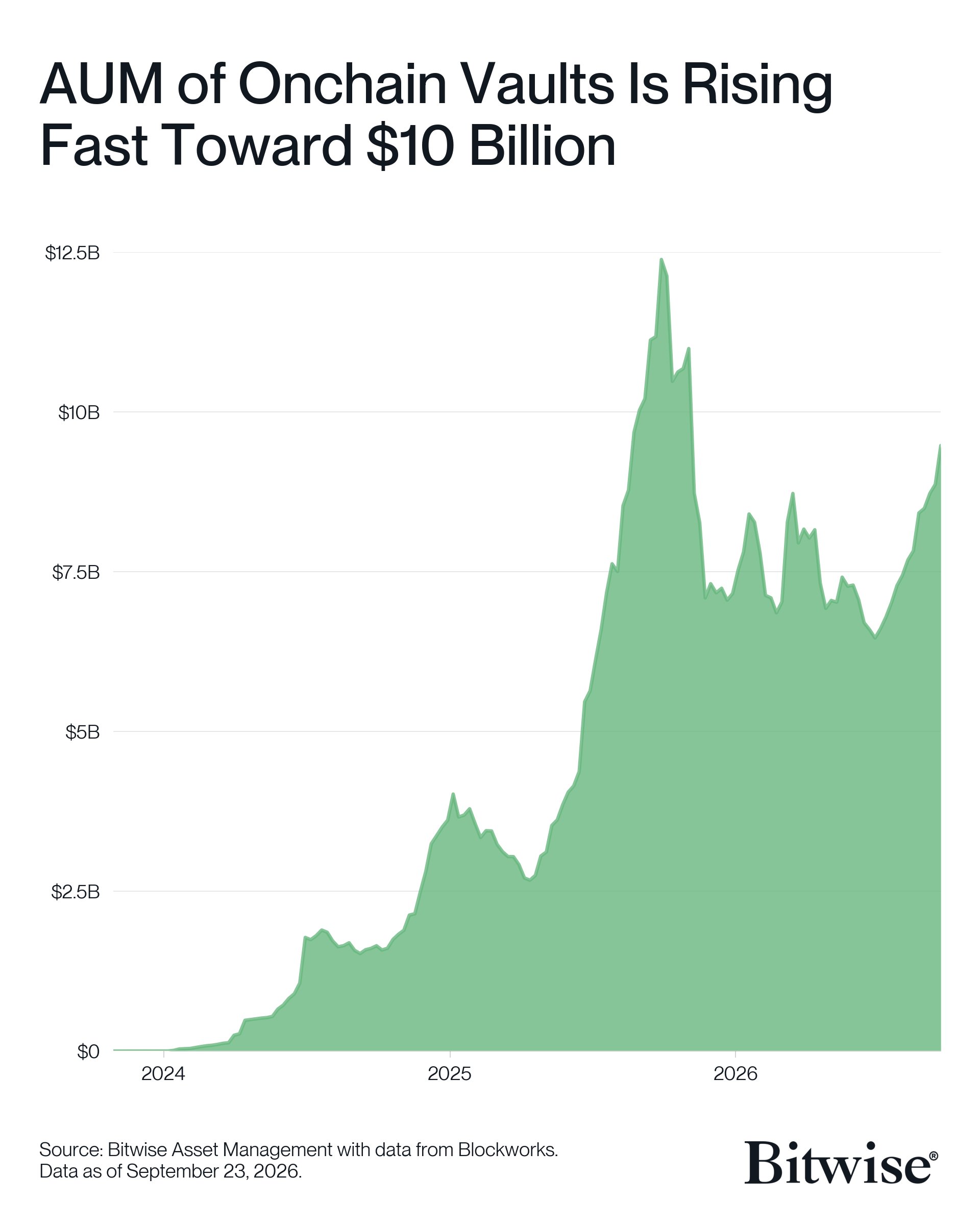
Introducing PPLUS—the Bitwise Premium+ RWA Vault—launching on @EmberProtocol.
PPLUS holds a curated portfolio of real-world assets and applies leverage, targeting 10%+ net yield.
PPLUS is only available to non-U.S. Persons. The vault pursues a leveraged credit strategy involving material risks, including the risk of partial or total loss of deposited assets.
What's inside:
↳ $PST by @humafinance — short-duration cross-border payment financing to institutions
↳ $sUSDai by @USDai_Official — loans backed by the GPUs that power AI
↳ $PRIME by @HastraFi — tokenized claims collateralized by prime home equity, in partnership with @Figure
Bitwise designs the strategy—curating assets, positions, and leverage parameters. Ember operates the vault and executes transactions.
PPLUS extends the Bitwise vault family from lending into strategy, and one step further along the risk-return curve.
Learn more: onchain.bitwiseinvestments.c…

21
19
97
54,234
Ryan Rasmussen retweeted

ETF Flow data and 13F reporting data back up this Bitwise survey that says long term allocators to Bitcoin ETFs held through the ~50% drawdown and many even bought more. By far, the biggest sellers of the ETFs over the last ~year were hedge funds and retail traders/investors
Institutions are generally reluctant to announce their crypto positions.
So we asked 15 of the world’s largest investment firms how they’re allocating to crypto today.
Introducing the first-ever Bitwise Institutional Crypto Adoption Report.
bitwiseinvestments.com/crypt…
17
12
108
26,904
Tomorrow @CamKhosravi and I are diving into avalanche-2:native with the Avalanche team.
Drop the questions you want us to ask here.
Curious what's driving Avalanche right now?
Tune in tomorrow at 12:30pm ET to hear @JohnNahas84 @RasterlyRock, and @CamKhosravi break it down.

12
15
103
4,809
Ryan Rasmussen retweeted
5/ Bitcoin and gold now travel together.
Most institutions we interviewed hold the two as a pair, as a hedge against currency debasement.
One sovereign wealth fund is even funding part of its crypto allocation by selling FX and gold reserves.
1
1
11
832
Pensions
Foundations
Corporations
Endowments
Sovereign Wealth Funds
The Institutions Are Coming

Earlier this year, Bitwise sat down with 15 of the world’s largest institutions: sovereign wealth funds, pensions, endowments, foundations.
Crypto was down 50%, but not one of the institutions we interviewed cut its allocation. Several bought more.
Here’s what else we learned:
2
1
21
3,008
Earlier this year, Bitwise sat down with 15 of the world’s largest institutions: sovereign wealth funds, pensions, endowments, foundations.
Crypto was down 50%, but not one of the institutions we interviewed cut its allocation. Several bought more.
Here’s what else we learned:
Institutions are generally reluctant to announce their crypto positions.
So we asked 15 of the world’s largest investment firms how they’re allocating to crypto today.
Introducing the first-ever Bitwise Institutional Crypto Adoption Report.
bitwiseinvestments.com/crypt…
2
13
66
11,288
10/ Sovereign wealth funds are coming, slowly.
Multiple were in due diligence on sizable allocations. Several had already allocated. Legal and regulatory setup takes over a year.
For some, crypto is also a national strategy, which makes the position stickier than most assume.
1
7
475
11/ These institutions have largely stopped debating whether crypto belongs in a portfolio. Now it’s how much, in what form, and under what governance.
We expect a majority of institutional investors to hold crypto within five years.
Full report: bitwiseinvestments.com/crypt…
6
475