
"Rendering II" by @ikrimae

VIKINGS ARE INVADING AGAIN. THIS TIME, THEY’RE ELECTRIC.
August BEV share:
🇳🇴 Norway 98.7%
🇩🇰 Denmark 85.9%
🇫🇮 Finland 51.6%
🇸🇪 Sweden 45.5%
Norway was the experiment. Denmark is the warning. The Nordics are showing what happens when EV adoption hits the steep part of the S-curve.
ICE doesn't slowly fade away. The market can flip remarkably fast.⚡via @electric_nick_
mobility.dk/nyheder/danmark-…

10
51
260

Mercedes just doubled their EV sales with the new 800V generation (GLA, GLB, GLC, CLA, C-class). BMWs new 800V platform is even bigger for them. In the popular X3 class, the electric iX3 only had 10% share. The new "Neue Klasse" iX3 has 50% share among X3 sales now. That's 5x.
1
German EVs have traditionally been lagging in tech, but their latest platforms are top tier. 2x faster charging than Tesla and higher range too. Mercedes has similar efficiency as Tesla nowadays. Massive single generation leap for them. And VWs new small/cheap MEB+ cars have 54k orders already. They are going to skyrocket to top places in EU car sales lists in many countries.
Every single time I ask AI to write any mesh rendering code, it uses super fat 100% fp32 vertex data. I asked to shave down to 20 bytes (similar to HypeHype layout). But we could go much smaller with mesh shaders with more advanced compression. But adds a lot of ALU to decode.

8
1
82
Normal/tangent = RGB10A2 (A = bitangent sign bit). 4+4 bytes.
UV = RG16_UNORM (4 bytes). Range [-8, +8]. Enough resolution for precisely accessing every 4096x4096 texel.
Position = RGBA16_UNORM (8 bytes). Vertex position inside object bounding box. Scale baked to model matrix.
1
5
fp16 is bad for normal, tangent as it has maximum precision close to origin and it can represent larger numbers than 1. Both are at unit sphere. UNORM/SNORM is better quality for same amount of bits.
fp16 is also bad for UV. It can only address 2048x2048 precisely, and if you tile, you have horrible precision. For example 8x tiling can only precisely address 256x256 texture. 16-bit UNORM can address 4096x4096 precisely with 8x tiling. Much better.
1
3

Every once in a while I think about how the Oakley Sunglasses guy sold his company for billions, but then instead of going into politics or whatevs, he did the irrational but utterly awesome thing of starting his own digital cinema camera company from scratch, which was RED.
1
13


Hao Li retweeted

I am open-sourcing DeckWerk, a multi-platform slide editor with stellar video support, real-time collaboration, and Agent support. I used to be on Linux but had to switch to Mac b/c there was no good enough slide editor - @OmarchyLinux & @dhh inspired me to vibe-code my own, so I'm finally back on Linux!
Install from source via GitHub (installers coming soon!):
github.com/vsitzmann/deckwer…

13
32
317

This was a fun little experiment i tried out today. I generated an animation with H3, then generated a 3D model per-frame at 12FPS with tripo3d.
I've had this idea for about a year now but agents can now easily automate the process so it only took a few hours to try it out.
This is horrible on memory and probably little to no practical application, but its fun and looks kinda cool. I might mess around with the technique a bit more and opus made a nice little video of it too :)

24
5
60

i wonder of one of the llms could polish the data. may not even need blender. kinda a math, continuity, smoothing problem. i have a test where i first fit a standard mesh to the generated mesh. then it's all just one mesh
2
1

Doug McNabb retweeted

Sometimes it takes 20+ years in software to learn this:
In the end, the hardware always wins.
1
1
9

First clip for Jeremy Strong as Mark Zuckerberg in ‘THE SOCIAL RECKONING’.
In theaters on October 9. https://nitter.net/t.co/la0PbLUlJm

710
373
8,716

Also the good guy absolutely refuses to give the one obvious counterargument that anyone would say first .... because of course that would torpedo the naive and impractical point that the writers want to make.
2
20


Casey Muratori retweeted

🧩 Order of the Sinking Star x Animal Well 🐾
Our second special bundle for the launch of Order of the Sinking Star includes the magnificent @Animal_Well! 🤗
Save 10% on both games when Order of the Sinking Star launches October 8!

1
6
175

Nice. Brad Smith (Microsoft president) is one of the many long tenured Good Guys of computing there, alongside Dave Cutler (Windows NT architect and savior of x64) and many others.

surprise announcement from Microsoft today. It's moving its comms teams out of marketing and into the legal and corporate side of the house under president Brad Smith theverge.com/news/1000374/mi…
10
7
276
Jeff Preshing retweeted

I’m crying of laughter - please let this be the model that solved Navier-Stokes
(this guy’s name is hayZee, we need to get him on here!)

64
91
862

There won't be any quest markers, minimaps and compasses in @fadedthegame . Instead you'll need to look at actual maps and building signs or ask around. All streets are named & buildings numbered.
(don't worry, I'll localize these)

4
7
131
Heyyyy here's some good new info... fans of cat sciencing or egg collection rooms will automatically get a discount on Steam.

📢 Order of the Sinking Star will be available October 8 for $29.99!
We're also happy to be partnering with @edmundmcmillen, @Billy_Basso, and @BIGMODEgames to bring you special Order of the Sinking Star x Mewgenics and Order of the Sinking Star x Animal Well Bundles! 🫶
📜 > orderofthesinkingstar.com/en…

18
13
709


100 gram VR glasses intrigue me. Move all the heavy stuff to your pocket. I will test wearing them when they arrive to local stores. I've not been a big VR far so far.

Meta's new VR glasses weigh 100 grams because there's nothing computing inside them. No chip, no battery, not even a tracking coprocessor. All of it lives in a puck in your pocket, connected through a fiber optic cable.
That one decision is the whole product.
Apple went halfway with Vision Pro. They moved the battery to an external pack but kept the M2 and R1 chips on your face, and the headset landed at over 600 grams. Weight became the most common complaint in reviews. Meta went the rest of the distance and amputated the computer entirely.
Once the silicon leaves the frame, everything else falls out of the physics. Nothing generates heat near your eyes, so there are no fans, and the magnesium shell alone handles cooling. No battery means no ballast on your nose. What's left is sensors, two micro-OLED panels, and pancake lenses. 100 grams versus 515 for a Quest 3.
The fiber optic tether is the part people will skip past. Driving dual 5K displays at 120Hz takes more bandwidth than thin copper handles well. Fiber moves that data through a strand that bends like a shoelace.
There's a real tradeoff, and Meta took it on purpose. The field of view is narrower than a Quest. They're betting people want a cinema and a workspace more than peripheral immersion.
Vision Pro is a computer you wear. Meta VR Glasses are a display you wear. The computer went back in your pocket, where it's lived since 2007.
4
32
This graph is 100% BS. GPT-4 and o1 were not better than a human. I used them, they sucked. o3 was the first usable one, but it required lots of babysitting from the developer. But "AI alone" was still at zero at that point. AI alone is finally a thing with Astra/Fable.


15
2
182


Now that's some good shading

The idea was to basically use minimum blending and use all 4 color channels on the screen to write 4 depths: Nearest frontsurface, nearest backsurface, furthest frontsurface and furthest backsurface. (you can do min and max by inverting the numbers) Rendering the liquid with ZTest Off gives a pretty good approximation of the surfaces the liquid has that are within the field of view. Combining this with screen space ray marching of the scene depth and one can get a pretty decent emulation of how a multibounce ray traced fluid would have looked like, while being much faster. Without the 4 depths it would have been impossible to properly show the optical depth of absorption of light of the entire mass of fluid with air in-between.

92


I would like to see maglev trains inside vacuum tubes: 1000km/h = faster than a plane. 20x less environmental impact = cheaper tickets. Less waiting vs airports. 10x faster than a car. Vacuum helps cooling super-conducting magnets. Why not?


41
1
105
Sebastian Aaltonen retweeted

How do you print a blank line?
std::cout << '\n'; // C++11
std::println(""); // C++23
std::println(); // C++26
C++23 added println but forgot to let you call it with no arguments
23
9
270
Codex Astra Ultra doing the Metal porting (according to my porting document) went surprisingly well. But I forgot to explain everything...
Example: it added a shader Y-flip macro. And used it in 36 shaders. The best practice is to Y-flip by negative viewport. No shader changes.

2
2
102

Maglev train in a vacuum tube can travel at 1000km/h. That's faster than a plane. And it has 20x less environmental impact. And wait times could be a fraction of airport wait times. You get 10x faster to destination versus car. And there's no traffic jams. That's the reason.
2
2
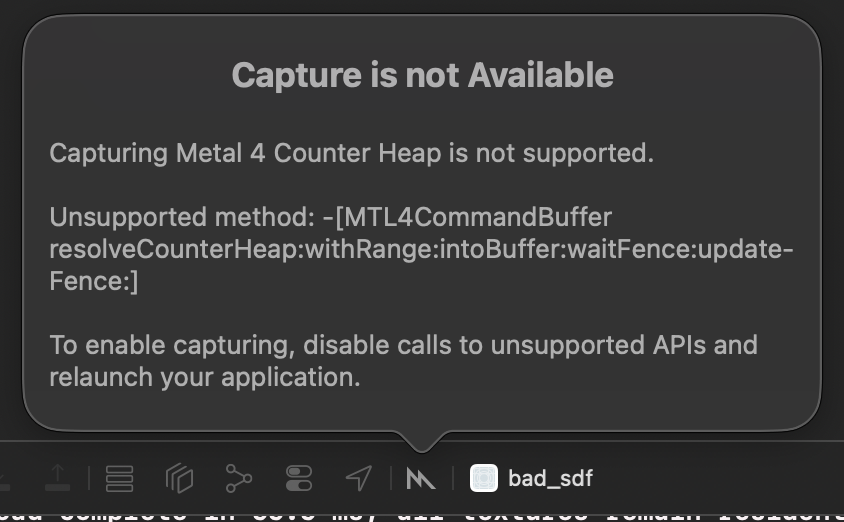
Xcode 27 (latest) doesn't support all Metal 4 features yet. Fortunately disabling counters is easy. Let's see if anything else is missing.
2
19
Codex remote controlling Blender with the MCP interface. Seems to work very well. Just a quick test to make it model all my bots according to concept art images. I have it tight triangle budgets: boss=100k, medium=10k, swarm=64 per part (x6) = 384. Mesh shader = 64 tri clusters.

24
5
188
these are great. lovely style.


Let's try updating Xcode... which likely requires updating MacOS. On Mac you are often forced to update the OS to install latest dev tools or latest web browser :(

4
54
Got Petafab running on iOS. Initially Codex capped frame rate to 30Hz, assuming we follow standard Unity conventions. Silly choice. I want to try to hit 120Hz of course. Here rendering at 94 fps in menus (full level). But in game it drops down to ~60 fps (+enemies + simulation).

7
1
112
As a comparison point, Claybook was running at 120Hz on ROG Ally at native 1080p. And Unreal Engine 4 was wasting half of the GPU time in Claybook. I have more efficient custom G-buffer, lighting and post stack this time. 100% custom codebase.
1
3
Has anyone tried to build a path tracer from scratch with minimal guidance using one of the latest LLMs? Curious how far they can go when it comes to more complex rendering algorithms.
3
10
No EVF is a huge mistake with this one. If it had a rangefinder-style corner EVF, this would have been an instant-buy for me. Instead, it has both no EVF and a worse LCD than the regular Z5II. For me it's back to thinking about either the Fuji X-E5 or the Sony a7C II again.

Say hello to your new everyday carry camera, the Nikon Z5IIC. 👋📷
🎬 Scene Mode: Get great results without first mastering complex settings.
🤳 Vari-Angle Screen: Easily shoot from a variety of positions, including overhead and selfie.
☁️ Picture Control Button: Quickly preview and apply built-in Picture Controls and favorites downloaded from Nikon Imaging Cloud’s growing library of Imaging Recipes.
🎞️ Film Grain: Capture photos and video with a nostalgic film look.
💡 Low-Light Performance: Capture rich color, fine detail and natural atmosphere, even in dim light.
The #NikonZ5IIC combines the simplicity and connectivity of smartphone photography with the elevated benefits of a full-frame mirrorless camera.
Pre-order yours: nikonusa.com/z5iic

1
5
Doug McNabb retweeted

The World is Changing: AI For Creativity
By Jeffrey Katzenberg
A few months ago, I sat in my office in Silicon Valley and watched as a tech founder showed me something extraordinary. On the screen was a fully realized, beautifully lit, well-composed animated scene. It was stunning and it made me feel exactly what I felt in 1986 watching Luxo Jr. That was the first time I watched a computer-animated 3D character take a breath and seem, against all reason, to have life. It left me in awe.
Later that day, I received a text from an artist I've known for thirty years, 350 miles to the south, in the city where I spent most of my career. After seeing a similar video, she texted: "Is this the end of us?" My answer was, "Certainly not.”
I have spent the better part of the last decade in Silicon Valley, but the heart of my career has been in Hollywood. Being deeply connected to both worlds means I have deep loyalties to each and a responsibility to speak honestly to both.
In 2023, I said that these new AI tools would cut the time and cost of producing world-class animation by as much as ninety percent within three years. Some colleagues were alarmed, many were furious.
There is growing fear and resistance surrounding AI within the creative community. I deeply understand it, because I've spent countless hours walking through animation studios watching gifted artists bent over their desks, rebuilding a single second of film for the tenth time because the ninth version wasn't quite right. I've sat in screening rooms where four years of people's labor played out in minutes, and I knew the name of every person that had spent countless hours bringing those images to life. The creative process is a calling, there's really no other way to describe it. From the outside some see resistance. From the inside, it is love.
People do not fight this hard for things they don't care about. The pushback coming out of Hollywood represents the collective effort of people who are deeply passionate about their craft.
Is History Repeating Itself?
The history here is more complicated than either side may realize. In 1906, the most famous composer in America, John Philip Sousa, published an essay titled “The Menace of Mechanical Music." He warned that the phonograph would become "a substitute for human skill, intelligence and soul."
Sousa's fight was not really about the machine, it was about money. The machines were playing his compositions, and the men who built them weren't paying him a cent. His campaign helped create the Copyright Act of 1909. He did not stop the technology. He changed the terms under which it could use his work.
A hundred years ago, sound came to the movies. We remember it now as a miracle, and it was. What we forget is who paid for it. Before sound, tens of thousands of musicians made their living in the orchestra pits of movie houses, scoring every film live, every night, in towns all over the world. When the soundtrack arrived, the work of one composer and one orchestra was recorded for a film that went into thousands of theaters. The union fought back with everything it had, taking out newspaper ads across the country warning against the menace of "canned music," one of them showing a mechanical man tearing the strings out of a harp while an angel wept.
They were not fools, and they were not Luddites. They were right. Those pit jobs did not come back. And yet (this is the part we have to be brave enough to admit), sound gave us the movie musical, the modern score, sfx, sound design, audio engineering, and an art form vastly larger than the one it disrupted. And it helped keep Hollywood in the forefront of world entertainment for the rest of the century and into the next. The loss was real. And yet the art form expanded.
This is a story that has been told over and over again. To resist technology is to risk irrelevance. Just look at Kodak or Blockbuster. To embrace technology is to open doors of new possibility. Just consider Apple and Netflix.
What I Learned From Walt Disney
In the mid-1980s, I was tapped to lead Disney's animation division at a moment when the studio was at an inflection point. Animation wasn't just another business unit. It was the soul of the company, a medium revered because of Walt's genius and his passion. But the production system was cumbersome and unforgiving. A single movie was 125,000 individual hand-drawn and painted cels, photographed one frame at a time. Every revision carried a cost measured in months. These degrees of difficulty shaped the kinds of stories we could tell.
We found our way forward in an unexpected place: Walt himself. The Disney archives held astonishing recordings of Walt explaining his creative process. His own writings. His notes and storyboards. Work product captured at every stage of his process. This was truly a gift. Listening, reading, sitting with the work itself, we heard him talk about character, about emotion, about how an audience feels when a character truly comes alive. He talked about making bold choices and refining a scene until it genuinely moved people. We didn't hear a word about pencils or paintbrushes. In fact, Walt was famous for being a technologist, forever hunting for state-of-the-art tools, often inventing them himself to achieve the images he saw in his head. But he never defined animation by the tools. He defined it by whether the audience believed the character. His principles were timeless. The tools were not.
That realization changed everything. We co-developed the Computer Animation Production System (CAPS) with a young Northern California company called Pixar, replacing hand-painted cels with CGI. In The Little Mermaid, the final scene shimmered with a dimensionality and light that the old process simply couldn't achieve. In Beauty and the Beast, the ballroom sequence moved with a cinematic sweep that placed the audience inside the emotion of the moment. In Aladdin, the Cave of Wonders felt vast and alive, and the Magic Carpet became an intricate, compelling character all its own. In The Lion King, the stampede carried a scale and intensity that raised the emotional stakes beyond anything we'd done before. Technology didn't diminish the craft, it expanded the canvas. It gave artists more room to create.
A decade later, the canvas expanded again. When Disney released Pixar's Toy Story, it wasn't simply a technical milestone. It was proof that a fully computer-animated film could carry real emotional weight, that it could make audiences laugh, cry, and believe. At DreamWorks, we made the difficult decision to sunset hand-drawn animation and become a fully computer-animated studio. It was the right thing to do, but it was not without pain. It cost talented people their place in an industry where they had worked their whole lives. Some made the leap to the new tools and did the finest work of their careers. Some never did.
Tools are never the point. The instruments change with every generation. What endures is taste and imagination. The magical ability to make an audience feel. One of the greatest storytellers of our generation, George Lucas, succinctly captured the eternal essence of this issue: “It’s not the how, it’s the why.”
A Distinction With a Difference
I asked one of the leading AI models a question that has been challenging me for months. What is the difference between reasoning and creating? Its answer changed how I think about almost everything happening in this industry. It said . . .
Reasoning and creating are two distinct cognitive modes, though they also work together. Reasoning is fundamentally evaluative and analytical. It operates on what already exists: facts, premises, evidence. It moves toward a conclusion that was in a sense already implied by the input. Reasoning is constrained by logic and truth. Its goal is to arrive somewhere correct, not to invent somewhere new.
Creating is fundamentally generative. It produces something that didn't exist before. And crucially, there's no single right answer waiting to be found. A blank page has infinite valid responses. Creation involves choices that can't be fully justified by logic alone. Taste, intuition and vision fill the gap where deduction runs out.
Reasoning is what Silicon Valley has been perfecting. Creating is what Hollywood has been practicing for more than a century. AI today operates almost entirely on the reasoning side of the line. It can deduce, evaluate, optimize, and pattern-match brilliantly. And while it can create, there is a real distinction to being creative. What it doesn’t yet have is those things that make us human: empathy, devotion, serendipity, the kind of creativity that comes from a person trying to say something only they could say. When the bot generates a piece of art, it is not trying to communicate anything. It is statistics, not soul; it is emulating things that have been done. By contrast, human creativity isn’t about repeating patterns of zeros and ones; it is about doing something new.
One day, AI may close this gap. Three years ago, the leaders building AI would have called what they are achieving today, improbable, if not impossible. Impossible is no longer improbable.
Today, the line between reasoning and creating is real. Even the leading technologists acknowledge we are not there yet. There is no scientific path to crossing this divide that anyone in the field can articulate today. Understanding that gap is where we will find common ground.
A Path Forward
In 2016, I closed one chapter in Hollywood with the sale of DreamWorks and opened another in Northern California, co-founding WndrCo. We’ve backed more than 50 founders building the next generation of technology and watched how breakthroughs in Silicon Valley emerge, first as experiments, then as platforms, and finally as infrastructure that reshapes entire industries. It's worth remembering that the last great revolution in animation also came from the north. Pixar was a Northern California company, forged not in the conventions of the Hollywood studio system, but in the technological breakthroughs of Silicon Valley. I've spent years on both sides of this bridge. For sure, I don’t have all the answers (take Quibi, for one!). But, from my past and present vantage points of my long career, here is what I see . . .
Brilliant people in Northern California building this technology have made something extraordinary. They have earned the right for the rest of us to be, if not believers, at least optimistic that what comes next will be remarkable. But they have not made an artist. The tools are powerful, but they are not what makes a story matter. That knowledge lives 350 miles to the south, inside people whose life's work has informed the very models you are building. The right path forward includes them by design, with credit, with consent, and with compensation. Build this with the storytellers. Not on top of them. Taste is not something that can be synthesized, it is uniquely human.
At the same time, Hollywood needs to accept that AI is not going away. The energy they are spending trying to make it disappear is energy they are not spending deciding the terms on which it will exist. And the terms are everything. The north needs something from it that they cannot build and cannot buy: creativity. The kind that takes a blank page and conjures a single right answer where there was none and has held audiences for a century. Without it, the most powerful reasoning engine ever invented will still be missing the only thing that makes a story worth telling.
The artists who learn to wield these new instruments will do things the engineers never dreamed of. They always have. Edison invented the motion picture but made terrible movies. It took Chaplin, Lloyd, Keaton and so many others to make movies emotional. Now, the canvas is about to expand yet again. We should decide now that we intend to paint on it.
There are so many valuable lessons in history. This has happened many times before, and it was never settled by the technology. It was settled by the terms. Sousa did not stop the phonograph; he helped write the law that made sure composers got paid. And two years ago, when the writers and the actors walked out, they were fighting for the very things Sousa was fighting for in 1906. Consent, compensation, the basic recognition that human creative work has a price that must be paid. The terms of that fight are still being negotiated, but the principle is older than any of us.
The tools-versus-no-tools argument is a trap. First, we must all agree that there should be terms. Then we can have the crucial debate about what fairness requires.
What I Learned From Steve Jobs
Years ago, Steve Jobs said, "It's in Apple's DNA that technology alone is not enough. It's technology married with the liberal arts, married with the humanities, that yields us the result that makes our hearts sing." He was describing a device. But he could just as easily have been describing this tale of two cities.
What I See Coming Soon
As the barriers and the costs come down, more films will get made, not fewer. Studios will get to take more risks. There will be more seats at the table, and very soon entirely new forms of storytelling. In the 1980s, animation was dismissed as a niche corner of the business. Today it is one of the most beloved and profitable forms of storytelling in the world. In live action, filmmakers like Steven Spielberg, James Cameron and Peter Jackson embraced new visual tools not as shortcuts, but as instruments, and expanded cinema in the process. Every time storytelling has met a genuine technological shift, from synchronized sound to color to computer animation, it has redefined the boundaries of the medium and grown larger in the process.
Assuredly, I don’t have all the answers, but I am confident that the creative opportunities will expand yet again. How we come through this is a choice. The north has the new tools. The south has the creative soul. The best future will draw on the best of both worlds.
745
1,317
7,496
Jonathan Blow retweeted

Breaking math news: The first-ever 3D Einstein tile, an object that tiles space in a never-repeating pattern, has been found by independent researcher Ioannis Tsiokos using GPT Astra. Resembles a chair. Mathematicians have de-slopped the proof. @kkakaes: quantamagazine.org/updates/t…


52
272
1,915
In everything I've watched/read by Terence Tao, I've been struck by the patience/humility he shows. He wrote a great article years ago about how he almost failed his PhD quals and what that taught him about humility and working hard:
ams.org/about-us/LivingProof… (page 96)
1
4
25
...and if you're curious about his notes on how his quals went, they're still available online:
web.math.princeton.edu/gener…
1
3

When companies "require optimism" that is going to have a big impact on what people say publicly, or in interviews.
1
1

Keeping the LPV around across frames now.


More work on Unbound Engine Web from the weekend. Decided to take a stab at dynamic GI.
Plan is:
- Light Propagation Volumes
- Inject RSM + Punctual + Emissive
- Far field SDF AO
First images. With artifacts still. Everything still requesting max limits from WebGPU.


1
Old scene from @andreintg running in the browser with GI. He set a lot of things to minimally emissive for style back then and I did not change anything :-)

3
5
20


Almost there on iOS. The current issues are that M1/M2 iPads (and the same architecture iPhones) don't support indirect mesh shaders (with indirect args) in Metal 4. And there's no support for BC6H/BC7 textures. Need ASTC/ASTC-HDR. Mac also supports BC, but iOS doesn't.


31
I have mesh shaders procedurally generating my enemies. They are extremely low poly. This is even lower than Quake 1. I will try the Blender MCP and ask Astra Ultra to do something better with it. But I don’t even have a mesh loader in my game :)

2
23


[encrypted in Finnish]
Sensofusion suunnittelee listautumista Helsingin pörssiin.
Tervetuloa 1.10.2026 klo 18 yhtiön järjestämään webcastiin ja vetämälleni virtuaaliselle tehdaskierrokselle.
Kaikki suunniteltuun listautumiseen liittyvä täältä: ipo.sensofusion.com

13
27
428

Auto SR is expanding to Intel Core Ultra Series 3 processors, now with support for 1080p input resolutions! 🎮
Learn more about Auto SR and how to get the most out of it in our latest DirectX Developer Blog:
devblogs.microsoft.com/direc…
4
38
206
NoGraphicsAPI: Pushed support for multiple queues. Supports modern suspend-resume renderpass on main command buffers (Metal4 + Vulkan1.3) instead of messy legacy secondary command buffers. Just one extra flag to begin_render_pass. Super clean.
github.com/sebbbi/NoGraphics…
2
1
91


NoGraphicsAPI liftoff on Metal 4 on Mac :)
Using my TextureViewPool reinterpret cast hack for descriptor indexing on the GPU.

4
2
119

Szymon Swistun retweeted

Whether you're on controller or mouse and keyboard, console or PC, you're on even ground - even on the same team.
The Crossplay Beta is live September 25–27. Queue up with your friends across platforms and climb Endless Spires around the clock!

10
46
349


To add Metal 4 support to NoGraphics API, we need a tiny Slang header that wraps the descriptor heaps, so that we can emit TextureViewPool indexing code instead. Metal supports 64-bit pointers like CUDA and Vulkan BDA natively. Slang GPU pointers work natively. No hassle there.

NoGraphicsAPI liftoff on Metal 4 on Mac :)
Using my TextureViewPool reinterpret cast hack for descriptor indexing on the GPU.
2
72

Packed particle layout using 16-bit int/fp struct fields. Borrowed my old ideas/code from Claybook's clay/fluid simulators.
Particle pool VRAM usage: 64MB->32MB
Performance: 12% faster sim/sort, 7% faster draw
Math on GPU is still pure fp32/int32. Not yet fp16/int16.

1
2
65

U.S. government urges Supreme Court to reverse Apple contempt ruling over App Store commission 9to5mac.com/2026/09/22/u-s-g… by @mvcmendes
5
2
46
The “injunction must say exactly what a party may do, and they can do anything however scheming that’s not explicitly prohibited” interpretation is antithetical to the rule of law as it would have courts writing precise business plans and operating manuals for companies.
1
1
16

The Swedish language unfortunately has the same word for "gaming" and "gambling". Social media recommendation algorithms are commonly referred to as just "the algorithm" in media. Working on new algorithms for the games industry used to bear some credibility, but nowadays...
13
1
189
Codex authored PETAFAB logos originally as tiny cubes. Super bad for SDF presentation. New ones have significantly less shapes and look massively better. And generate faster too.

22
iphone-performance-gaming-tier AppStore flag guarantees Metal 4 and 8GB RAM (6GB usable). After estimated iPhone 18 first month sales, NoGraphicsAPI Metal 4 backend should have 45% iPhone coverage at end of the year. Assuming I build it first of course...
PETAFAB on iPhone?
Codex crunched through August Steam HW survey results with latest driver info from Vulkan HW database.
NoGraphicsAPI support = 71.62% of Steam gamers.
Assuming I add a GPU pointer -> buffer+index pair mapping fallback for draw/copy commands.
github.com/sebbbi/NoGraphics…
8
3
65
Outoa käytöstä Kepulta. Haja-asutusalueella auto on pakollinen. Jokaisella on maalla mahdollisuus ladata kotona, toisin kuin kerrostaloissa kaupungeissa. Yösähkö on puoli-ilmaista ja uudehkolla sähköautolla pääsee yli 600km yhdellä latauksella. Täydellinen kulkuväline maaseudulle

Suomalainen autoilija on vuosikymmenet maksanut miljarditolkulla enemmän veroja kuin infran ylläpitoon on palautettu. Ihmettelen Kepun intoa nostaa autoilijan veroja miljardilla, kun olisi kerrankin mahdollisuus keventää autoilijan verotaakkaa hallitusti.
iltalehti.fi/politiikka/a/63…

3
7
Codex crunched through August Steam HW survey results with latest driver info from Vulkan HW database.
NoGraphicsAPI support = 71.62% of Steam gamers.
Assuming I add a GPU pointer -> buffer+index pair mapping fallback for draw/copy commands.
github.com/sebbbi/NoGraphics…
7
5
179
Yeah. That works. I was toying with a similar idea but with 32/32-bit split. 16/48 split seems better. Those macros are a bit hacky, but they do their job. It is a workable approach. But it doesn't support real pointer arithmetic in the shader.
1
2
Sebastian Aaltonen retweeted


We’re working with an independent advisory group of mathematicians to help OpenAI responsibly share advances in AI and mathematics.
The group will advise on how we assess and communicate new mathematical results, uphold academic and professional standards, and build tools that support mathematical research and learning.
Through this work, we want mathematicians to be at the center of shaping how AI supports mathematical understanding and how its benefits reach the wider community.
openai.com/index/advisory-gr…
32
107
1,585
500km range Renault 5 will be a much more useful car. Many families have just a single car, and it must also be useful for long Christmas/Eastern trips to meet family. 500km WLTP = 350km on highway. That's a big improvement. Hopefully charging speed also improves.

🚨 ¡Renault va a por todas con el R5! ⚡️🚗
El utilitario eléctrico se renovará en 2027 para plantar cara a China:
🔋 Toda la gama adoptará baterías LFP
🛣️ ¡Hasta 500 km de autonomía!
¿Qué te parece el cambio? 👇

1
1
5
